CE-703 (C) · Integrated Waste Management/Unsolved PYQ Paper
CE-703-C Integrated Waste Management - Nov 2023 Question Paper
Under each question, How to answer lists the points an answer should cover, outlined by CampusPrep from the syllabus. Check the details against your textbook.
-
7 MarksaDiscuss the physical, chemical and biological properties of municipal solid waste.
How to answer
- Define municipal solid waste and need for characterization
- Physical properties: density, moisture content, particle size, etc.
- Chemical properties: proximate/ultimate analysis, calorific value, C/N ratio
- Biological properties: biodegradability, odour, vector attraction
-
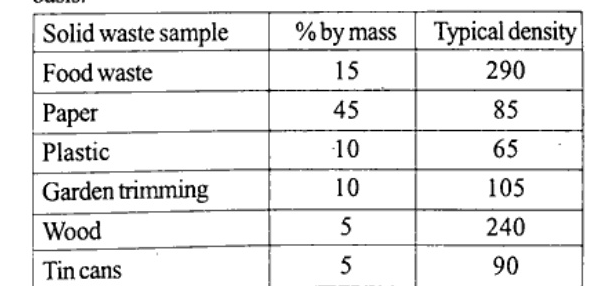
7 MarksbEstimate the density of a solid waste sample, on a discarded basis.
How to answer
- Use discarded-basis density formula: 100 / sum(%i / density_i)
- Tabulate % by mass and typical density for 6 components
- Calculate weighted sum and overall density
- State result with units
-
7 MarksaExplain in detail any two major sources of solid waste along with the characteristics and remedial measures followed to reduce the impact on the environment.
How to answer
- Select any two major sources e.g. residential, commercial, industrial
- Characteristics: composition, generation rate, hazardous fraction
- Environmental impacts: leachate, air, health
- Remedial measures: segregation, recycling, treatment and disposal
-
7 MarksbWith neat schematic diagram explain hauled container system and stationery container system.
How to answer
- Define hauled container vs stationary container system
- Describe operation cycle and equipment
- Provide neat schematic diagram for both
- Compare applicability and advantages
-
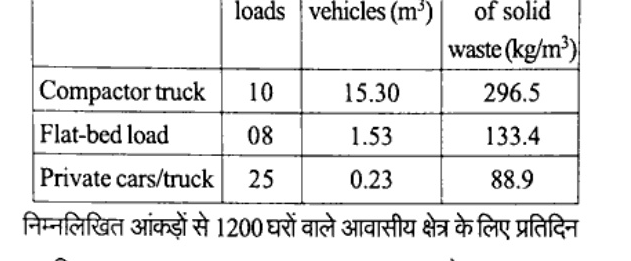
7 MarksaFrom the following data estimate the waste generation rate per day for a residential area consisting of 1200 houses. The observation location is a transfer station that receives all the waste collected for disposal. The observation period is one week. Also estimate per capita generation rate assuming 4 persons per house.
How to answer
- Compute mass per load = volume x specific weight for each vehicle type
- Total weekly mass = sum(No. of loads x mass)
- Daily generation rate = weekly total / 7
- Per capita rate = daily rate / (1200x4)
-
7 MarksbWhat are the different biological and chemical techniques adopted for energy and resource recovery? Describe each of them in detail.
How to answer
- List biological techniques: composting, anaerobic digestion, etc.
- List chemical techniques: incineration, pyrolysis, gasification
- Explain principle and products for each
- Energy and resource recovery aspects
-
7 MarksaExplain briefly about different types of Transfer Station and also explain the factors to be considered in the design of transfer station.
How to answer
- Define transfer station and its need
- Types: direct load, storage load, combined
- Design factors: capacity, location, equipment, traffic
- Brief operation aspects
-
7 MarksbWith neat sketches explain the following:
- i)Garbage Chutes
- ii)Route Optimization
How to answer
- Sketch garbage chute in multistorey building with sections
- Explain working and precautions
- Sketch route optimization concept / collection routing
- Benefits of optimized routing
-
7 MarksaWhat is volume reduction and write a short note on mechanical volume reduction?
How to answer
- Define volume reduction and its objectives
- Need to reduce volume for handling and disposal
- Mechanical methods: compaction, shredding, baling
- Equipment and efficiency notes
-
7 MarksbWith a neat sketch, explain the working of conventional municipal solid waste incinerator.
How to answer
- Draw labelled sketch of conventional MSW incinerator
- Describe feeding, combustion chamber, air supply
- Heat recovery and flue gas cleaning
- Ash handling and emissions control
-
7 MarksaExplain the mechanism of 3T's to control the high temperature in an incinerator.
How to answer
- Define 3T's: Temperature, Time, Turbulence
- Role of each in complete combustion
- Typical values for high temperature control
- Effect on emissions and efficiency
-
7 MarksbExplain with neat sketch about the Indore method of composting the municipal solid waste.
How to answer
- Describe Indore method pits and layering
- Materials: night soil, refuse, soil, etc.
- Turning schedule and moisture control
- Neat sketch of pit cross-section and compost formation
-
7 MarksaDetermine the landfill area required for a municipality with a population of 50,000 given the following details.
- i)Solid waste generation - 1500 gm/person/day
- ii)Compacted Density of soil waste in landfill - 500 kg/m3
- iii)Average compacted depth of solid waste - 3m
How to answer
- Total daily waste = population x per capita generation
- Annual volume = mass / compacted density
- Area = volume / depth with cover allowance
- Compute landfill area required
-
7 MarksbWith neat sketches explain the procedure adopted in sanitary land fill.
How to answer
- Draw cross-section of sanitary landfill with liner and cover
- Steps: site preparation, waste spreading, compaction
- Daily cover, leachate and gas management
- Final cover and monitoring
-
14 MarksWrite any two of the following:
- a)Characteristics of solid waste
- b)Recycling and recovery of waste management
- c)Pit method of sanitary land filling
- d)Deep well injection
How to answer
- Choose any two topics from a-d
- Define and explain key principles
- Add diagrams/examples where relevant
- Management significance and applications
Go to where you left off?
Quick Add to Notes
Save questions, your own notes and screenshots into notes filed by unit. It takes a free account.
Create free accountHave an account? Log in
Notes Panel