CE-602 · Environmental Engineering-I/Unsolved PYQ Paper
CE-602 Environmental Engineering - I - May 2022 Question Paper
Under each question, How to answer lists the points an answer should cover, outlined by CampusPrep from the syllabus. Check the details against your textbook.
-
7 MarksaDiscuss the important factors which affect the per capita demand of water supply.
How to answer
- Define per capita demand and factors categories
- Climatic, size of city, living standard, industrial/commercial demand
- Pressure, metering, sewerage, water quality and cost
- Concluding effect on lpcd variation
-
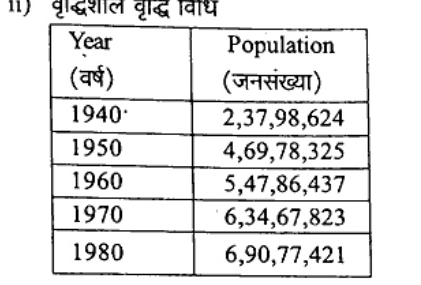
7 MarksbIn a town, it has been decided to provide 200 litre of water per head per day in the $21^{st}$ century. Estimate the domestic water requirement of this town in the year AD 2000 by projecting the population of the town by
- i)Arithmetic Increase Method;
- ii)Incremental Increase Method:
How to answer
- Tabulate census populations 1940-1980
- Compute arithmetic increase x-bar and incremental increase y-bar
- Project population to 2000 by each method
- Multiply by 200 lpcd for domestic requirement
-
7 MarksaWrite a note on common impurities found in water.
How to answer
- Classify suspended, colloidal, dissolved impurities
- Inorganic vs organic and biological impurities
- Sources and health/aesthetic effects
- Significance for treatment
-
7 MarksbDescribe in brief various tests conducted for chemical examination of water (minimum 4 tests).
How to answer
- List pH, hardness, chlorides, solids, DO, BOD, nitrogen etc.
- Brief procedure for any 4 tests
- Reagents and significance of each
- Permissible limits
-
7 MarksaDescribe the process of sedimentation with coagulation, as adopted in water treatment plants. Include in your answer the factors affecting coagulation also describe any two commonly used chemicals.
How to answer
- Principle of coagulation and floc formation
- Sedimentation with coagulation process flow
- Factors: dose, pH, temperature, mixing
- Two chemicals e.g. alum, ferric chloride with reactions
-
7 MarksbA coagulation-sedimentation plant clarifies 50 million litre of water per day. The raw water has an alkalinity equivalent of 4 mg/l of $CaCO_3$. The filter alum required at the plant is 20 mg/l. Determine the filter alum and the quick lime (containing 88% CaO) required per year by the plant. Use the following molecular weights: $Al = 27; S = 32; O = 16; H = 1; Ca = 40; C = 12$.
How to answer
- Write alum-lime reaction stoichiometry
- Check alkalinity requirement vs available
- Compute alum dose per year from 50 MLD flow
- Compute quick lime with 88% CaO purity
-
7 MarksaDescribe 5 types of sewer appurtenances in detail.
How to answer
- Define sewer appurtenances purpose
- Describe manholes, drop manholes, catch basins, flushing tanks, etc.
- Construction and location details
- Sketch layout where needed
-
7 MarksbA population of 30,000 is residing in a town having an area of 60 hectares. If the average coefficient of runoff for this area is 0.60, and the time of concentration of the design rain is 30 minutes, calculate the discharge for which the sewer of a proposed combined system will be designed for the town in question. (Assume per capita water supply = 135 lpcd; and 80% of water supply is converted into sewage).
How to answer
- Compute sanitary sewage = population x 135 x 0.8
- Compute storm runoff by Rational formula Q=CIA
- Add dry weather + storm for combined sewer
- State design discharge
-
7 MarksaWrite short note on disposal by dilution. Draw a neat sketch of Oxygen sag curve with labelling and also explain why oxygen sag curve is important?
How to answer
- Define disposal by dilution and conditions
- Draw labelled oxygen sag curve with zones
- Explain de-oxygenation vs re-aeration
- Importance for stream standards and treatment
-
7 MarksbThe $BOD_5$ of waste water is 150 mg/l at $20^\circ C$. The K value is known to be 0.23 per day. What would $BOD_8$ be, if the test was run at $15^\circ C$.
How to answer
- Recall BOD_t = L0(1-10^{-Kt}) relation
- Find ultimate BOD L0 from BOD5 at 20C
- Adjust K for 15C using temperature coefficient
- Compute BOD8 at 15C
-
7 MarksaDesign a rapid sand filters for a city having a population of 2,00,000 with rate of water supply 150 lpcd. Assume the rate of filtration is 4000 l/h/$m^2$.
How to answer
- Compute total water demand = population x 150 lpcd
- Determine filter area from filtration rate 4000 l/h/m2
- Provide number, size and standby units
- Check wash water and appurtenances
-
7 MarksbIn two periods of each of 20 years, a city has grown from 30,000 ($P_0$ at $t_0$ = 0) to 1,70,000 ($P_1$ at $t_1$ = 20 years) and then to 3,00,000 ($P_2$ at $t_2$ = 40 years). Determine
- i)the saturation population;
- ii)the equation of the logistic curve;
- iii)the expected population after the next 20 years.
How to answer
- Apply logistic formula with P0, P1, P2
- Solve for saturation population Ps
- Derive logistic equation constants
- Forecast population after next 20 years
-
7 MarksaDescribe the various considerations to be taken while planning and sitting a waste water treatment plant.
How to answer
- Site selection, topography and soil
- Proximity to disposal, power and expansion
- Environmental and public health considerations
- Hydraulics and sludge disposal layout
-
7 MarksbList out the various forces responsible for filtration processes. Determine the expanded depth and backwash velocity for cleaning a filter with granular sand medium of size 0.4 mm, with a specific gravity of 2.65, depth of filter 0.67m with porosity 0.4, and filtering velocity 5m/hr. the shape factor $\phi$ is 0.85 and the porosity of expanded sand is 0.7.
How to answer
- List mechanical straining, sedimentation, adsorption, etc. forces
- Write expanded bed and backwash velocity formulas
- Substitute d=0.4mm, Gs=2.65, porosity values
- Compute expanded depth and vb
-
14 MarksaA city discharges 1.25 $m^3/s$ of wastewater into a stream whose minimum rate of flow is 8.0 $m^3/s$. The velocity of the stream is about 3.0 km/h. The temperature of the waste water is $20^\circ C$ and that of the stream is $15^\circ C$. The $20^\circ C$ $BOD_5$ of the wastewater is 250 mg/L and that of the stream is 2 mg/L. The wastewater contains no dissolved oxygen, but the stream is flowing with saturated DO concentration of 9.2 mg/L. Saturated DO at $15^\circ C$ is 10.2 mg/L. At $20^\circ C$, de-oxygenation constant ($K_d$) is estimated to be 0.3 per day and re-aeration constant ($K_a$) is 0.7 per day. Determine the critical oxygen deficit and its location. Also estimate the $20^\circ C$ $BOD_5$ of a sample taken at the critical point. Use the temperature coefficients of ($\theta$) 1.135 for $K_d$ and 1.024 for $K_a$.
How to answer
- Compute mixture temperature, BOD and DO deficit at outfall
- Correct Kd and Ka to stream temperature
- Find critical time tc and distance xc
- Find critical deficit Dc and BOD5 at critical point
Go to where you left off?
Quick Add to Notes
Save questions, your own notes and screenshots into notes filed by unit. It takes a free account.
Create free accountHave an account? Log in
Notes Panel