CE-305 · Strength of Materials/Unsolved PYQ Paper
CE-305 Strength of Materials - Nov 2022 Question Paper
Under each question, How to answer lists the points an answer should cover, outlined by CampusPrep from the syllabus. Check the details against your textbook.
-
2 MarksaA circular steel bar of length 'L' cross-sectional area 'A' and weight 'W' is fixed at its upper end and hangs vertically. Find the elongation of the bar under its own weight.
How to answer
- Consider a section of thickness dx at distance x from the bottom free end
- Express weight of portion below section: $W_x = W \cdot \frac{x}{L}$
- Elongation of element: $d\delta = \frac{W_x dx}{AE}$
- Integrate from $x = 0$ to $L$ to obtain $\delta = \frac{WL}{2AE}$
-
6 MarksbA steel rod of $25\text{ mm}$ in diameter and $2\text{ meter}$ long is subjected to an axial pull of $45\text{ kN}$. Find: i) The intensity of stress ii) The strain iii) Elongation Take $E = 2 \times 10^5\text{ N/mm}^2$.
How to answer
- Calculate area $A = \frac{\pi}{4}(25)^2 = 490.87\text{ mm}^2$
- Calculate stress $\sigma = \frac{P}{A} = \frac{45000}{490.87} \approx 91.67\text{ N/mm}^2$
- Calculate strain $\epsilon = \frac{\sigma}{E} = \frac{91.67}{2\times 10^5} \approx 4.58 \times 10^{-4}$
- Calculate elongation $\delta L = \epsilon \times L = 4.58 \times 10^{-4} \times 2000 \approx 0.917\text{ mm}$
-
6 MarkscA straight bar $450\text{ mm}$ long is $20\text{ mm}$ in diameter for the first $250\text{ mm}$ length and $10\text{ mm}$ diameter for the remaining length. If the bar is subjected to an axial pull of $10\text{ kN}$. Find the extension of the bar. Take $E = 2 \times 10^5\text{ N/mm}^2$.
How to answer
- Calculate area of first part $A_1 = \frac{\pi}{4}(20)^2 = 314.16\text{ mm}^2$ and second part $A_2 = \frac{\pi}{4}(10)^2 = 78.54\text{ mm}^2$
- Calculate extension of first portion: $\delta_1 = \frac{10000 \times 250}{314.16 \times 2\times 10^5} \approx 0.0398\text{ mm}$
- Calculate extension of second portion: $\delta_2 = \frac{10000 \times 200}{78.54 \times 2\times 10^5} \approx 0.1273\text{ mm}$
- Total extension $\delta = \delta_1 + \delta_2 \approx 0.167\text{ mm}$
-
14 MarksA rectangular block of material is subjected to a tensile stress of $110\text{ N/mm}^2$ on one plane and a tensile stress of $47\text{ N/mm}^2$ on a plane at right angle, together with shear stresses of $63\text{ N/mm}^2$ on the same planes. Find: i) The direction of the principal planes. ii) The magnitude of the principal stress. iii) The magnitude of the greatest shear stress.
How to answer
- Identify $\sigma_x = 110\text{ N/mm}^2$, $\sigma_y = 47\text{ N/mm}^2$, $\tau_{xy} = 63\text{ N/mm}^2$
- Calculate $\tan 2\theta_p = \frac{2(63)}{110 - 47} = \frac{126}{63} = 2$, yielding $\theta_p$
- Calculate major and minor principal stresses using $\sigma_{1,2} = \frac{110+47}{2} \pm \sqrt{\left(\frac{110-47}{2}\right)^2 + 63^2}$
- Compute maximum shear stress $\tau_{\max} = \frac{\sigma_1 - \sigma_2}{2}$
-
7 MarksaDraw the shear force and bending moment diagrams for a beam supported and loaded as shown in figure.
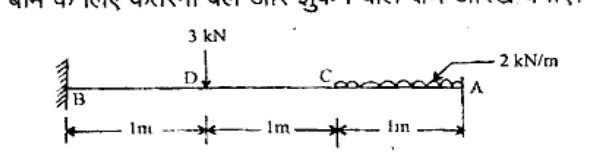
How to answer
- Determine reaction force and moment at the fixed support B
- Calculate shear force values along sections A-C, C-D, and D-B
- Calculate bending moment values along the beam length
- Draw Shear Force Diagram (SFD) with proper sign convention
- Draw Bending Moment Diagram (BMD) indicating parabolic and linear variations
-
7 MarksbDerive the relation between the rate of loading, shear force and bending moment.
How to answer
- Consider an element of length dx subjected to distributed load w, shear forces F and F+dF, moments M and M+dM
- Apply vertical equilibrium condition $\sum F_y = 0$ to get $\frac{dF}{dx} = -w$
- Apply moment equilibrium condition $\sum M = 0$ neglecting higher order terms
- Obtain relation $\frac{dM}{dx} = F$
-
14 MarksA beam of length $l$ simply supported at the ends carries a point load $W$ at a distance $a$ from the left end. Find the deflection under the load and the maximum deflection using Macaulay's method.
How to answer
- Determine support reactions: $R_A = \frac{W b}{l}$ and $R_B = \frac{W a}{l}$ where $b = l - a$
- Write Macaulay's moment equation: $EI \frac{d^2y}{dx^2} = R_A x - W [x - a]$
- Integrate twice to obtain slope and deflection equations with constants $C_1$ and $C_2$
- Apply boundary conditions $y=0$ at $x=0$ and $x=l$ to find constants
- Evaluate deflection at $x = a$: $y = -\frac{W a^2 b^2}{3 E I l}$
- Determine location of maximum deflection (where slope = 0) and find maximum deflection
-
14 MarksFind the Euler's critical load for a hollow cylindrical cast iron column $200\text{ mm}$ external diameter and $25\text{ mm}$ thick, if it is $6\text{ meter}$ long and hinged at both ends. Take $E = 8 \times 10^4\text{ N/mm}^2$. Compare Euler's Critical load with the Rankine's critical load taking $f_c = 550\text{ N/mm}^2$ and $a = 1/1600$. For what length of column Euler's critical loads by Euler's and Rankine's formula be equal.
How to answer
- Compute $D = 200\text{ mm}$, $d = 200 - 2(25) = 150\text{ mm}$, $A = \frac{\pi}{4}(200^2 - 150^2) = 13744.5\text{ mm}^2$
- Calculate $I = \frac{\pi}{64}(200^4 - 150^4) = 53.689 \times 10^6\text{ mm}^4$
- Calculate Euler's buckling load: $P_E = \frac{\pi^2 E I}{L^2} = \frac{\pi^2 (8 \times 10^4)(53.689 \times 10^6)}{6000^2} \approx 1.177 \times 10^6\text{ N}$
- Calculate radius of gyration $k = \sqrt{I/A}$ and Rankine load $P_R = \frac{f_c A}{1 + a(L/k)^2}$
- Compare $P_E$ and $P_R$
- Set $P_E = P_R$ or analyze the condition under which they become equal
-
7 MarksaExplain in detail St. Venant Theory.
How to answer
- State Saint-Venant's theory (Maximum Principal Strain Theory)
- State criterion: failure occurs when maximum principal strain equals yield strain in simple tension
- Mathematical formulation: $\epsilon_1 = \frac{1}{E}[\sigma_1 - \mu(\sigma_2 + \sigma_3)] \le \frac{\sigma_y}{E}$
- Simplify for 2D stress state
- Discuss limitations and applicability to materials
-
7 MarksbA air vessel of a torpedo is $530\text{ mm}$ external diameter and $10\text{ mm}$ thick, the length being $1830\text{ mm}$. Find the change in the external diameter and the length when charged to $10.5\text{ N/mm}^2$ internal pressure. Take $E = 2.1 \times 10^5\text{ N/mm}^2$ and Poisson's ratio $= 0.3$.
How to answer
- Calculate internal diameter $d = 530 - 2(10) = 510\text{ mm}$
- Calculate circumferential strain: $\epsilon_c = \frac{pd}{4tE}(2-\mu) = \frac{10.5 \times 510}{4 \times 10 \times 2.1 \times 10^5} (2 - 0.3)$
- Calculate change in diameter: $\Delta D \approx \epsilon_c \times D$
- Calculate longitudinal strain: $\epsilon_l = \frac{pd}{4tE}(1-2\mu) = \frac{10.5 \times 510}{4 \times 10 \times 2.1 \times 10^5} (1 - 0.6)$
- Calculate change in length: $\Delta L = \epsilon_l \times L$
-
14 MarksA solid shaft is to transmit $337.5\text{ kW}$ at $120\text{ r.p.m.}$ If the shear stress of the material must not exceed $80\text{ N/mm}^2$. Find the required diameter.
How to answer
- Calculate torque: $T = \frac{60 \times P}{2 \pi N} = \frac{60 \times 337.5 \times 10^3}{2 \pi \times 120} = 26856.7\text{ N}\cdot\text{m} = 26.857 \times 10^6\text{ N}\cdot\text{mm}$
- Use torsion formula: $T = \frac{\pi}{16} \tau d^3$
- Substitute $\tau = 80\text{ N/mm}^2$: $26.857 \times 10^6 = \frac{\pi}{16} \times 80 \times d^3$
- Solve for diameter: $d = \left(\frac{16 \times 26.857 \times 10^6}{80\pi}\right)^{1/3} \approx 119.5\text{ mm} \approx 120\text{ mm}$
-
14 MarksA beam AB $10\text{ meters}$ long has supports at its ends A and B. It carried a point load of $5\text{ kN}$ at $3\text{ meters}$ from A and a point load of $5\text{ kN}$ at $7\text{ meters}$ from A and a uniformly distributed load of $1\text{ kN}$ per meter between the point loads. Draw SF and BM diagrams for the beam.
How to answer
- Due to symmetry: $R_A = R_B = \frac{5 + 5 + 1 \times 4}{2} = 7\text{ kN}$
- Determine shear forces: $V_{A-C} = 7\text{ kN}$, $V_{C^+} = 2\text{ kN}$, $V$ decreases linearly to $-2\text{ kN}$ at D, $V_{D^+} = -7\text{ kN}$, $V$ drops to 0 at B
- Calculate bending moments: $M_A = 0$, $M_C = 7 \times 3 = 21\text{ kN}\cdot\text{m}$, $M_{\text{center}} = 7(5) - 5(2) - 1(2)(1) = 23\text{ kN}\cdot\text{m}$, $M_D = 21\text{ kN}\cdot\text{m}$, $M_B = 0$
- Draw SFD with step changes at point loads and linear slope in the UDL section
- Draw BMD with linear variation on spans AC and DB, and parabolic profile between C and D
Go to where you left off?
Quick Add to Notes
Save questions, your own notes and screenshots into notes filed by unit. It takes a free account.
Create free accountHave an account? Log in
Notes Panel