CE-305 · Strength of Materials/Unsolved PYQ Paper
CE-305 Strength of Materials - Dec 2023 Question Paper
Under each question, How to answer lists the points an answer should cover, outlined by CampusPrep from the syllabus. Check the details against your textbook.
-
7 MarksaDeduce the relation between the Modulus of Elasticity and Modulus of Rigidity.
How to answer
- Consider an element subjected to pure shear stress $\tau$.
- Express linear strain along diagonals in terms of shear strain $\phi = \tau/G$.
- Express diagonal tensile and compressive strain in terms of $E$ and Poisson's ratio $\mu$.
- Equate the strain expressions to obtain $E = 2G(1 + \mu)$.
-
7 MarksbA Load of $175\text{ N}$ falls through a height of $40\text{ mm}$ on to a collar rigidly attached to the lower end of a vertical bar $1.8\text{ m}$ long and of $1.8\text{ cm}^2$ cross-sectional area. The upper end of the vertical bar is fixed. Determine the maximum instantaneous stress induced in the bar. $E = 2 \times 10^5\text{ N/mm}^2$
How to answer
- Calculate static stress $\sigma_{st} = P/A = 175 / 180 = 0.972\text{ N/mm}^2$.
- Calculate static deflection $\delta_{st} = \sigma_{st} L / E = (0.972 \times 1800) / (2 \times 10^5) = 0.00875\text{ mm}$.
- Apply impact formula: $\sigma_{max} = \sigma_{st} [1 + \sqrt{1 + 2h/\delta_{st}}]$.
- Compute final maximum instantaneous stress.
-
7 MarksaDeduce the relation between Shear Force and Bending Moment.
How to answer
- Consider a small beam element of length $dx$ under distributed load $w(x)$.
- Write equilibrium of vertical forces: $dF = -w\,dx$ or $dF/dx = -w$.
- Take moments about one section: $(M + dM) - M - F\,dx + w\,dx\,(dx/2) = 0$.
- Neglect higher order infinitesimals to obtain $dM/dx = F$.
-
7 MarksbAn overhanging beam is shown in figure 1. Draw the S.F and B.M
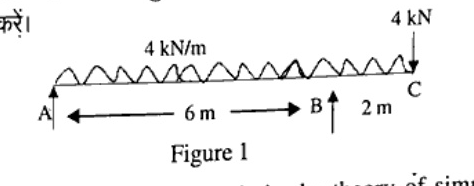
How to answer
- Calculate support reactions at A and B using static equilibrium conditions.
- Write shear force equations along segments AB and BC, identify shear force values at key points.
- Locate point of zero shear force and calculate maximum positive bending moment.
- Calculate bending moment at support B and overhang end C.
- Draw Shear Force and Bending Moment Diagrams indicating critical values and points of contraflexure.
-
5 MarksaWrite the assumptions made in the theory of simple bending.
How to answer
- Material is homogeneous and isotropic.
- Beam is initially straight and has constant cross-section.
- Plane sections before bending remain plane after bending (Bernoulli's assumption).
- Modulus of elasticity is same in tension and compression.
- Radius of curvature is large compared to cross-sectional dimensions.
-
5 MarksbDeduce the section modulus for a hollow circular section of internal diameter 'd' and external diameter 'D'.
How to answer
- Define section modulus as $Z = \frac{I}{y_{max}}$.
- Write formula for moment of inertia of hollow circular cross section: $I = \frac{\pi}{64}(D^4 - d^4)$.
- Identify maximum distance from neutral axis: $y_{max} = \frac{D}{2}$.
- Compute $Z = \frac{\pi (D^4 - d^4)/64}{D/2} = \frac{\pi}{32 D}(D^4 - d^4)$.
-
4 MarkscProve that the ratio of depth to width of the strongest beam that can be cut-out from a circular log of diameter 'd' is 1.414.
How to answer
- Relate dimensions of inscribed beam: $b^2 + h^2 = d^2 \implies h^2 = d^2 - b^2$.
- Express section modulus $Z = \frac{b h^2}{6} = \frac{b(d^2 - b^2)}{6} = \frac{b d^2 - b^3}{6}$.
- For maximum strength, set $\frac{dZ}{db} = 0 \implies d^2 - 3b^2 = 0 \implies b = \frac{d}{\sqrt{3}}$.
- Calculate corresponding depth: $h = \sqrt{d^2 - d^2/3} = \sqrt{\frac{2}{3}} d$.
- Find ratio: $\frac{h}{b} = \frac{\sqrt{2/3} d}{d/\sqrt{3}} = \sqrt{2} \approx 1.414$.
-
7 MarksaObtain the expression for shearing stress at a section of a loaded beam.
How to answer
- Consider an element of beam of length $dx$ between two transverse planes.
- Calculate longitudinal normal forces due to bending moments $M$ and $M+dM$ on an area above level $y$.
- Determine unbalanced horizontal force $dF_H = \frac{dM}{I} \int y\,dA = \frac{dM}{I} A\bar{y}$.
- Equate horizontal shearing force to shearing stress: $\tau b\,dx = dF_H$.
- Substitute $\frac{dM}{dx} = F$ to obtain $\tau = \frac{F A\bar{y}}{I b}$.
-
7 MarksbA T-section beam with $100\text{ mm} \times 15\text{ mm}$ flange and $150\text{ mm} \times 15\text{ mm}$ web is subjected to a Shear force of $10\text{ kN}$ at a section. Draw the variation of shear stress across the depth of the beam and obtain the value of maximum shear stress of the section
How to answer
- Locate centroid (Neutral Axis) of the T-section.
- Calculate moment of inertia $I_{NA}$ about the neutral axis.
- Calculate shear stress at top of flange (zero), flange-web junction in flange and web, neutral axis, and bottom of web (zero).
- Determine the maximum shear stress (at NA or junction).
- Plot shear stress distribution profile showing step jump at junction.
-
7 MarksaDiscuss about moment area theorems.
How to answer
- State Mohr's First Theorem: Change in slope between two points equals area under $M/EI$ diagram between them: $\theta_B - \theta_A = \int_A^B \frac{M}{EI} dx$.
- State Mohr's Second Theorem: Tangential deviation of point B from tangent at A equals moment of $M/EI$ diagram about B: $t_{B/A} = \int_A^B \frac{M}{EI} x\,dx$.
- State conditions and sign conventions for applying these theorems.
-
7 MarksbFind the slope and deflection of simply supported beam of span L, carrying i) a point load P at the centre ii) a U.D.L of w kN/m over the entire span using the moment area method.
How to answer
- Part i: Draw M/EI diagram (triangular with max $PL/4EI$ at center). Use Theorem 1 for slope at support: $\theta_A = \text{Area} = \frac{1}{2}(L/2)(PL/4EI) = \frac{PL^2}{16EI}$. Use Theorem 2 for center deflection: $\delta_C = \text{moment of half area about A} = \frac{PL^3}{48EI}$.
- Part ii: Draw M/EI diagram (parabolic with max $wL^2/8EI$ at center). Use Theorem 1 for slope at support: $\theta_A = \frac{2}{3}(L/2)(wL^2/8EI) = \frac{wL^3}{24EI}$.
- Use Theorem 2 for center deflection: $\delta_C = \frac{5wL^4}{384EI}$.
-
7 MarksaDerive an expression for circumferential stress for a thin spherical shell of internal diameter $d$, wall thickness $t$ and subjected to an internal pressure $p$.
How to answer
- Consider a diametral plane cutting the thin sphere into two halves.
- Total bursting force acting on projected area: $P_{burst} = p \times \frac{\pi d^2}{4}$.
- Total resisting force developed in the shell material: $P_{res} = \sigma \times (\pi d t)$.
- Equating forces: $p \frac{\pi d^2}{4} = \sigma (\pi d t) \implies \sigma = \frac{p d}{4t}$.
-
7 MarksbA thin cylindrical shell $90\text{ cm}$ long, $20\text{ cm}$ internal diameter having thickness of metal as $8\text{ mm}$ is filled with fluid at atmospheric pressure. If an additional $20\text{ cm}^3$ of fluid is pumped into the cylinder, Find: i) The pressure exerted by the fluid on the cylinder ii) The hoop stresses induced. Take $E = 2.1 \times 10^5\text{ N/mm}^2$ and Poisson's ratio $= 0.30$
How to answer
- Calculate original internal volume $V = \frac{\pi}{4} d^2 L = \frac{\pi}{4} (200)^2 (900) = 2.827 \times 10^7\text{ mm}^3$.
- Volumetric strain $\frac{\Delta V}{V} = \frac{20000}{2.827 \times 10^7} = 7.074 \times 10^{-4}$.
- Use volumetric strain formula: $\frac{\Delta V}{V} = \frac{p d}{4 t E}(5 - 4\mu)$ to solve for internal pressure $p$.
- Calculate hoop stress $\sigma_h = \frac{p d}{2 t}$.
-
7 MarksaA metal bar of $10\text{mm}$ diameter when subjected to a pull of $23.55\text{kN}$ gave and elongation of $0.3\text{mm}$ on a gauge length of $200\text{mm}$. In a torsion test maximum shear stress of $40.71\text{N/mm}^2$ was measured on a bar of $50\text{mm}$ diameter. The angle of twist measured over a length of $300\text{mm}$ being $0^\circ 21'$. Determine the Poisson's Ratio.
How to answer
- Calculate Young's modulus $E = \frac{P L_1}{A_1 \delta L}$ using tensile test data.
- Convert twist angle $\theta = 21' = \frac{21}{60} \times \frac{\pi}{180}\text{ radians}$.
- Calculate Modulus of Rigidity $G = \frac{\tau_{max} L_2}{R \theta}$ using torsion test data.
- Use elastic relation $E = 2G(1 + \mu)$ to compute Poisson's ratio $\mu = \frac{E}{2G} - 1$.
-
7 MarksbWhat must be the length of a $5\text{mm}$ diameter Aluminium wire so that it can be twisted through 1 complete revolution without exceeding a shear of $42\text{N/mm}^2$. Take, $G = 27\text{ GPO}$.
How to answer
- Identify $R = d/2 = 2.5\text{ mm}$, $\theta = 2\pi\text{ rad}$, $\tau = 42\text{ N/mm}^2$, $G = 27\text{ GPa} = 27 \times 10^3\text{ N/mm}^2$ (GPO printed as GPa).
- Use torsion formula: $\frac{\tau}{R} = \frac{G\theta}{L}$.
- Solve for $L = \frac{G \cdot R \cdot \theta}{\tau}$.
- Calculate numerical value of $L$ in meters.
-
7 MarksaDeduce the relation between Shear force and intensity of loading.
How to answer
- Consider a differential element of length $dx$ of a loaded beam.
- Consider shear forces $F$ and $F + dF$ acting on the left and right faces.
- Apply vertical equilibrium: $\sum F_y = 0 \implies F - (F + dF) - w\,dx = 0$.
- Conclude $\frac{dF}{dx} = -w$ (rate of change of shear force equals load intensity).
-
7 MarksbWrite a brief note on: i) Stress and strain ii) Mohr's circle
How to answer
- Define stress (intensity of internal resisting force per unit area) and types (tensile, compressive, shear).
- Define strain (deformation per unit original dimension) and types (longitudinal, lateral, shear, volumetric).
- Describe Mohr's circle: a graphical method to determine normal and shear stresses on inclined planes.
- Explain key features: center coordinates $((\sigma_x+\sigma_y)/2, 0)$, radius $R$, principal stresses, and max shear stress.
Go to where you left off?
Quick Add to Notes
Save questions, your own notes and screenshots into notes filed by unit. It takes a free account.
Create free accountHave an account? Log in
Notes Panel