CE-305 · Strength of Materials/Unsolved PYQ Paper
CE-305 Strength of Materials - Jun 2024 Question Paper
Under each question, How to answer lists the points an answer should cover, outlined by CampusPrep from the syllabus. Check the details against your textbook.
-
5 MarksaA circular steel bar of length 'L' cross-sectional area 'A' and weight 'W' is fixed at its upper end and hangs vertically. Find the elongation of the bar under its own weight.
How to answer
- Consider an element $dx$ at distance $x$ from the free end
- Weight of the bar below section $x$: $W_x = W \cdot \frac{x}{L}$
- Elongation of element: $d\delta = \frac{W_x dx}{A E} = \frac{W x dx}{A L E}$
- Integrate from $x = 0$ to $x = L$ to obtain $\delta = \frac{W L}{2 A E}$
-
5 MarksbA steel rod of $25\text{ mm}$ in diameter and $2\text{ meter}$ long is subjected to an axial pull of $45\text{ kN}$. Find: i) The intensity of stress ii) The strain iii) Elongation Take $E = 2 \times 10^5\text{ N/mm}^2$.
How to answer
- Calculate area: $A = \frac{\pi}{4}(25)^2 \approx 490.87\text{ mm}^2$
- Calculate stress: $\sigma = \frac{P}{A} = \frac{45 \times 10^3}{490.87} \approx 91.67\text{ N/mm}^2$
- Calculate strain: $\epsilon = \frac{\sigma}{E} = \frac{91.67}{2 \times 10^5} \approx 4.58 \times 10^{-4}$
- Calculate elongation: $\delta L = \epsilon \cdot L = 4.58 \times 10^{-4} \times 2000 \approx 0.917\text{ mm}$
-
4 MarkscA straight bar $450\text{ mm}$ long is $20\text{ mm}$ in diameter for the first $250\text{ mm}$ length and $10\text{ mm}$ diameter for the remaining length. If the bar is subjected to an axial pull of $10\text{ kN}$. Find the extension of the bar. Take $E = 2 \times 10^5\text{ N/mm}^2$.
How to answer
- Area of part 1: $A_1 = \frac{\pi}{4}(20)^2 = 314.16\text{ mm}^2$, $L_1 = 250\text{ mm}$
- Area of part 2: $A_2 = \frac{\pi}{4}(10)^2 = 78.54\text{ mm}^2$, $L_2 = 450 - 250 = 200\text{ mm}$
- Extension $\delta = \frac{P}{E} \left(\frac{L_1}{A_1} + \frac{L_2}{A_2}\right)$
- Substitute values: $\delta = \frac{10 \times 10^3}{2 \times 10^5} \left(\frac{250}{314.16} + \frac{200}{78.54}\right) \approx 0.05 \times (0.7958 + 2.5465) \approx 0.167\text{ mm}$
-
7 MarksaDraw the S.F and B.M diagrams of the beam shown in Figure 1.
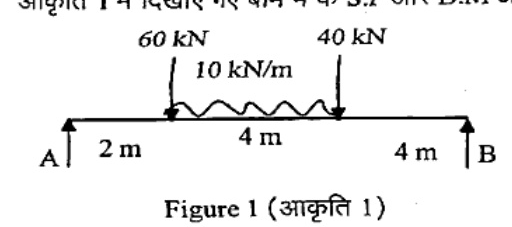
How to answer
- Calculate support reactions $R_A$ and $R_B$ using $\sum F_y = 0$ and $\sum M_A = 0$
- Write SF equations along sections: $0-2\text{ m}$, $2-6\text{ m}$, and $6-10\text{ m}$
- Calculate and plot Shear Force values across key points
- Write BM equations along spans and determine point of zero shear (maximum bending moment)
- Plot Bending Moment diagram with parabolic variation under UDL and linear variation elsewhere
-
7 MarksbFind the SF at left support, if a simply supported beam of span $6\text{ m}$ is subjected an eccentric point load of $9\text{ kN}$ at distance of $2\text{ m}$ from the left support.
How to answer
- Let left support be $A$ and right support be $B$. Distance from load to right support: $b = 6 - 2 = 4\text{ m}$
- Taking moments about $B$: $R_A \times 6 = 9 \times 4 \implies R_A = 6\text{ kN}$
- Shear force at left support (just to the right of $A$) is equal to $R_A = +6\text{ kN}$
-
7 MarksaDerive the expression for shear stress distribution over I-section.
How to answer
- State general shear stress equation: $\tau = \frac{V \cdot A\bar{y}}{I \cdot b}$
- Sketch I-section geometry with dimensions of flanges and web
- Derive expression for shear stress in flanges at distance $y$ from neutral axis
- Derive expression for shear stress in web at junction and at neutral axis (maximum shear stress)
- Draw characteristic parabolic shear stress distribution diagram across depth
-
7 MarksbThe Young's Modulus of material is $21 \times 10^4\text{ N/mm}^2$ and its modulus of Rigidity is $8.4 \times 10^4\text{ N/mm}^2$ and determine its Poisson's ratio and Bulk modulus.
How to answer
- Use relation $E = 2G(1 + \mu)$ to find $\mu$: $1 + \mu = \frac{E}{2G} = \frac{21 \times 10^4}{2 \times 8.4 \times 10^4} = 1.25 \implies \mu = 0.25$
- Use relation $E = 3K(1 - 2\mu)$ to find $K$: $K = \frac{E}{3(1 - 2\mu)}$
- Substitute values: $K = \frac{21 \times 10^4}{3(1 - 2 \times 0.25)} = \frac{21 \times 10^4}{1.5} = 14 \times 10^4\text{ N/mm}^2 = 1.4 \times 10^5\text{ N/mm}^2$
-
14 MarksWhat do you understand by pure Torsion? Also deduce its expression at pure Torsion equation.
How to answer
- Define pure torsion: shaft subjected only to twisting couple without axial, shear, or bending forces
- State assumptions in torsion theory (circular sections remain circular, planes remain plane)
- Consider a circular shaft subjected to torque $T$, derive shear strain $\gamma = \frac{r \theta}{L}$
- Relate shear stress to shear strain $\tau = G \gamma = \frac{G r \theta}{L} \implies \frac{\tau}{r} = \frac{G \theta}{L}$
- Derive total torque from elementary ring: $T = \int \tau r dA = \frac{\tau}{r} J \implies \frac{T}{J} = \frac{\tau}{r}$
- Combine into torsion equation: $\frac{T}{J} = \frac{\tau}{r} = \frac{G \theta}{L}$
-
7 MarksaA hollow steel shaft $3\text{ m}$ long must transmit a torque of $25\text{ kNm}$. The total angle of twist in this length is not to exceed $2.5^\circ$ and the allowable shearing stress is $90\text{ MPa}$. Determine the inside and outside diameter of the shaft if $G = 85\text{ GPa}$.
How to answer
- Express polar moment of inertia $J = \frac{\pi}{32} (D^4 - d^4)$
- Apply stiffness condition: $J \ge \frac{TL}{G\theta}$ with $\theta = 2.5 \times \frac{\pi}{180}\text{ rad}$
- Apply strength condition: $\frac{J}{D} \ge \frac{T}{2\tau}$
- Since ratio $k = d/D$ is not given, either assume standard ratio (e.g., $k = 0.6$) or express $D$ and $d$ simultaneously from both criteria
- Calculate resulting outer and inner diameters satisfying both criteria
-
7 MarksbA thin spherical vessel $100\text{ mm}$ diameter and $12.5\text{ mm}$ thick is filled with water. More water is pumped in until the pressure reaches $4.2\text{ MPa}$. How much extra water is required to reach this pressure? Assume $E = 210\text{ GPa}$, $\nu = 0.25$.
How to answer
- Calculate initial volume of the sphere: $V = \frac{\pi}{6} d^3 = \frac{\pi}{6}(100)^3 \approx 523599\text{ mm}^3$
- Calculate circumferential stress: $\sigma = \frac{p d}{4 t} = \frac{4.2 \times 100}{4 \times 12.5} = 8.4\text{ N/mm}^2$
- Calculate volumetric strain of vessel: $\epsilon_v = \frac{3 p d}{4 t E}(1 - \nu) = \frac{3 \times 8.4}{210 \times 10^3} (1 - 0.25) = 9 \times 10^{-5}$
- Calculate extra water pumped (assuming water is incompressible or considering vessel expansion): $\Delta V = V \times \epsilon_v = 523599 \times 9 \times 10^{-5} \approx 47.12\text{ mm}^3$
-
7 MarksaA solid circular shaft is to transmit $375\text{ kW}$ at $150\text{ RPM}$. Find the diameter of the shaft if the shear stress is not to exceed $65\text{ N/mm}^2$.
How to answer
- Calculate torque transmitted: $T = \frac{P \times 60}{2 \pi N} = \frac{375 \times 10^3 \times 60}{2 \pi \times 150} \approx 23873.24\text{ N}\cdot\text{m} = 2.387 \times 10^7\text{ N}\cdot\text{mm}$
- Apply torsion formula: $T = \frac{\pi}{16} \tau D^3$
- Solve for $D$: $D^3 = \frac{16 \times 2.387 \times 10^7}{\pi \times 65} \approx 1870425\text{ mm}^3$
- $D = (1870425)^{1/3} \approx 123.2\text{ mm}$
-
7 MarksbWrite the assumption of theory of simple bending and prove the relations, $$\frac{M}{I} = \frac{\sigma}{y} = \frac{E}{R}$$
How to answer
- List key assumptions of pure/simple bending (material homogeneous and isotropic, plane sections remain plane, Hooke's law obeyed, radius of curvature large)
- Consider an element at distance $y$ from neutral axis: strain $\epsilon = \frac{y}{R}$
- Using Hooke's law, $\sigma = E \epsilon = \frac{E}{R} y \implies \frac{\sigma}{y} = \frac{E}{R}$
- Calculate resisting moment: $M = \int \sigma y dA = \frac{E}{R} \int y^2 dA = \frac{E}{R} I$
- Combine to give bending equation: $\frac{M}{I} = \frac{\sigma}{y} = \frac{E}{R}$
-
14 MarksA solid shaft is to transmit $337.5\text{ kW}$ at $120\text{ r.p.m.}$ If the shear stress of the material must not exceed $80\text{ N/mm}^2$. Find the required diameter.
How to answer
- Calculate torque: $T = \frac{P \times 60}{2 \pi N} = \frac{337.5 \times 10^3 \times 60}{2 \pi \times 120} \approx 26856.7\text{ N}\cdot\text{m} = 2.686 \times 10^7\text{ N}\cdot\text{mm}$
- Use torsion formula: $T = \frac{\pi}{16} \tau D^3$
- Solve for diameter: $D^3 = \frac{16 \times 2.686 \times 10^7}{\pi \times 80} \approx 1709859\text{ mm}^3$
- $D = (1709859)^{1/3} \approx 119.6\text{ mm} \approx 120\text{ mm}$
-
14 MarksA beam $AB$ $10\text{ meters}$ long has supports at its ends $A$ and $B$. It carried a point load of $5\text{ kN}$ at $3\text{ meters}$ from $A$ and a point load of $5\text{ kN}$ at $7\text{ meters}$ from $A$ and a uniformly distributed load of $1\text{ kN}$ per meter between the point loads. Draw SF and BM diagrams for the beam.
How to answer
- By symmetry, calculate reactions: Total load $= 5 + 5 + (1 \times 4) = 14\text{ kN} \implies R_A = R_B = 7\text{ kN}$
- Calculate Shear Force at key points: SF from $x=0$ to $3\text{ m}$ is $+7\text{ kN}$; drops to $+2\text{ kN}$ at $x=3\text{ m}$; varies linearly from $+2\text{ kN}$ to $-2\text{ kN}$ between $x=3\text{ m}$ and $7\text{ m}$ (zero at midspan $x=5\text{ m}$); drops to $-7\text{ kN}$ at $x=7\text{ m}$; constant $-7\text{ kN}$ to $B$
- Calculate Bending Moments: $M_A = M_B = 0$; $M$ at $3\text{ m} = 7 \times 3 = 21\text{ kNm}$; Maximum BM at center ($x=5\text{ m}$) $= 7(5) - 5(2) - 1(2)(1) = 35 - 10 - 2 = 23\text{ kNm}$; $M$ at $7\text{ m} = 21\text{ kNm}$
- Draw Shear Force Diagram with step drops and linear slope
- Draw Bending Moment Diagram with straight lines in outer segments and parabolic profile in the middle $4\text{ m}$ segment
Go to where you left off?
Quick Add to Notes
Save questions, your own notes and screenshots into notes filed by unit. It takes a free account.
Create free accountHave an account? Log in
Notes Panel