CE-305 · Strength of Materials/Unsolved PYQ Paper
CE-305 Strength of Materials - Jun 2023 Question Paper
Under each question, How to answer lists the points an answer should cover, outlined by CampusPrep from the syllabus. Check the details against your textbook.
-
7 MarksaDeduce the total extension of a uniformly tapering rod of diameters $d$ and $D$ over a length of $L$, when the rod is subjected to an axial load $P$.
How to answer
- Consider an elemental length $dx$ at a distance $x$ from the smaller end.
- Express diameter at section: $D_x = d + \frac{D-d}{L}x$.
- Find elongation of element: $d(\delta) = \frac{P dx}{A_x E} = \frac{4 P dx}{\pi D_x^2 E}$.
- Integrate from $x = 0$ to $x = L$.
- Final expression: $\delta L = \frac{4 P L}{\pi E D d}$.
-
7 MarksbA steel rod of $3\text{ cm}$ diameter and $5\text{ m}$ long is connected to two grips and the rod is maintained at a temperature of $95^\circ\text{C}$. Determine the stress and force pull exerted when temperature falls to $30^\circ\text{C}$, if i) The ends do not yield ii) The ends yield by $0.12\text{ cm}$. Take $E = 2 \times 10^5\text{ MN/m}^2$ and $\alpha = 12 \times 10^{-6}/^\circ\text{C}$.
How to answer
- Calculate temperature drop $\Delta T = 95 - 30 = 65^\circ\text{C}$ and cross-sectional area $A = \frac{\pi}{4}(0.03)^2\text{ m}^2$.
- Case (i) Ends do not yield: Stress $\sigma = \alpha \Delta T E$, Force $P = \sigma \times A$.
- Case (ii) Ends yield by $\delta = 0.0012\text{ m}$: Stress $\sigma' = \frac{L \alpha \Delta T - \delta}{L} E$, Force $P' = \sigma' \times A$.
-
7 MarksaDraw the S.F and B.M diagrams of the beam shown in Figure 1.
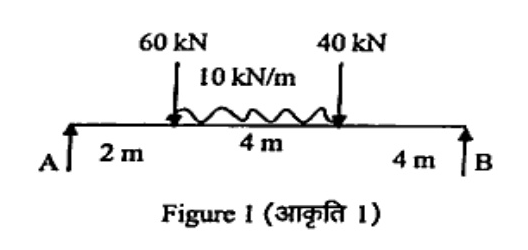
How to answer
- Determine support reactions at A and B by applying static equilibrium conditions ($\sum F_y = 0$, $\sum M_A = 0$). Total span = $2 + 4 + 4 = 10\text{ m}$.
- Calculate shear force at critical sections (A, at 2 m before and after 60 kN, along UDL, at 6 m before and after 40 kN, at B).
- Calculate bending moments at key points (supports and load application points).
- Plot SFD with straight lines for point loads and linear slopes for UDL.
- Plot BMD with parabolic curve under UDL and straight linear variations elsewhere.
-
7 MarksbFind the SF at left support, if a simply supported beam of span $6\text{ m}$ is subjected an eccentric point load of $9\text{ kN}$ at distance of $2\text{ m}$ from the left support.
How to answer
- Identify beam parameters: span $L = 6\text{ m}$, load $W = 9\text{ kN}$, $a = 2\text{ m}$, $b = 4\text{ m}$.
- Take moment about right support B: $R_A \times 6 = 9 \times 4 \implies R_A = 6\text{ kN}$.
- The shear force at the left support is equal to the reaction at the left support, i.e., $6\text{ kN}$.
-
7 MarksaA simply supported beam of span $L$, carrying a point load $P$ at $0.3L$ from left support. Determine the mid-span displacements and slopes at the supports, using the method of integration.
How to answer
- Find reactions: $R_A = 0.7P$, $R_B = 0.3P$.
- Set up differential equation using Macaulay's method: $EI \frac{d^2y}{dx^2} = 0.7P x - P [x - 0.3L]$.
- Integrate once for slope: $EI \frac{dy}{dx} = \frac{0.7P x^2}{2} + C_1 - \frac{P [x - 0.3L]^2}{2}$.
- Integrate twice for deflection and apply boundary conditions $y(0)=0$ and $y(L)=0$ to find constants $C_1$ and $C_2$.
- Compute slopes at supports ($x=0$, $x=L$) and deflection at mid-span ($x=0.5L$).
-
7 MarksbA compound cylinder is made by shrinking a cylindrical of external diameter $300\text{ mm}$ and internal diameter of $250\text{ mm}$ over another cylindrical of external diameter $250\text{ mm}$ and internal diameter $200\text{ mm}$. The radial pressure at the junction after shrinking is $8\text{ N/mm}^2$. Find the final stresses sent up across the section, when the compound cylinder is subjected to an internal fluid pressure of $84.5\text{ N/mm}^2$.
How to answer
- Determine Lame's constants due to shrinkage pressure alone ($p = 8\text{ N/mm}^2$ at $r = 125\text{ mm}$) for inner and outer cylinders.
- Calculate hoop stresses at inner radius ($r=100$), junction ($r=125$), and outer radius ($r=150$) due to shrinkage.
- Treat the compound cylinder as a single thick cylinder with $r_i = 100\text{ mm}$ and $r_o = 150\text{ mm}$ under internal pressure $84.5\text{ N/mm}^2$ and compute bursting hoop stresses.
- Superimpose shrinkage stresses and internal pressure stresses to find final resultant stresses.
-
7 MarksaDerive the shear stress formula from fundamentals.
How to answer
- Consider an elemental length $dx$ of a beam subjected to bending moments $M$ and $M + dM$.
- Consider an area of cross-section above distance $y_1$ from the neutral axis.
- Calculate unbalanced normal force $dF = \int \frac{dM \cdot y}{I} dA$.
- Equate unbalanced force to shearing force on longitudinal area: $\tau b dx = dF$.
- Deduce final formula: $\tau = \frac{dM}{dx} \frac{A \bar{y}}{I b} = \frac{V A \bar{y}}{I b}$.
-
7 MarksbA $120\text{ mm} \times 50\text{ mm}$ I-Section is subjected to a shearing force of $10\text{ kN}$. Calculate the shear stress at the neutral axis and at the top of the web. Given $I = 220 \times 10^4\text{ mm}^4$, $\text{Area} = 9.4 \times 10^2\text{ mm}^2$, $\text{web thickness} = 3.5\text{ mm}$ and $\text{flange thickness} = 5.5\text{ mm}$.
How to answer
- Calculate first moment of area of the flange about neutral axis: $A_f \bar{y}_f = (50 \times 5.5) \times (60 - 2.75) = 275 \times 57.25\text{ mm}^3$.
- Compute shear stress at the top of the web ($b = t_w = 3.5\text{ mm}$): $\tau = \frac{V (A_f \bar{y}_f)}{I \times t_w}$.
- Calculate first moment of area of half web: $A_w \bar{y}_w = (3.5 \times (60 - 5.5)) \times \frac{54.5}{2}$.
- Compute shear stress at neutral axis: $\tau_{\text{max}} = \frac{V (A_f \bar{y}_f + A_w \bar{y}_w)}{I \times t_w}$.
-
7 MarksaA hollow steel shaft $3\text{ m}$ long must transmit a torque of $25\text{ kNm}$. The total angle of twist in this length is not to exceed $2.5^\circ$ and the allowable shearing stress is $90\text{ MPa}$. Determine the inside and outside diameter of the shaft if $G = 85\text{ GPa}$.
How to answer
- State torsion equations: $\frac{T}{J} = \frac{\tau}{D/2}$ and $\frac{T}{J} = \frac{G\theta}{L}$.
- Convert $\theta$ into radians: $\theta = 2.5 \times \frac{\pi}{180}\text{ rad}$.
- From strength criterion: $\frac{T}{J/R} \le \tau \implies \frac{16 T D}{\pi(D^4 - d^4)} \le \tau$.
- From stiffness criterion: $\frac{T L}{G J} \le \theta \implies J = \frac{\pi}{32}(D^4 - d^4) \ge \frac{T L}{G \theta}$.
- Assume diameter ratio $k = d/D$ or solve simultaneously for $D$ and $d$ satisfy both constraints.
-
7 MarksbA thin spherical vessel $100\text{ mm}$ diameter and $12.5\text{ mm}$ thick is filled with water. More water is pumped in until the pressure reaches $4.2\text{ MPa}$. How much extra water is required to reach this pressure? Assume $E = 210\text{ GPa}$, $\gamma = 0.25$.
How to answer
- Calculate initial volume of spherical shell: $V = \frac{\pi}{6} d^3$.
- Calculate volumetric strain of the spherical vessel: $\epsilon_v = \frac{3 p d}{4 t E} (1 - \nu)$ (taking $\gamma = \nu = 0.25$).
- Determine the increase in volume of the sphere: $\Delta V = V \times \epsilon_v$.
- Extra water required equals $\Delta V$ (assuming incompressible water, or including water compressibility if bulk modulus $K_w$ were given).
-
7 MarksaConstruct shear and bending moment diagrams for the loaded beam shown below in the Figure 2.
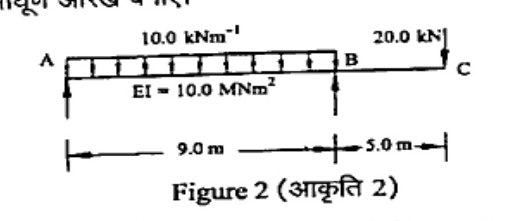
How to answer
- Find reaction forces at supports A and B using $\sum M_A = 0$ and $\sum F_y = 0$.
- Calculate SF at key sections: just right of A, just left of B, just right of B, and at overhang end C.
- Locate point of zero shear to find maximum positive bending moment between A and B.
- Calculate bending moments at A, at zero shear location, at support B, and at C.
- Draw SFD with linear variation across AB and constant across BC; draw BMD with parabolic profile across AB and linear across BC.
-
7 MarksbFind the maximum deflection and slopes at supports of a simply supported beam of span '$l$' subjected to a point load of '$W$' acting at a distance of '$a$' from the left hand support.
How to answer
- Set up bending moment equation: $M_x = \frac{W b}{l} x - W [x - a]$.
- Integrate using Macaulay's method to get general expressions for slope and deflection.
- Apply boundary conditions $y = 0$ at $x = 0$ and $x = l$ to evaluate constants $C_1$ and $C_2$.
- Obtain slopes at supports: $\theta_A = \frac{W a b (l + b)}{6 E I l}$ and $\theta_B = \frac{W a b (l + a)}{6 E I l}$.
- Determine position of zero slope (maximum deflection) and substitute back to find maximum deflection.
-
7 MarksaA solid steel shaft has to transmit $75\text{ kW}$ power at $200\text{ rpm}$. Taking allowable shear stress $70\text{ N/mm}^2$. Find suitable diameter of shaft with the maximum torque transmitted on each revolution exceeds the mean by $30\%$.
How to answer
- Calculate mean torque: $T_{\text{mean}} = \frac{P \times 60}{2 \pi N} = \frac{75000 \times 60}{2 \pi \times 200}\text{ N}\cdot\text{m}$.
- Calculate maximum torque: $T_{\text{max}} = 1.30 \times T_{\text{mean}}$.
- Use torsion formula: $T_{\text{max}} = \frac{\pi}{16} \tau d^3$.
- Solve for diameter $d$: $d = \left( \frac{16 T_{\text{max}}}{\pi \tau} \right)^{1/3}$.
-
7 MarksbDerive torsion equation and give the assumptions made for the derivation of torsion equation.
How to answer
- List assumptions: homogeneous, isotropic material obeying Hooke's law, plane cross-sections remain plane and circular, twist is uniform along length.
- Consider an element on shaft surface to establish relationship between shear strain and angle of twist: $\gamma = \frac{r \theta}{L} \implies \frac{\tau}{r} = \frac{G \theta}{L}$.
- Express resisting torque of an elemental ring: $dT = \tau \cdot dA \cdot r = \frac{G \theta}{L} r^2 dA$.
- Integrate over the entire section: $T = \frac{G \theta}{L} \int r^2 dA = \frac{G \theta}{L} J$.
- Combine to obtain final torsion equation: $\frac{T}{J} = \frac{\tau}{r} = \frac{G \theta}{L}$.
-
7 MarksaDefine three moduli of elasticity and state the relation between them.
How to answer
- Define Young's Modulus ($E = \frac{\text{Tensile/Compressive Stress}}{\text{Longitudinal Strain}}$).
- Define Shear Modulus / Modulus of Rigidity ($G = \frac{\text{Shear Stress}}{\text{Shear Strain}}$).
- Define Bulk Modulus ($K = \frac{\text{Direct Stress}}{\text{Volumetric Strain}}$).
- State relationships connecting them: $E = 2G(1 + \nu)$, $E = 3K(1 - 2\nu)$, and $E = \frac{9KG}{3K + G}$.
-
7 MarksbWrite a brief note on: i) Stress and strain ii) Mohr's circle
How to answer
- Part (i): Define normal and shear stress; define longitudinal, lateral, and volumetric strain; write Hooke's law.
- Part (ii): Explain Mohr's circle as a graphical method to determine normal and shear stresses on inclined planes.
- State center coordinates $\left(\frac{\sigma_x + \sigma_y}{2}, 0\right)$ and radius $R = \sqrt{\left(\frac{\sigma_x - \sigma_y}{2}\right)^2 + \tau_{xy}^2}$.
- Sketch representative Mohr's circle indicating principal stresses.
Go to where you left off?
Quick Add to Notes
Save questions, your own notes and screenshots into notes filed by unit. It takes a free account.
Create free accountHave an account? Log in
Notes Panel