ME-405 · MANUFACTURING TECHNOLOGY/Unsolved PYQ Paper
ME-405 Manufacturing Technology - Jun 2022 Question Paper
Under each question, How to answer lists the points an answer should cover, outlined by CampusPrep from the syllabus. Check the details against your textbook.
-
7 MarksaWhat are the four different ways for failure of cutting tools? Explain with neat sketch.
How to answer
- Define tool failure modes: flank wear, crater wear, plastic deformation, chipping/breakage
- Explain mechanism for each with causes
- Neat sketch showing flank and crater wear on tool
- Effect on surface finish and tool life
-
7 MarksbA cylindrical bar of 100 mm diameter is orthogonally straight turned with cutting velocity, feed and depth of cut of 120 m/min, 0.25 mm/rev and 4 mm, respectively. The specific cutting energy of the work material is $1\times 10^3$ J/m$^3$. Neglect the contribution of feed force towards cutting power. Find the main or tangential cutting force (in N).
How to answer
- Material removal rate $MRR = V \cdot f \cdot d$
- Cutting power $P = u \cdot MRR$ where $u$ is specific energy
- Tangential force $F_c = P/V$
- Substitute values and compute $F_c$ in N
-
14 MarksTwo cutting tools are being compared for a machining operation. The tool life equations are: Carbide tool: $VT^{1.6} = 3000$ HSS tool: $VT^{0.6} = 200$. Where V is the cutting speed in m/min and T is the tool life in min. The carbide tool will provide higher tool life if the cutting speed in m/min exceeds what value. Try to justify your statement.
How to answer
- Write Taylor tool life $VT^n = C$ for both tools
- Equate tool life $T$ to find break-even $V$
- Solve $V^{1.6}/3000 = V^{0.6}/200$ for $V$
- Justify carbide better above break-even due to lower n effect
-
14 MarksWrites down about the super finishing processes given below in brief:
- i)Honing
- ii)Lapping
- iii)Electro polishing
- iv)Buffing
How to answer
- Define superfinishing purpose - low roughness, high accuracy
- Brief principle, tool/medium and application of honing
- Brief principle of lapping, electro-polishing, buffing
- Comparison of finish achievable
-
7 MarksaWhat is gear hobbing and how does it work? Write the Advantages and Limitations of Gear Hobbing Process, with neat sketch.
How to answer
- Define gear hobbing - generating process with hob cutter
- Working principle with rotation and feed relations
- Neat sketch of hob and gear blank setup
- Advantages and limitations list
-
7 MarksbWhat are the difference between gear production and gear generation? Compare between them.
How to answer
- Define gear production vs gear generation concepts
- Explain forming vs generating principles
- Compare on accuracy, tooling, productivity, cost
- Examples of each method
-
7 MarksaDefine hot extrusion and cold extrusion Process on the basis of surface finish, mechanical properties, material used and machine specification.
How to answer
- Define hot extrusion and cold extrusion with temperature range
- Compare surface finish, mechanical properties, materials
- Compare machine tonnage and tooling specification
- Applications of each
-
7 MarksbWhat is blow moulding? What are the advantage and Defects of Blow Moulding?
How to answer
- Define blow moulding principle with parison and air pressure
- Steps: extrusion of parison, clamping, blowing, ejection
- Advantages for hollow parts
- Typical defects: wall thickness variation, flash, warpage
-
7 MarksaWrite down the short note on welding of plastics. What are the Advantage and limitation of the technology?
How to answer
- Define plastic welding methods: hot gas, ultrasonic, friction etc.
- Brief procedure and materials weldable
- Advantages: light weight joints, no fasteners
- Limitations: joint strength, material compatibility
-
7 MarksbDifferentiate between the product developed by transfer moulding and extrusion moulding in all the aspects.
How to answer
- Define transfer moulding and extrusion moulding principles
- Compare process, mould, product shapes, materials
- Compare on all aspects: cost, rate, finish, size
- Typical products for each
-
7 MarksaDraw the logical diagram of electrochemical machining, and describe the procedure, working principle, advantage and limitation of the process.
How to answer
- Draw logical/block diagram of ECM cell: tool, workpiece, electrolyte, power supply
- Explain working principle - anodic dissolution, Faraday's law
- Procedure steps and process parameters
- Advantages and limitations
-
7 MarksbWhat is the characteristics of electron beam machining, write the advantage and limitation of the EBM.
How to answer
- Define EBM with high velocity electron beam in vacuum
- Characteristics: high energy density, vacuum, precision
- Advantages for micro-machining hard materials
- Limitations: cost, vacuum, safety, MRR
-
14 MarksWrites the part program for machining centers (milling) for the given geometry. All dimensions are in mm.
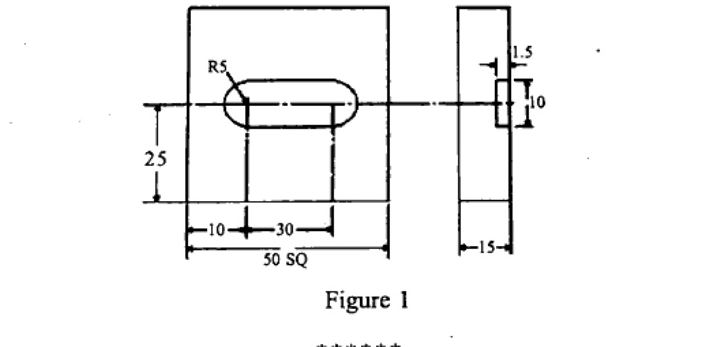
How to answer
- Interpret Figure 1: 50 SQ plate, 15 mm thick, slot 30x10 with R5
- Select datum, tools, speeds/feeds and coordinate system
- Write milling sequence: facing, slotting, finishing
- Give complete part program with G/M codes
Go to where you left off?
Quick Add to Notes
Save questions, your own notes and screenshots into notes filed by unit. It takes a free account.
Create free accountHave an account? Log in
Notes Panel