EC-601 · Digital Signal Processing/Unsolved PYQ Paper
EC-601 Digital Signal Processing - May 2022 Question Paper
Under each question, How to answer lists the points an answer should cover, outlined by CampusPrep from the syllabus. Check the details against your textbook.
-
7 MarksaDefine System. Determine whether the system $y[n] = 2x[n]u[n]$ is
- i)Memoryless
- ii)Stable
- iii)Time invariant
- iv)Causal
How to answer
- Definition of system as mapping of input to output
- Check memoryless: output depends only on present input
- Check BIBO stability with bounded input
- Check time-invariance by shift test and causality by dependence on future
-
7 MarksbDefine the terms: linearity, time invariance and causality for a discrete time system.
How to answer
- Define linearity via superposition: additivity and homogeneity
- Define time invariance via shift preservation
- Define causality via no dependence on future inputs
- Give mathematical conditions for discrete-time system
-
7 MarksaDescribe z-transform and its properties.
How to answer
- Definition of z-transform summation formula
- Region of convergence concept
- List properties: linearity, shifting, scaling, convolution
- Relation to system analysis
-
7 MarksbFind the transfer function of the given signal flow graph of the system.
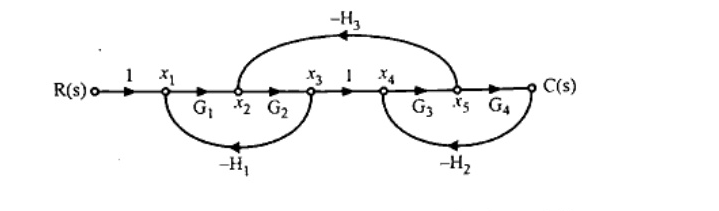
How to answer
- Identify forward paths and loops from signal flow graph
- Apply Mason's gain formula
- Compute determinants Delta and path determinants
- Simplify to get C(s)/R(s) transfer function
-
7 MarksaExplain DFS (Discrete Fourier Series) and its properties.
How to answer
- Definition of DFS for periodic sequences
- Analysis and synthesis equations
- Key properties: periodicity, linearity, shift, convolution
- Relation to DFT
-
7 MarksbCompute 8-point DFT of the sequence $x(n) = \{1, 1, 1, 1, 1, 0, 0\}$.
How to answer
- Use 8-point DFT formula X(k)=sum x(n)W^nk
- Compute twiddle factors for N=8
- Evaluate summation for k=0 to 7
- List 8 DFT coefficients
-
7 MarksaCompute the FFT for the sequence $x(n) = n + 1$ where $N = 8$ using the DIT algorithm.
How to answer
- Form sequence x(n)=1 to 8 for N=8
- Draw 3-stage DIT butterfly with bit-reversed input
- Compute stage-wise outputs using twiddle factors
- Obtain 8-point FFT values
-
7 MarksbExplain about decimation in frequency FFT algorithm.
How to answer
- Principle of decimation in frequency decomposition
- Derivation of even and odd frequency splits
- Butterfly structure and bit-reversal of output
- Comparison with DIT flow
-
7 MarksaExplain briefly about different structures in FIR systems.
How to answer
- Direct form FIR structure
- Cascade and linear-phase structures
- Lattice structure
- Diagrams for each realization
-
7 MarksbDiscuss the characterization of IIR filters and compare with FIR filters.
How to answer
- Characterization: poles, feedback, infinite impulse response
- Design from analog filters
- Comparison table: stability, phase, complexity, memory
- Applications of each
-
7 MarksaExplain the classification of discrete time signals and systems.
How to answer
- Classification of signals: energy/power, periodic, even/odd, etc.
- Classification of systems: linear, causal, stable, etc.
- Examples for each category
- Block representation
-
7 MarksbFind inverse z-transform of $$X(z) = \frac{z^{-4}}{z-1} + z^{-6} + \frac{z^{-3}}{z+0.5}$$
How to answer
- Split X(z) into three terms
- Use standard pairs: 1/(z-a) and delay property
- Apply inverse z-transform term-wise
- Write final x(n) with unit step functions
-
7 MarksaFind circular convolution for the following sequences $x_{1}(n) = \{1, 2, 3, 4\}$ and $x_{2}(n) = \{1, 2, 1, 2\}$.
How to answer
- Use circular convolution formula or matrix method
- Compute for N=4 point
- Perform modulo-4 index summation
- Obtain 4-point result sequence
-
7 MarksbCompute DFT of the sequence $x(n) = \{1, 2, 3, 4, 4, 3, 2, 1\}$ using the DIF FFT algorithm.
How to answer
- Arrange input in natural order for DIF
- Draw 3-stage DIF butterfly with twiddle factors
- Compute stage outputs
- Obtain bit-reversed DFT output
-
14 MarksWrite short notes on:
- i)DFT
- ii)Bilinear transformation method
- iii)Rectangular window
- iv)Block diagram
How to answer
- Define DFT with formula
- Explain bilinear transformation s to z mapping
- Describe rectangular window function and effects
- Explain general DSP block diagram
Go to where you left off?
Quick Add to Notes
Save questions, your own notes and screenshots into notes filed by unit. It takes a free account.
Create free accountHave an account? Log in
Notes Panel