EC-402 · Signals & Systems/Unsolved PYQ Paper
EC-402 Signal and System - Jun 2025 Question Paper
Under each question, How to answer lists the points an answer should cover, outlined by CampusPrep from the syllabus. Check the details against your textbook.
-
7 MarksaDistinguish between the following:
- i)Continuous time signal and discrete time signal.
- ii)Unit step and Unit Ramp functions.
- iii)Periodic and Aperiodic Signals.
- iv)Deterministic and Random Signals.
How to answer
- Define each pair with key criteria
- Give mathematical expression / example for each
- Tabulate differences in tabular form
- Mention continuous vs discrete domain and examples
-
7 MarksbDetermine whether the systems described by the equations are linear, time invariant, dynamic and stable:
- i)$y_1(t) = x(t-3) + (3-t)$
- ii)$y_1(t) = \frac{dx(t)}{dt}$
- iii)$y(n) = nx(n) + bx^2(n)$
How to answer
- Test linearity via superposition / homogeneity
- Test time-invariance via delayed input vs delayed output
- Check memory / dynamic vs static and causality
- Check BIBO stability via bounded input condition
-
7 MarksaDetermine whether the following signals are energy or power signals.
- i)$x(t) = tu(t)$
- ii)$x(t) = u(t)e^{-at}$
How to answer
- Recall energy $E=\int|x|^2$ and power $P=\lim$ definitions
- Evaluate integral for $x(t)=tu(t)$ for infinite energy
- Evaluate integral for $x(t)=u(t)e^{-at}$ with parameter a
- Classify as energy, power or neither
-
7 MarksbGive block diagram representation of linear time invariant discrete time systems and also state their properties.
How to answer
- Draw direct-form block diagram with delays, adders, multipliers
- Show convolution-sum representation $y(n)=\sum h(k)x(n-k)$
- List properties: linearity, time-invariance, causality, stability, LTI convolution
-
7 MarksaThe input and output of a causal LTI system are related by the differential equation: $$d^2y(t)/dt^2 + 6dy(t)/dt + 8y(t) = 2x(t)$$ Find the impulse response of the system
How to answer
- Take Laplace transform with zero initial conditions for causal system
- Find transfer function $H(s)=2/(s^2+6s+8)$
- Partial fraction expansion into first-order terms
- Inverse Laplace to get $h(t)$ multiplied by $u(t)$
-
7 MarksbFind the convolution of two signals $x(t) = u(t-1) - u(t+1)$ and $h(t) = e^{-at}u(t),\ a > 0.$
How to answer
- Write convolution integral $y(t)=\int x(\tau)h(t-\tau)d\tau$
- Express $x(t)$ window from given step difference
- Split integration limits based on $u(t)$ causality
- Evaluate exponential integral to get closed form
-
7 MarksaState and prove the time shifting, differentiation and integration properties of Z transform.
How to answer
- Define Z-transform $X(z)=\sum x(n)z^{-n}$
- Prove time-shifting: $x(n-k) \leftrightarrow z^{-k}X(z)$
- Prove differentiation / multiplication by n property
- Prove summation / integration property with ROC change
-
7 MarksbUsing properties of z-transform, find z-transform and ROC of signal. $$\frac{1}{(1-z^{-1})^2}$$
How to answer
- Recall standard pair $u(n) \leftrightarrow 1/(1-z^{-1})$
- Apply differentiation-in-z-domain / multiplication by n property
- Obtain transform of $n u(n)$ as $z^{-1}/(1-z^{-1})^2$
- State ROC $|z|>1$ for right-sided sequence
-
7 MarksaExplain the concept of ROC and discuss about different properties of ROC.
How to answer
- Define ROC as set of z where Z-sum converges
- Explain ROC does not contain poles
- Discuss ROC shapes for right, left, two-sided sequences
- Relate ROC to causality and stability
-
7 MarksbDiscuss about the DTFT and its properties.
How to answer
- Define DTFT $X(e^{j\omega})=\sum x(n)e^{-j\omega n}$
- State periodicity, linearity, time/frequency shifting
- Explain convolution and Parseval properties
- Give existence / convergence condition
-
7 MarksaFind the exponential Fourier series representation of the signal $x(t) = \cos^2 t$
How to answer
- Use identity $\cos^2 t = (1+\cos 2t)/2$
- Identify fundamental frequency $\omega_0=2$
- Compute exponential coefficients $C_k$ via Euler formula
- Write series $x(t)=\sum C_k e^{jk\omega_0 t}$
-
7 MarksbCompute the Fourier transform of the signal x(t) applying differentiation-in-time property of the Fourier transform.
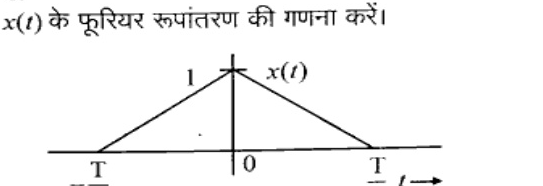
How to answer
- Sketch triangular $x(t)$ and find its second derivative as impulses
- Apply differentiation-in-time: $d^2x/dt^2 \leftrightarrow (j\omega)^2 X(\omega)$
- Find Fourier transform of impulse train
- Divide by $(j\omega)^2$ to obtain $X(\omega)$ as sinc-squared
-
7 MarksaDiscuss state variable representation and matrix representation of systems.
How to answer
- Define state vector, state equation $\dot X=AX+BU$
- Define output equation $Y=CX+DU$
- Explain matrix representation with A,B,C,D matrices
- Give example of obtaining state model from differential equation
-
7 MarksbThe spectral range of a signal extends from 5.6 MHz to 6.8 MHz. Find the minimum sampling rate and maximum sampling time.
How to answer
- Identify highest frequency $f_H=6.8$ MHz and bandwidth $B=1.2$ MHz
- Apply bandpass sampling criterion $f_s \ge 2f_H/k$
- Compute minimum sampling rate
- Compute maximum sampling interval $T_s=1/f_s$
-
14 MarksWrite a short note on any two:
- a)Sampling Theorem and its applications.
- b)Convergence of discrete time Fourier Transform
- c)Unilateral Z-Transform
- d)Basic operation on Signals for DT Signal
How to answer
- Select any two topics from a-d
- Give definition, statement / mathematical form
- Explain key conditions and diagram if needed
- Mention applications / significance
Go to where you left off?
Quick Add to Notes
Save questions, your own notes and screenshots into notes filed by unit. It takes a free account.
Create free accountHave an account? Log in
Notes Panel