CS-501 · Theory of Computation/Unsolved PYQ Paper
CS-501 Theory of Computation - Nov 2022 Question Paper
Under each question, How to answer lists the points an answer should cover, outlined by CampusPrep from the syllabus. Check the details against your textbook.
-
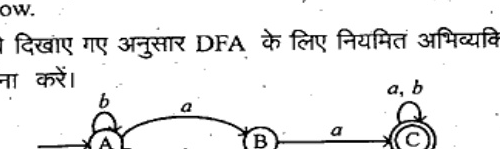
7 MarksaCompute the Regular Expression for the DFA as shown below.
How to answer
- Identify start state A, intermediate B, final C.
- Apply state elimination / Arden's theorem step by step.
- Obtain regular expression for strings reaching C.
- Simplify expression.
-
7 MarksbDesign DFA's for detecting 1001 Sequence without Overlap over the alphabet $\Sigma = \{0, 1\}$
How to answer
- Define states for prefixes of 1001 and non-overlapping reset.
- Define transition table for alphabet {0,1}.
- Draw DFA with trap/dead handling after detection.
- Explain non-overlapping behavior.
-
7 MarksaDesign a NFA that accepts the language over the alphabet, $\Sigma = \{0, 1, 2\}$ where the decimal equivalent of the language is divisible by 3.
How to answer
- Use remainders 0,1,2 modulo 3 as states.
- Define transition on digit d as new_remainder = (old*10 + d) mod 3.
- Mark remainder 0 state as accepting.
- Show NFA (DFA) diagram.
-
7 MarksbIdentify the language, L generated by the following grammar, G: $G = (\{S, A, B\}, \{a, b\}, \{S \to Aa, A \to a|B, B \to bB|b\}, S)$.
How to answer
- Expand productions S -> Aa, A -> a|B, B -> bB|b.
- Derive general sentential forms.
- Identify pattern b^n a a or similar.
- State language L in set notation.
-
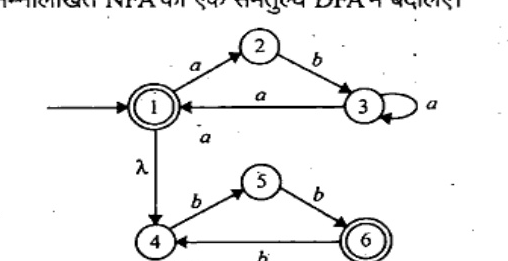
7 MarksaConvert the following NFA to an equivalent DFA.
How to answer
- Compute lambda-closure of start state 1 including state 4.
- Apply subset construction for inputs a and b.
- Construct transition table for reachable subsets.
- Draw equivalent DFA and mark accepting subsets containing 6.
-
7 MarksbFind a regular grammar that generates the language on {a,b} consisting of all strings with exactly one a's and no more than two b's.
How to answer
- Enumerate allowed strings: exactly one a and 0-2 b's.
- Define nonterminals for count of b's before/after a.
- Write regular (right-linear) productions.
- Verify generation.
-
7 MarksaConstruct context free grammars to accept the language $L = \{a^{n+2} b^{m+1} \mid n = m\}$ over the alphabet, $\Sigma = \{a, b\}$
How to answer
- Rewrite condition n=m as L = {a^{n+2} b^{n+1} | n>=0}.
- Introduce variable generating matched a^n b^n core.
- Add extra fixed a's and b.
- Give productions e.g. S -> aAb with base.
-
7 MarksbConstruct Non-Deterministic Pushdown Automata (NPDA) to accept the language $L = \{0^{n+1}1^{2n} \mid n >= m\}$ over the alphabet, $\Sigma = \{0, 1\}$
How to answer
- Define stack alphabet and push 0's.
- On reading 1's pop or count double.
- Use nondeterminism for n>=m condition as printed.
- Define accept by empty stack / final state.
-
7 MarksaConstruct Turing Machine (TM) to accept the language $L = \{0^{n} 1^{n} 2^{n} \mid n >= 0\}$ over the alphabet, $\Sigma = \{0, 1, 2\}$
How to answer
- Describe tape alphabet and marking strategy for 0,1,2.
- Give state transitions to match one of each symbol.
- Handle n=0 (empty) acceptance.
- Show acceptance by halting in final state.
-
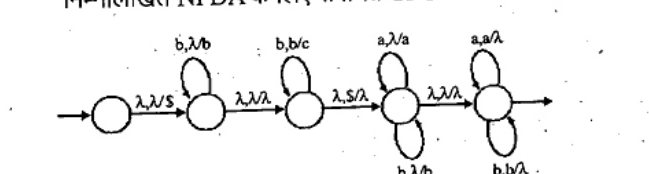
7 MarksbConstruct corresponding CFG for the following NPDA.
How to answer
- List NPDA states and stack operations from diagram.
- Apply standard NPDA-to-CFG triplet construction.
- Generate productions for push/pop pairs.
- Simplify to equivalent CFG.
-
7 MarksaGive a Deterministic PDA that accepts $\{a^{m} b^{n} c^{n} \mid m,n \geq 0\}$ over the alphabet, $\Sigma = \{a, b, c\}$.
How to answer
- Push a's then match b's with c's or skip.
- Use stack to count n for b^n c^n.
- Allow arbitrary m a's without stack change.
- Define deterministic transitions and acceptance.
-
7 MarksbGive an NPDA that simulates the following grammar (S is start symbol): $S \to aBB \mid cDD$ $B \to cD \mid aS$ $D \to dD \mid d$
How to answer
- Use standard CFG-to-NPDA construction with single state.
- Push start symbol S then expand productions.
- Match terminals against input.
- Show simulation for given S,B,D productions.
-
7 MarksaShow that the following language on $\Sigma = \{a, b, c\}$ is not context-free. $L = \{a^{i} b^{2i} a^{i} \mid i \geq 0\}$
How to answer
- Assume L context-free and apply pumping lemma.
- Choose suitable string a^p b^{2p} a^p.
- Show pumped decomposition violates form.
- Conclude L not context-free.
-
7 MarksbProve that a language $L$ is recursive if and only if $L$ and $\overline{L}$ are recursively enumerable.
How to answer
- Define recursive and recursively enumerable.
- Prove forward: recursive implies both L and complement r.e.
- Prove reverse: dovetail enumerators for L and complement.
- Conclude equivalence.
-
7 MarksaProve that there is no algorithm that determines whether an arbitrary Turing Machine halts when run with the input string 101.
How to answer
- Assume decider for halting on 101 exists.
- Reduce general halting problem to this fixed-input case.
- Derive contradiction via diagonalization / universality.
- Conclude undecidability.
-
7 MarksbProve that the problem of determining whether for a Turing machine M the language L(M) is regular is undecidable.
How to answer
- State Rice's theorem / reduction from halting.
- Construct TM whose language is regular iff original halts.
- Show decidability would solve halting.
- Conclude regularity problem undecidable.
Go to where you left off?
Quick Add to Notes
Save questions, your own notes and screenshots into notes filed by unit. It takes a free account.
Create free accountHave an account? Log in
Notes Panel