CS-501 · Theory of Computation/Unsolved PYQ Paper
CS-501 Theory of Computation - Dec 2024 Question Paper
Under each question, How to answer lists the points an answer should cover, outlined by CampusPrep from the syllabus. Check the details against your textbook.
-
8 MarksaWhat is a DFA machine? Design a deterministic finite automata machine over the alphabet set $\{0, 1\}$, accepting all strings starting and ending with different alphabet.
How to answer
- Define DFA as 5-tuple with transition function
- Design logic for start and end symbols different
- Draw transition diagram and transition table
- Argue correctness of acceptance
-
6 MarksbDefine finite-automata machine mathematically and explain its types.
How to answer
- Give 5-tuple mathematical definition Q, Sigma, delta, q0, F
- Explain each component
- Explain types: DFA, NFA, epsilon-NFA, Moore, Mealy
-
6 MarksaConsider the following grammar for list structures: $S \to a / \wedge / (T)$ $T \to T,S / S$ Find left most derivation, right most derivation and parse tree for the string $(((a,a),\wedge(a)),a)$.
How to answer
- Apply productions S -> a/^/(T) and T -> T,S/S
- Show leftmost derivation steps for (((a,a),^(a)),a)
- Show rightmost derivation steps
- Draw parse tree
-
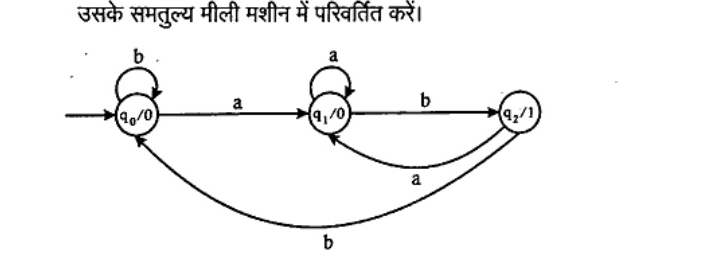
8 MarksbWrite the differences between Mealy and Moore machine. Convert the given Moore machine into its equivalent Mealy machine.
How to answer
- List differences: output timing, states vs transitions, etc.
- Note Moore output per state q0/0,q1/0,q2/1
- Construct Mealy transitions with output on edges
- Draw equivalent Mealy machine
-
8 MarksaDiscuss about the Chomsky hierarchy of languages with their grammar constraints rules and corresponding automata for each class.
How to answer
- State 4 Chomsky types 0-3
- Give grammar constraints for each
- Give corresponding automata: TM, LBA, PDA, FA
- Give example languages
-
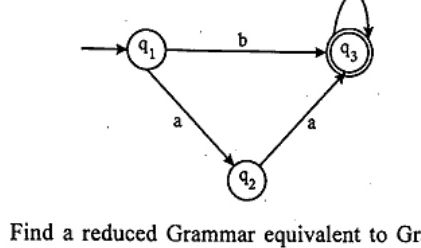
6 MarksbDefine the regular expression. Find the regular expression for the given DFA machine.
How to answer
- Define regular expression
- Apply state elimination / Arden's theorem to given DFA
- Derive expression for paths to final q3
- Simplify final regular expression
-
8 MarksaFind a reduced Grammar equivalent to Grammar $G$, having Production rules $P$. $P: \{ S \to AC / B, A \to a, C \to c / BC, E \to aA / e \}$
How to answer
- Eliminate non-generating and non-reachable symbols
- Remove epsilon/null productions for E -> e
- Remove unit production S -> B
- Give final reduced productions
-
6 MarksbConstruct the PDA accepting the language $\{(ab)^n : n \ge 1\}$ by empty stack.
How to answer
- Define PDA tuple and empty-stack acceptance
- Push (ab)^n pattern logic using stack
- Give transition functions for push/pop
- Show acceptance by empty stack
-
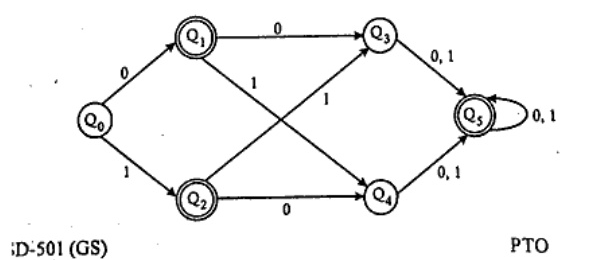
8 MarksaMinimize the DFA using Myhill-Nerode Theorem.
How to answer
- Apply Myhill-Nerode distinguishability / partition method
- Iteratively split states Q0-Q5
- Merge equivalent states
- Draw minimized DFA
-
6 MarksbConvert the grammar $S \to AB, A \to BS / b, B \to SA / a$ into Greibach normal form.
How to answer
- Remove unit/epsilon productions if any
- Order variables S,A,B
- Substitute to get terminal-starting form
- Introduce new variables to get A -> a alpha form
-
6 MarksaExplain the different models of the Turing machines.
How to answer
- Define Turing machine model
- Describe single-tape, multi-tape, NDTM, universal variants
- Compare power and equivalence
- Give schematic diagrams
-
8 MarksbShow that $L = \{a^n b^n c^n / n \ge 1\}$ is not a context-free language.
How to answer
- State pumping lemma for CFL
- Assume L = {a^n b^n c^n} is CFL
- Choose pumping string and decomposition uvwxy
- Derive contradiction, hence not CFL
-
7 MarksaExplain the difference between tractable and intractable problems with examples.
How to answer
- Define tractable (P, polynomial) vs intractable (exponential/NP-hard)
- Give examples: sorting vs TSP
- Discuss decidability/complexity relevance
- Conclude with table
-
7 MarksbIs NPDA (non-deterministic PDA) and DPDA (deterministic PDA) equivalent or not? Illustrate with an example.
How to answer
- Define NPDA and DPDA acceptance power
- State non-equivalence for CFL vs DCFL
- Give example e.g. palindromes or {a^n b^n} vs {ww^R}
- Conclude NPDA strictly more powerful
-
4 MarksaExplain P and NP problems with examples.
How to answer
- Define P: polynomial-time solvable
- Define NP: nondeterministic polynomial verifiable
- Give examples for each
- Mention P vs NP question
-
10 MarksbWrite a short notes on the following:
- i)Universal Turing machine
- ii)Post Correspondence Problem
How to answer
- Define Universal Turing Machine simulation
- Explain encoding and halting aspect
- Define PCP statement and undecidability
- Give example instance of PCP
Go to where you left off?
Quick Add to Notes
Save questions, your own notes and screenshots into notes filed by unit. It takes a free account.
Create free accountHave an account? Log in
Notes Panel