UNIT 6: Posets, Hasse Diagrams and Lattices
1. Ordered Sets and Hasse Diagrams
Definition of Partial Order
[!IMPORTANT]
A partial order on a set $P$ is a binary relation "$\preceq$" that is reflexive, antisymmetric, and transitive. The set $P$ together with "$\preceq$" forms a "partially ordered set" or "poset": $(P, \preceq)$.
Properties:
-
Reflexivity: For all $a \in P$, $a \preceq a$.
-
Antisymmetry: For all $a, b \in P$, if $a \preceq b$ and $b \preceq a$, then $a = b$.
-
Transitivity: For all $a, b, c \in P$, if $a \preceq b$ and $b \preceq c$, then $a \preceq c$.
[!TIP]
To show something is a poset, check all three properties above with proper cases.
Examples of Posets
-
$(\mathbb{N}, \leq)$: "less than or equal to" on natural numbers.
-
$(\mathcal{P}(S), \subseteq)$: Power set of $S$ with subset relation.
-
$(\mathbb{Z}, |)$: Set of integers with "divides" ($a|b$) relation.
Poset Notation and Terminology
-
$(P, \preceq)$: Denotes a poset.
-
Chain: A subset of $P$ where every two elements are comparable (i.e., $\forall a, b$, $a \preceq b$ or $b \preceq a$).
-
Antichain: A subset where no two different elements are comparable.
-
Maximal Element: $m \in P$, if there is no $x \in P$ such that $m \prec x$.
-
Minimal Element: $n \in P$, if there is no $x \in P$ such that $x \prec n$.
-
Greatest Element: $g \in P$, with $a \preceq g$ for all $a \in P$.
-
Least Element: $l \in P$, with $l \preceq a$ for all $a \in P$.
Hasse Diagrams
Definition and Purpose
[!IMPORTANT]
A Hasse diagram is a graphical representation of a finite poset, where elements are drawn as vertices, and edges denote the partial order, omitting reflexive and implied (by transitivity) edges.
- Useful to visualize the structure and relationships within a poset.
Steps to Construct a Hasse Diagram
-
Write all elements as points (vertices).
-
Draw an edge upward from $a$ to $b$ if $a \prec b$ and no $c$ with $a \prec c \prec b$ (i.e., $b$ covers $a$).
-
Place smaller (with respect to order) elements lower and larger elements higher.
-
Do not draw edges for reflexivity or transitivity.
[!TIP]
Omit drawing loops (reflexive edges) and direct edges where there is a chain (due to transitivity).
Example: Drawing Hasse Diagram for a Simple Poset
Let $A = \{1, 2, 4\}$ with the relation "$a | b$" ("divides").
-
Step 1: List ordered pairs where $a | b$.
- $1|1$, $1|2$, $1|4$, $2|2$, $2|4$, $4|4$
-
Step 2: Remove reflexive pairs and use only "covering pairs":
- $1$ is covered by $2$ ($1|2$), $2$ is covered by $4$ ($2|4$)
-
Hasse Diagram:
-
$1$ at the bottom.
-
Connect $1 \rightarrow 2$ (edge up).
-
Connect $2 \rightarrow 4$ (edge up).
-
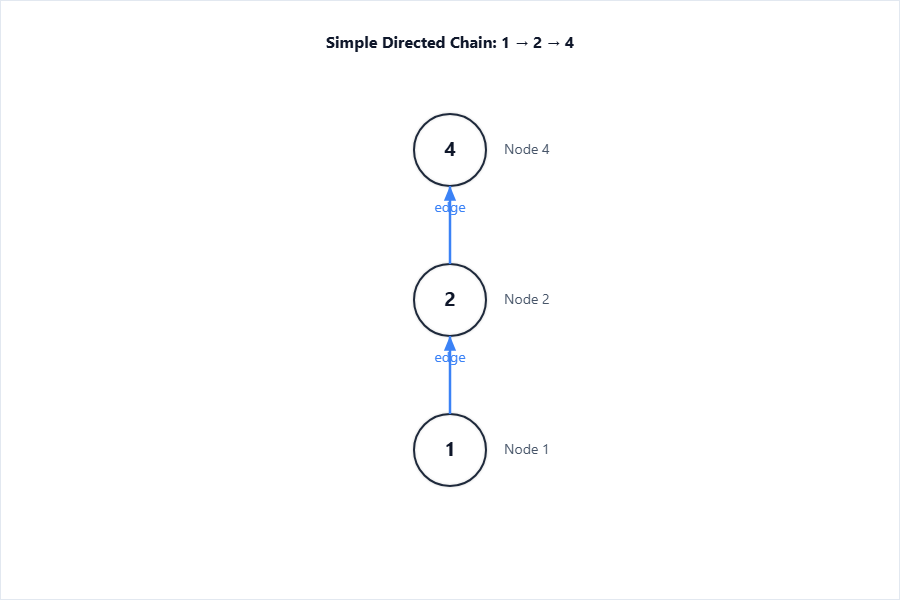
Above diagram shows the Hasse diagram for $(\{1,2,4\}, |)$.
Numerical Example:
Draw the Hasse diagram for $(S, \subseteq)$, where $S = \{\emptyset, \{a\}, \{b\}, \{a, b\}\}$.
-
Pairs: $\emptyset \subseteq \{a\}, \emptyset \subseteq \{b\}, \{a\} \subseteq \{a, b\}, \{b\} \subseteq \{a, b\}$, etc.
-
Levels:
-
Bottom: $\emptyset$
-
Middle: $\{a\}$ and $\{b\}$
-
Top: $\{a, b\}$
-
-
Edges: (from bottom up)
-
$\emptyset \rightarrow \{a\}$
-
$\emptyset \rightarrow \{b\}$
-
$\{a\} \rightarrow \{a, b\}$
-
$\{b\} \rightarrow \{a, b\}$
-
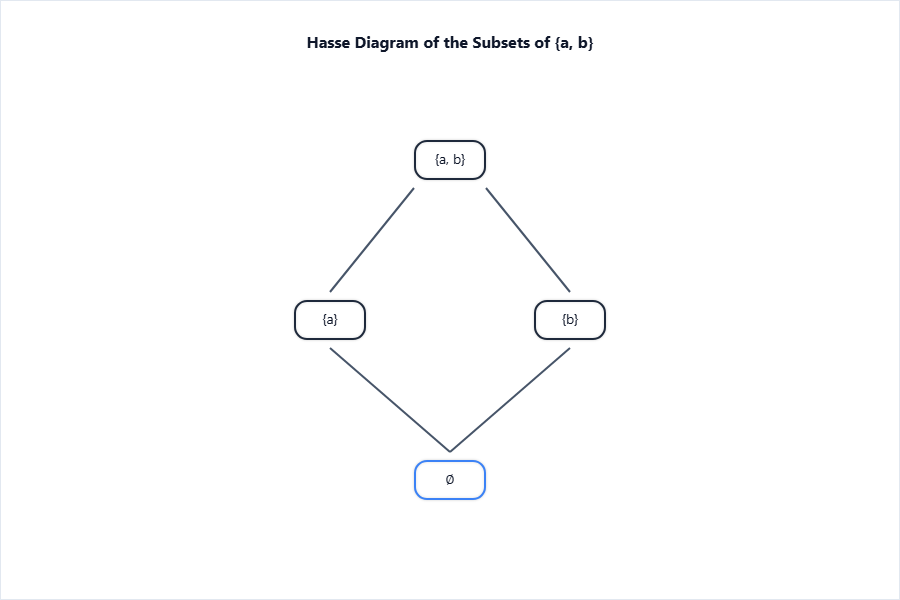
This Hasse diagram illustrates all subset relations in $S$ without redundant edges.
2. Isomorphic and Well-Ordered Sets
Isomorphic Ordered Sets
Definition of Order Isomorphism
[!IMPORTANT]
Two posets $(A, \leq_A)$ and $(B, \leq_B)$ are "order isomorphic" if there exists a bijection $f: A \to B$, such that for all $x, y \in A$,
$$ x \leq_A y \iff f(x) \leq_B f(y) $$
- Such $f$ preserves the ordering structure.
Criteria for Isomorphism
-
$f$ must be bijective (one-to-one and onto).
-
$f$ must preserve the order: $x \leq y \implies f(x) \leq f(y)$.
-
$f^{-1}$ (its inverse) must also preserve order.
[!TIP]
Isomorphism means "same structure as a poset," not just same elements.
Numerical Example
Are $(\{1, 2, 3\}, \leq)$ and $(\{a, b, c\}, \leq_{lex})$ with $a < b < c$ isomorphic?
-
Possible bijection: $1 \to a$, $2 \to b$, $3 \to c$.
-
$1 < 2$ maps to $a < b$, $2 < 3$ maps to $b < c$.
-
All comparisons preserved.
Conclusion: The two ordered sets are isomorphic under this mapping.
Well-Ordered Sets
Definition
[!IMPORTANT]
A totally ordered set $(A, \leq)$ is "well-ordered" if every non-empty subset of $A$ has a least element.
Examples
-
$(\mathbb{N}, \leq)$ is well-ordered.
-
Every finite totally ordered set is well-ordered.
-
$(\mathbb{Z}, \leq)$ is not well-ordered.
Properties of Well-Ordered Sets
-
Every chain in a well-ordered set is finite or countably infinite.
-
There are no infinite strictly descending sequences.
-
Every subset has a unique minimal (least) element.
[!TIP]
Beware: "Totally ordered" does not always mean "well-ordered"!
3. Properties of Lattices, Bounded and Complemented Lattices
Lattices
Definition of Lattice
[!IMPORTANT]
A poset $(L, \leq)$ is a lattice if every pair of elements $a, b \in L$ has both a least upper bound (join, $a \vee b$) and a greatest lower bound (meet, $a \wedge b$) in $L$.
Meet and Join Operations
-
Meet ($a \wedge b$): Greatest element $\leq a$ and $\leq b$.
-
Join ($a \vee b$): Least element $\geq a$ and $\geq b$.
Formally:
$$ a~\wedge~b = \textrm{Greatest lower bound (GLB)~of~} \{a, b\} $$
$$ a~\vee~b = \textrm{Least upper bound (LUB)~of~} \{a, b\} $$
Lattice as Algebraic Structure
-
$(L, \wedge, \vee)$ forms an algebraic structure called a "lattice."
-
The operations satisfy:
-
Commutativity: $a \wedge b = b \wedge a$, $a \vee b = b \vee a$
-
Associativity: $a \wedge (b \wedge c) = (a \wedge b) \wedge c$, etc.
-
Absorption: $a \wedge (a \vee b) = a$, $a \vee (a \wedge b) = a$
-
Idempotency: $a \wedge a = a$, $a \vee a = a$
-
Examples: Smallest Lattice Structures
-
Divisors of $6$: $L = \{1, 2, 3, 6\}$, "$|$" operation.
-
Meets (GLB): $\gcd$
-
Joins (LUB): $\mathrm{lcm}$
-
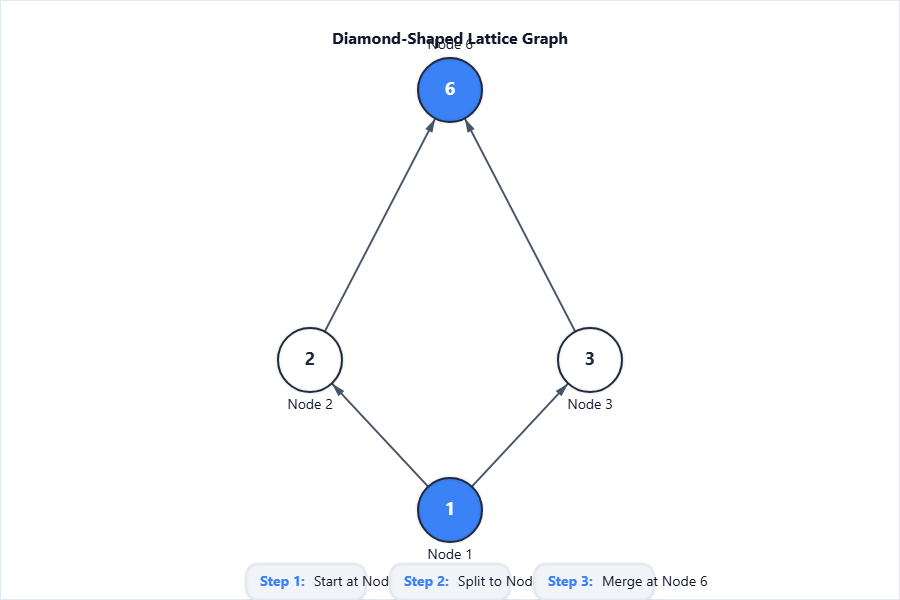
-
Numerical Example: Meet and Join in Set Lattice
Let $S = \{\emptyset, \{a\}, \{b\}, \{a, b\}\}$.
For $A = \{a\}$, $B = \{b\}$:
-
$A \wedge B = \{a\} \cap \{b\} = \emptyset$
-
$A \vee B = \{a\} \cup \{b\} = \{a, b\}$
-
Properties of Lattices
Derivations and Proofs
- Commutativity:
$$ a \wedge b = b \wedge a $$
$$ a \vee b = b \vee a $$
Both GLB and LUB are symmetric in $a$ and $b$.
- Associativity:
$$ (a \wedge b) \wedge c = a \wedge (b \wedge c) $$
$$ (a \vee b) \vee c = a \vee (b \vee c) $$
Proof:
-
GLB of $\{a, b, c\}$ is the same, regardless of grouping.
-
Absorption:
$$ a \wedge (a \vee b) = a $$
Consider: $a \leq a \vee b$ (by definition), so GLB of $a$ and $a \vee b$ is $a$, i.e. $a \wedge (a \vee b) = a$.
- Idempotency:
$$ a \wedge a = a $$
$$ a \vee a = a $$
GLB and LUB of the same element is itself.
Table: Properties of Lattice Operations
| Property | Meet $(\wedge)$ | Join $(\vee)$ |
|---|---|---|
| Commutativity | $a\wedge b = b\wedge a$ | $a\vee b = b\vee a$ |
| Associativity | $(a\wedge b)\wedge c$ = $a\wedge (b\wedge c)$ | $(a\vee b)\vee c = a\vee (b\vee c)$ |
| Idempotency | $a\wedge a = a$ | $a\vee a = a$ |
| Absorption | $a\wedge(a\vee b)=a$ | $a\vee(a\wedge b)=a$ |
Importance/Applications
-
Lattices form abstract models for order.
-
Used in logic (Boolean Algebra), algebra (ideals), computer science (data flow analysis), and set theory.
Bounded Lattices
Definition
[!IMPORTANT]
A lattice $(L, \leq)$ is bounded if it has both a least element (0 or $\hat{0}$) and a greatest element (1 or $\hat{1}$); i.e., for all $a \in L,\, \hat{0} \leq a \leq \hat{1}$.
Examples of Bounded Lattices
-
The lattice of subsets $\mathcal{P}(S)$ is bounded: least element $\emptyset$, greatest element $S$.
-
The divisor lattice of $6$: $1$ is least, $6$ is greatest.
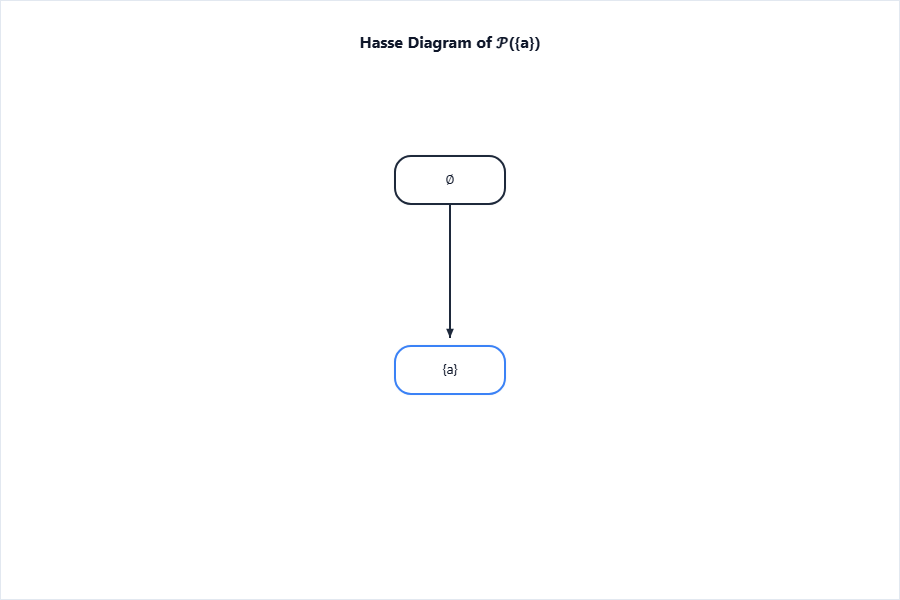
Numerical Example
Let $L = \{0, 1\}$ with $0 \leq 1$.
-
Least: $0$, Greatest: $1$
-
$0 \wedge 1 = 0$, $0 \vee 1 = 1$
So $(\{0,1\}, \leq)$ is a bounded lattice.
Complemented Lattices
Definition
[!IMPORTANT]
A bounded lattice $(L, \leq, \hat{0}, \hat{1})$ is complemented if, for every $a \in L$, there exists $b \in L$ such that:
$$ > a \wedge b = \hat{0} \quad \textrm{and} \quad a \vee b = \hat{1} > $$
$b$ is called a complement of $a$.
Uniqueness of Complements
-
In general lattices, complements may not be unique.
-
Boolean lattices: Complements are unique.
[!TIP]
State if the lattice is distributive and bounded to ensure unique complements.
Example: Boolean Lattice as Complemented Lattice
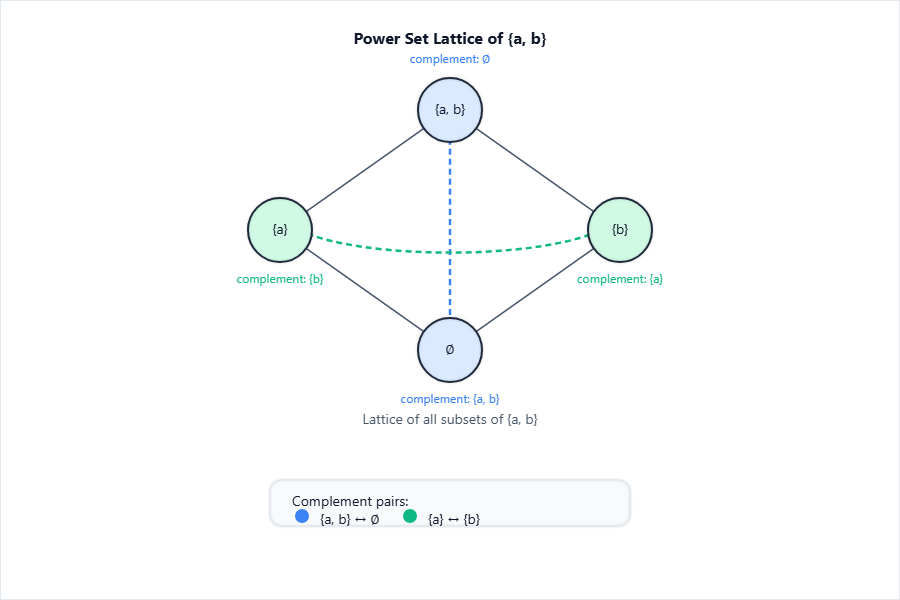
-
Consider $\mathcal{P}(\{a, b\})$, the lattice of $\{\emptyset, \{a\}, \{b\}, \{a, b\}\}$:
-
Complement of $\{a\}$ is $\{b\}$ (union = whole set, intersection = $\emptyset$).
-
Likewise for $\{b\}$.
-
Numerical Example
Let $L = (\mathcal{P}(\{a\}), \subseteq)$: $\{\emptyset, \{a\}\}$.
-
$\emptyset$'s complement is $\{a\}$
-
$\emptyset \vee \{a\} = \{a\}$ (greatest)
-
$\emptyset \wedge \{a\} = \emptyset$ (least)
-
-
$\{a\}$'s complement is $\emptyset$
Both elements have complements; thus, $L$ is a complemented (and Boolean) lattice.
End of UNIT 6 Notes
[!TIP]
For full marks: Write definitions exactly, always draw clean Hasse diagrams, emphasize algebraic proofs for lattice properties, and clearly contrast bounded/complemented/Boolean cases in tables or examples.