CS-302 · Discrete Structure/Unsolved PYQ Paper
CS-302 Discrete Structure - Jun 2023 Question Paper
Under each question, How to answer lists the points an answer should cover, outlined by CampusPrep from the syllabus. Check the details against your textbook.
-
7 MarksaProve that $P(A) \subseteq P(B)$ if and only if $A \subseteq B$.
How to answer
- Assume $A \subseteq B$ and show $X \in P(A) \implies X \in P(B)$
- Assume $P(A) \subseteq P(B)$ and let $x \in A$, then $\{x\} \in P(A)$
- Since $P(A) \subseteq P(B)$, $\{x\} \in P(B)$, hence $x \in B$
- Conclude that both directions hold, establishing the equivalence
-
7 MarksbSuppose that $R$ is the relation on the set of strings of English letters such that $aRb$ if and only if $l(a) = l(b)$, where $l(x)$ is the length of the string $x$. Is $R$ an equivalence relation?
How to answer
- State conditions for an equivalence relation: reflexive, symmetric, transitive
- Check reflexivity: $l(a) = l(a) \implies aRa$
- Check symmetry: $l(a) = l(b) \implies l(b) = l(a) \implies bRa$
- Check transitivity: $l(a) = l(b)$ and $l(b) = l(c) \implies l(a) = l(c) \implies aRc$
- Conclude that $R$ is an equivalence relation
-
7 MarksaIllustrate the concept of an inverse function. Let $f : Z \to Z$ be such that $f(x) = x + 1$. Is $f$ invertible? if it is then what is its inverse?
How to answer
- Define inverse function and condition for invertibility (bijective)
- Prove $f(x) = x + 1$ is injective (one-to-one): $x_1 + 1 = x_2 + 1 \implies x_1 = x_2$
- Prove $f(x)$ is surjective (onto): for any $y \in Z$, $x = y - 1 \in Z$ such that $f(x) = y$
- Conclude $f$ is bijective, hence invertible
- State $f^{-1}(y) = y - 1$
-
7 MarksbDefine group. Explain the properties of groups.
How to answer
- Definition of an algebraic structure $(G, *)$
- Property 1: Closure property
- Property 2: Associative property
- Property 3: Existence of identity element
- Property 4: Existence of inverse element
- Mention abelian group (commutative property) as an extension
-
14 MarksLet $S = N \times N$. Let $*$ be the operation on $S$ defined by $(a, b) * (a', b') = (aa', bb')$. i) Define $f : (S, *) \to (Q, \times)$ by $f(a, b) = a/b$. Show that $f$ is a homomorphism. ii) Find the congruence relation $\sim$ in $S$ determined by the homomorphism $f$, that is, where $x \sim y$ if $f(x) = f(y)$.
How to answer
- Part i: Compute $f((a, b) * (a', b')) = f(aa', bb') = (aa')/(bb')$.
- Compute $f(a, b) \times f(a', b') = (a/b) \times (a'/b') = (aa')/(bb')$. Since they are equal, $f$ is a homomorphism.
- Part ii: Let $x = (a, b)$ and $y = (c, d)$. Then $x \sim y \iff f(a, b) = f(c, d) \iff a/b = c/d \iff ad = bc$.
- State the congruence relation as $(a, b) \sim (c, d) \iff ad = bc$ on $N \times N$.
-
7 MarksaShow that the $((p \lor q) \land \neg p) \to q$ compound proposition is a tautology.
How to answer
- Construct truth table for variables $p$ and $q$ (4 rows)
- Evaluate columns: $p \lor q$, $\neg p$, $(p \lor q) \land \neg p$
- Evaluate conditional $((p \lor q) \land \neg p) \to q$
- Observe all entries in the final column are True ($T$)
- Alternatively, prove using logical equivalences: $((p \lor q) \land \neg p) \equiv (p \land \neg p) \lor (q \land \neg p) \equiv F \lor (q \land \neg p) \equiv q \land \neg p$, then $(q \land \neg p) \to q \equiv \neg(q \land \neg p) \lor q \equiv (\neg q \lor p) \lor q \equiv T$
-
7 MarksbUse existential and universal quantifiers to express the statement. "No one has more than three grandmothers" using the propositional function $G(x, y)$, which represents "$x$ is the grandmother of $y$."
How to answer
- Identify the variables: let $y$ be any person and $x_1, x_2, x_3, x_4$ be potential grandmothers
- Formulate condition for 4 distinct grandmothers
- Negate the existence of four distinct grandmothers for any individual $y$
- Write full logical expression using $\forall$ and $\exists$
-
7 MarksaDiscuss the 6 tuple notation of finite state machine $M$ with an example.
How to answer
- Define 6-tuple $M = (Q, \Sigma, \Delta, \delta, \lambda, q_0)$
- Explain each component: states $Q$, input alphabet $\Sigma$, output alphabet $\Delta$, transition function $\delta$, output function $\lambda$, initial state $q_0$
- Provide a concrete example of Mealy or Moore machine with state diagram and transition table
-
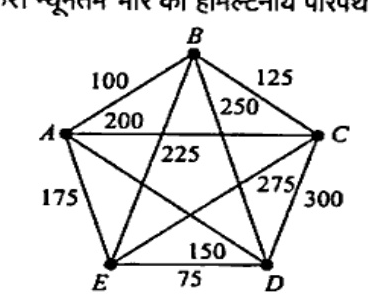
7 MarksbConsider the complete weighted graph $G$ in the following figure with 5 vertices. Find a Hamiltonian circuit of minimal weight.
How to answer
- List all possible Hamiltonian circuits (or use TSP algorithms / branch & bound / brute force for 5 vertices)
- Calculate weights of different candidate cycles
- Determine the circuit with the minimum sum of edge weights
- State the optimal vertex sequence and its total weight
-
7 MarksaDiscuss the various applications of graph colouring.
How to answer
- Briefly define vertex colouring and chromatic number
- Application 1: Timetabling and scheduling problems
- Application 2: Register allocation in compiler optimization
- Application 3: Map colouring (Four Colour Theorem)
- Application 4: Frequency assignment in mobile/radio networks
-
7 MarksbState Euler's formula for a planar graph. Give an example of a planar graph with 5 vertices and 5 regions and verify Euler's formula for your example.
How to answer
- State Euler's formula: $v - e + r = 2$ for a connected planar graph
- Given $v = 5$ and $r = 5$, find required edges: $e = v + r - 2 = 5 + 5 - 2 = 8$
- Draw an example planar graph with $v = 5$ vertices, $e = 8$ edges, and $r = 5$ regions (including outer region)
- Verify $v - e + r = 5 - 8 + 5 = 2$
-
7 MarksaConsider the set $A = \{4, 5, 6, 7\}$. Let $R$ be the relation $\le$ on $A$. Draw the directed graph and the Hasse diagram of $R$.
How to answer
- List pairs of $R$: $(4,4), (4,5), (4,6), (4,7), (5,5), (5,6), (5,7), (6,6), (6,7), (7,7)$
- Draw directed graph: 4 nodes with self-loops and directed edges for all ordered pairs
- Draw Hasse diagram: vertical chain with edges $4 - 5 - 6 - 7$ (omitting self loops and transitive edges)
-
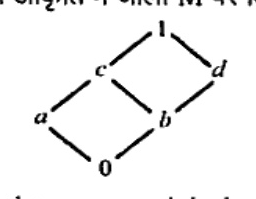
7 MarksbConsider the lattice $M$ in the following figure. i) Find the non-zero join irreducible elements and atoms of $M$. ii) Is $M$ distributive and complemented?
How to answer
- Part i: Identify elements in the lattice: 0 at bottom, atoms/coverings of 0 are $a$ and $b$.
- Determine non-zero join-irreducible elements (elements that cannot be written as $x \lor y$ with $x, y < z$).
- Part ii: Test distributive law on sublattices (check for pentagon $N_5$ or diamond $M_3$ sublattices).
- Check whether each element has a complement (an element $x'$ such that $x \land x' = 0$ and $x \lor x' = 1$).
-
14 MarksDiscuss in brief any two of the following: i) Partial ordering relation ii) Cosets iii) Disjunctive normal form iv) Pigeonhole principle
How to answer
- For (i): Define reflexive, antisymmetric, transitive relation with an example (e.g., subset relation).
- For (ii): Define left and right cosets $aH$ and $Ha$ in a group $G$ with subgroup $H$ and properties.
- For (iii): Define DNF as a sum of minterms / disjunction of conjunctions with an example.
- For (iv): State standard and generalized pigeonhole principles with an illustrative application.
Go to where you left off?
Quick Add to Notes
Save questions, your own notes and screenshots into notes filed by unit. It takes a free account.
Create free accountHave an account? Log in
Notes Panel