CS-302 · Discrete Structure/Unsolved PYQ Paper
CS-302 Discrete Structure - Dec 2023 Question Paper
Under each question, How to answer lists the points an answer should cover, outlined by CampusPrep from the syllabus. Check the details against your textbook.
-
7 MarksaOut of 120 students surveyed, it was found that 20 students have studied French, 50 students have studied English, 70 students have studied Hindi, 5 have studied English and French, 20 have studied English and Hindi, 10 have studied Hindi and French, only 3 students have studied all the three languages. Find how many students have studied:
- i)Hindi alone
- ii)French alone
- iii)English, but not Hindi
- iv)Hindi, but not French
How to answer
- Define sets E, H, F and use inclusion-exclusion for surveyed counts
- Compute only-Hindi = |H| - |EfH| - |HfF| + |all three|
- Compute only-French and English-but-not-Hindi, Hindi-but-not-French similarly
- Substitute numbers: 20 French, 50 English, 70 Hindi, 5,20,10 pairwise, 3 all three
-
7 MarksbIf R be a relation in the set of integers Z defined by $R = \{(x, y) : x \in Z, y \in Z, (x-y) \text{ is multiple of } 3\}$. Show that it is an equivalence relation.
How to answer
- Define R as congruence modulo 3 on Z
- Show reflexive: (x-x)=0 divisible by 3
- Show symmetric: if 3|(x-y) then 3|(y-x)
- Show transitive: if 3|(x-y) and 3|(y-z) then 3|(x-z)
-
7 MarksaIf $f : R \rightarrow R$ $f(x) = \begin{cases} 3x-12, & x > 3 \\ 2x^{2}+3, & -2 < x \le 3 \\ 3x^{2}-7, & x \le -2 \end{cases}$ find $f^{-1}(3), f^{-1}(0), f^{-1}(-2).$
How to answer
- Consider piecewise definition on x>3, -2<xa43, xa4-2
- Solve f(x)=3,0,-2 in each branch and retain admissible x
- Collect pre-images for each value
- State $f^{-1}$ sets
-
7 MarksbShow that $1^{2} + 2^{2} + 3^{2} + ... + n^{2} = \dfrac{n(n+1)(2n+1)}{6}, n \ge 1$ by mathematical induction
How to answer
- Verify base case n=1
- Assume true for n=k (induction hypothesis)
- Add $(k+1)^2$ and simplify to formula for k+1
- Conclude by mathematical induction
-
7 MarksaProve that $F = \{a + b\sqrt{2}; a, b \text{ rational}\}$ is a field.
How to answer
- Show closure under addition and multiplication
- Verify field axioms: associativity, identity, inverses
- Show existence of multiplicative inverse using rationalization with $\sqrt{2}$
- Conclude $F$ is subfield of reals
-
7 MarksbDefine the following
- i)Symmetric Group
- ii)Normal Subgroup
- iii)Homomorphism
How to answer
- Define symmetric group as permutations under composition
- Define normal subgroup via $gHg^{-1}=H$
- Define homomorphism preserving operation
-
7 MarksaConstruct the truth table of the following formula:
- i)$\sim (p \vee (q \vee r)) \Leftrightarrow ((p \vee q) \wedge (p \vee r))$
- ii)$(\sim q \Rightarrow \sim p) \Rightarrow (p \Rightarrow q)$
How to answer
- List all 8 assignments for p,q,r
- Evaluate inner disjunctions/conjunctions and implications
- Compare LHS and RHS for equivalence / check tautology
- Present complete truth table
-
7 MarksbWrite the negation of the following.
- i)If the determinant of a system of linear equations is zero then either the system has no solution or has an indefinite no. of solutions.
- ii)Either today is not a Sunday or today is not a Wednesday.
How to answer
- Translate 'if-then' and 'either-or' into propositional form
- Apply De Morgan and implication negation rules
- Write negated statement with quantifiers/connectives reversed
- Give final negation in English
-
7 MarksaShow that the proposition $\neg(p \wedge q)$ and $\neg p \vee q$ are logically equivalent.
How to answer
- Recall $\neg(p\wedge q) \equiv \neg p \vee \neg q$ is De Morgan form
- Construct 4-row truth table for p,q
- Show columns for both propositions match
- Conclude logical equivalence
-
7 MarksbObtain the conjunctive normal form of
- i)$p \wedge (p \Rightarrow q)$
- ii)$\sim p \Rightarrow [r \wedge (p \Rightarrow q)]$
How to answer
- Replace $p\Rightarrow q$ by $\neg p \vee q$
- Apply distributive / De Morgan laws
- Express as conjunction of disjunctions of literals
- Simplify to CNF
-
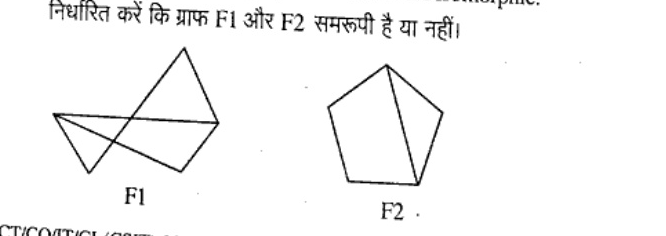
7 MarksaDetermine whether the graphs F1 and F2 are isomorphic.
How to answer
- Count vertices and edges and degree sequences of F1 and F2
- Check necessary conditions for isomorphism
- Attempt bijection preserving adjacency or find invariant violation
- Conclude isomorphic or not
-
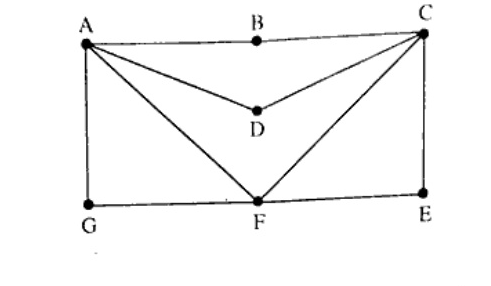
7 MarksbFind an Euler Path in the graph below.
How to answer
- Compute degree of each vertex A,B,C,D,E,F,G
- Identify 0 or 2 odd-degree vertices for Euler trail
- Trace trail using Fleury's algorithm without repeating edges
- Present vertex sequence covering all edges
-
7 MarksaDefine a lattice. Let $(L, \le, \vee, \wedge)$ be a lattice, and $a, b, c, d \in L$ be such that $a \le b$ and $c \le d$. Show that $a \vee c \le b \vee d$ and $a \wedge c \le b \wedge d$.
How to answer
- Define lattice as poset with lub and glb / algebraic axioms
- Use $a\le b$ implies $a\vee d \le b\vee d$ etc.
- Show $a\vee c \le b\vee d$ by transitivity of order
- Dually show $a\wedge c \le b\wedge d$
-
7 MarksbShow that $D_{12}$ and $D_{18}$ are isomorphic lattices. Further, show that none is isomorphic to the lattice $D_{20}$.
How to answer
- Recall D_n is divisor lattice under divisibility
- List divisors of 12, 18, 20 and draw Hasse structure
- Give explicit order-preserving bijection between D12 and D18
- Show invariant (e.g., number of elements / structure) prevents isomorphism with D20
-
7 MarksaShow that $a_{n} = c_{1}2^{n} + c_{2}4^{n}$ is a solution of the recurrence relation $a_{n} - 6a_{n-1} + 8a_{n-2} = 0$.
How to answer
- Substitute $a_n=c_12^n+c_24^n$ into LHS
- Compute $a_{n-1}, a_{n-2}$ terms
- Simplify to show $a_n-6a_{n-1}+8a_{n-2}=0$
- Conclude it satisfies recurrence
-
7 MarksbFind the sequence having the generating function $G(x)$ given by $\dfrac{x}{1-2x}$.
How to answer
- Write $x/(1-2x)=x\cdot 1/(1-2x)$
- Expand $1/(1-2x)=\sum 2^n x^n$
- Multiply by x to shift index
- Identify sequence $a_n = 2^{n-1}$ for $n\ge1$
Go to where you left off?
Quick Add to Notes
Save questions, your own notes and screenshots into notes filed by unit. It takes a free account.
Create free accountHave an account? Log in
Notes Panel