CE-702 (C) · Structural Dynamics/Unsolved PYQ Paper
CE-702-C Structural Dynamics - Nov 2023 Question Paper
Under each question, How to answer lists the points an answer should cover, outlined by CampusPrep from the syllabus. Check the details against your textbook.
-
7 MarksaDiscuss Newmark's method for numerical evaluation of dynamic response of single degree of freedom system.
How to answer
- Definition of Newmark's method as step-by-step numerical integration for SDOF dynamic response
- Governing equation $m\ddot{u}+c\dot{u}+ku=p(t)$ and Newmark assumptions with parameters $\gamma, \beta$
- Recurrence / incremental algorithm steps for displacement, velocity, acceleration
- Discussion of stability, accuracy and special cases: average acceleration and linear acceleration methods
-
7 MarksbA single degree of system consists of a mass 20 kg, spring of stiffness 2200N/m and a dashpot with a damping coefficient of 60 N-s/m is subjected to a harmonic excitation of $F = 200\sin 5t$ Newton's. Determine the steady state of response and write the solution of equation of motion.
How to answer
- Compute natural frequency $\omega_n=\sqrt{k/m}$, damping ratio $\zeta$ and excitation frequency $\omega=5$ rad/s
- Compute frequency ratio and dynamic magnification factor for harmonic excitation
- Determine steady-state amplitude and phase lag
- Write total solution as transient plus steady-state $u(t)$ and equation of motion $m\ddot{u}+c\dot{u}+ku=F_0\sin\omega t$
-
7 MarksaWhat is damping? Discuss the critical damping with example.
How to answer
- Define damping as energy dissipation mechanism in vibrating system
- Define critical damping $c_c=2m\omega_n$ and damping ratio $\zeta=c/c_c$
- Discuss critically damped response $\zeta=1$ with non-oscillatory return to equilibrium
- Give structural/mechanical example contrasting under, critical and over damping
-
7 MarksbDerive equation of motion for single degree of freedom system damped forced vibration.
How to answer
- Draw SDOF mass-spring-damper with harmonic force and free-body diagram
- Apply Newton's second law / D'Alembert's principle
- Include inertia, damping $c\dot{u}$, stiffness $ku$ and forcing $p(t)$ terms
- Obtain $m\ddot{u}+c\dot{u}+ku=p(t)$ for damped forced vibration
-
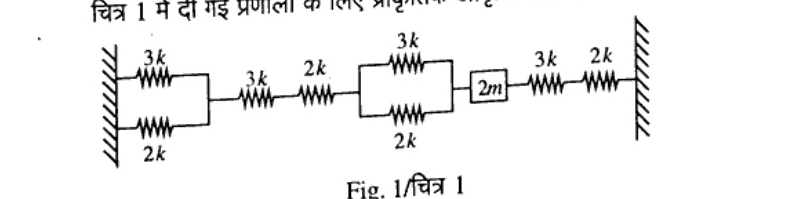
14 MarksFind the natural frequency for given system in Fig. 1.
How to answer
- Reduce series and parallel spring combinations to equivalent stiffness $k_{eq}$
- Identify mass $2m$ in the spring-mass system fixed at both ends
- Use $\omega_n=\sqrt{k_{eq}/m_{eq}}$
- Compute natural frequency and cyclic frequency $f_n$
-
7 MarksaExplain 'Logarithmic decrement' and 'Duhamel's integral' method for undamped system.
How to answer
- Define logarithmic decrement $\delta=\ln(u_n/u_{n+1})$ and relation to damping ratio
- Explain free-decay measurement for undamped/light-damped system
- State Duhamel's integral for response to arbitrary loading via impulse superposition
- Give formula $u(t)=\int_0^t p(\tau)h(t-\tau)d\tau$ for undamped system
-
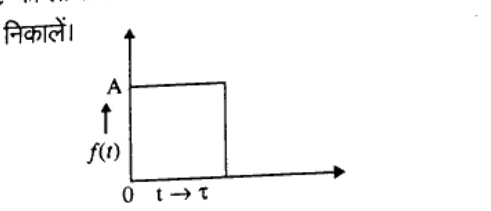
7 MarksbFind the Laplace transformation of a pulse height 'A' and duration '$\tau$' for rectangular pulse as given in Fig. 2. Deduce the Laplace transform of unit impulse.
How to answer
- Express rectangular pulse $f(t)=A$ for $0<t<\tau$, zero otherwise using unit step functions
- Apply Laplace definition $F(s)=\int_0^{\infty}f(t)e^{-st}dt$
- Obtain $F(s)=A(1-e^{-s\tau})/s$
- Take limit for unit impulse to deduce $L\{\delta(t)\}=1$
-
7 MarksaDiscuss in detail the Eigen value problem and the methods used for solving the problems.
How to answer
- Define eigenvalue problem $(K-\omega^2M)\phi=0$ and characteristic equation
- Explain natural frequencies and mode shapes as eigenpairs
- List solution methods: characteristic polynomial, matrix iteration, Stodola, Holzer, Jacobi, QR
- Discuss orthogonality and expansion of response
-
7 MarksbDiscuss the methods of matrix iteration.
How to answer
- State principle of matrix iteration for fundamental mode by repeated multiplication
- Explain Stodola / power method with assumed trial vector and normalization
- Discuss convergence, sweeping and higher mode iteration
- Mention advantages and limitations for MDOF systems
-
7 MarksaWrite notes on viscous dampers.
How to answer
- Define viscous damper and linear force-velocity relation $f_D=c\dot{u}$
- Describe construction and energy dissipation mechanism
- Give equation of motion inclusion and damping ratio
- List structural applications
-
7 MarksbExplain D'Alembert's principle and its applications.
How to answer
- State D'Alembert's principle: dynamic equilibrium with inertia force $-m\ddot{u}$
- Convert dynamics to equivalent statics $\sum F - m\ddot{u}=0$
- Derive SDOF/MDOF equations of motion using it
- Give structural dynamics applications
-
14 MarksDerive equation of natural frequency for axial vibration of bar and bending vibration of beam as continuous system.
How to answer
- Consider bar element with axial displacement $u(x,t)$ and beam in bending $v(x,t)$
- Apply equilibrium on differential element to get wave equation $EA u''=m\ddot{u}$ and beam equation $EI v''''+m\ddot{v}=0$
- Assume harmonic solution and apply boundary conditions
- Obtain frequency equations and $\omega_n$ expressions for modes
-
14 MarksWrite note on any four of the followings :
- i)Fourier transform methods
- ii)Response to unit impulse
- iii)Vibration isolation
- iv)Arbitrary force
- v)Equation of motion
- vi)Matrix formulation
How to answer
- Select any four topics from the six listed items
- Give definition, governing formula and physical significance for each
- Include diagram or example where relevant
- Summarize applications in structural dynamics
Go to where you left off?
Quick Add to Notes
Save questions, your own notes and screenshots into notes filed by unit. It takes a free account.
Create free accountHave an account? Log in
Notes Panel