CE-702 (C) · Structural Dynamics/Unsolved PYQ Paper
CE-702-C Structural Dynamics - Nov 2022 Question Paper
Under each question, How to answer lists the points an answer should cover, outlined by CampusPrep from the syllabus. Check the details against your textbook.
-
7 MarksaDefine Logarithmic Decrement. Sketch and show how Logarithmic decrement varies with damping ratio?
How to answer
- Define logarithmic decrement as natural log of ratio of successive amplitudes
- Give formula delta = ln(u_n/u_n+1) = 2*pi*zeta/sqrt(1-zeta^2)
- Sketch decaying response and delta vs zeta curve
-
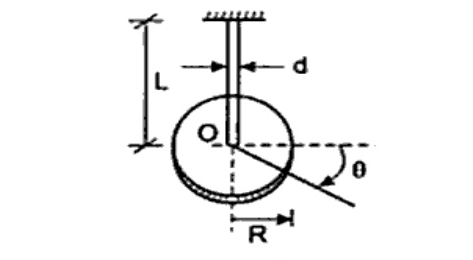
7 MarksbA rigid disc of mass $m$ is mounted at the end of a flexible shaft. As shown in fig.1. Neglecting the weight of the shaft and neglecting damping derive the equation for free torsional vibration of the disc. The modulus of rigidity of the shaft is G.
How to answer
- Neglect shaft mass and damping, consider torsional DOF theta
- Torsional stiffness k_t = G*J/L with J for shaft diameter d
- Mass moment of inertia of disc about shaft axis
- Derive equation I*theta_ddot + k_t*theta = 0
-
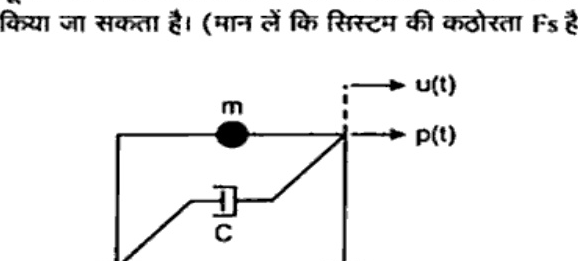
5 MarksaDescribe how the equation of motion can be set up using Newton's second law of motion for the system shown in Fig.2: (Assume the stiffness of the system is Fs)
How to answer
- Draw free-body diagram of mass m with inertia, damping, stiffness forces
- Apply Newton's second law sum F = m*u_ddot
- Include external load p(t) and frame stiffness Fs
- Obtain m*u_ddot + C*u_dot + Fs*u = p(t)
-
5 MarksbIndicate how the equation is modified for earthquake horizontal ground acceleration $u_g$.
How to answer
- Replace p(t) by effective earthquake load
- Introduce ground acceleration ug(t)
- Relative displacement formulation
- Obtain m*u_ddot + C*u_dot + Fs*u = -m*ug_ddot
-
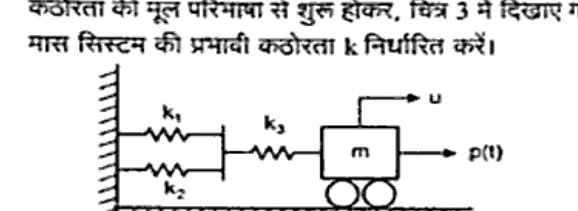
4 MarkscStarting from the basic definition of stiffness, determine the effective stiffness $k$ of the spring mass system shown in Fig.3
How to answer
- Define stiffness as force per unit displacement
- k1 and k2 in parallel add
- Result in series with k3
- Effective k = (k1+k2)*k3/(k1+k2+k3)
-
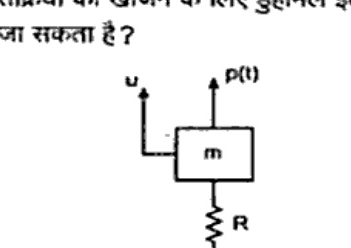
7 MarksaIndicate how Duhamel integral can be used to find the response of system shown in Fig.4 (a) for Unit impulse?
How to answer
- Define unit impulse and impulse response h(t)
- State Duhamel integral u(t)= integral p(tau)h(t-tau) dtau
- Apply to undamped/damped SDOF in Fig.4(a)
- Explain superposition for arbitrary p(t)
-
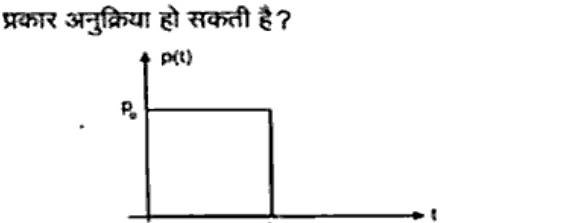
7 MarksbShow how the response can be had for the rectangular pulse shown in Fig.4 (b)?
How to answer
- Describe rectangular pulse p(t)=P0 for 0<t<t0, zero otherwise
- Use Duhamel integral in two time ranges
- Give response for forced phase and free vibration phase
- Mention shock spectrum / max response
-
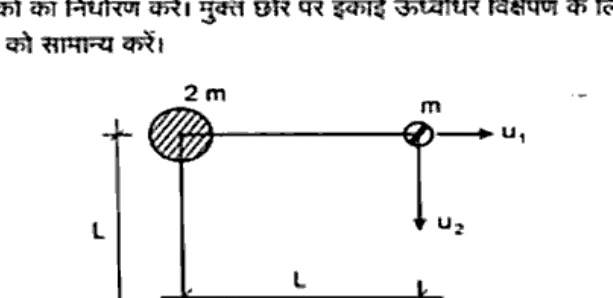
14 MarksDetermine the natural frequencies and modes of vibration for the system shown in Fig.5. Normalize the modes to have unit vertical deflection at the free end.
How to answer
- Form mass and stiffness matrices for 2-DOF frame
- Solve eigenvalue problem |k - omega^2 m|=0
- Obtain two natural frequencies
- Normalize modes to unit vertical deflection at free end and sketch
-
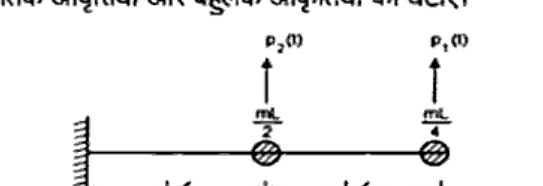
14 MarksDetermine the equation of motion of the beam shown in Fig. 6 (a) expressed in terms of Displacements $u_1$ and $u_2$ shown in Fig.6 (b). Hence deduce natural frequencies and mode shapes.
How to answer
- Model cantilever with lumped masses mL/2 and mL/4
- Write flexibility/stiffness for u1,u2
- Form 2x2 equation M*u_ddot + K*u = p(t)
- Solve for frequencies and mode shapes
-
14 MarksDescribe the dynamic analysis procedure as per IS 1893:2002 for a high rise building with 4 stories. Indicate how the mass is lumped and the seismic force is distributed along the height. Distinguish between CQC and SRSS procedures given in the code.
How to answer
- Outline IS 1893:2002 response spectrum method for 4-storey building
- Lumping of floor masses and lateral stiffness
- Distribution of base shear along height
- Differentiate CQC vs SRSS combination rules
-
14 MarksFind the first three vibration frequencies and modes of an uniform beam clamped at one end and free at the other. Sketch the mode shapes.
How to answer
- Set cantilever boundary conditions fixed-free
- Solve frequency equation cos(betaL)cosh(betaL)+1=0
- First three roots betaL ~1.875, 4.694, 7.855
- Give frequencies omega_n and sketch mode shapes
-
14 MarksWrite Short Notes on:
- a)Hamilton Principle
- b)Holzer method
- c)Response spectrum
- d)Uncoupling of equations of motion.
How to answer
- State Hamilton principle of least action
- Outline Holzer trial-and-error for torsional systems
- Define response spectrum and its use
- Explain modal uncoupling using orthogonality
Go to where you left off?
Quick Add to Notes
Save questions, your own notes and screenshots into notes filed by unit. It takes a free account.
Create free accountHave an account? Log in
Notes Panel