CE-701 · Geotechnical Engg/Unsolved PYQ Paper
CE-701 Geotechnical Engineering - Nov 2023 Question Paper
Under each question, How to answer lists the points an answer should cover, outlined by CampusPrep from the syllabus. Check the details against your textbook.
-
6 MarksaEstablish the following relationship for soil parameters $e S_r = wG$, where $e =$ void ratio, $w =$ water content, $S_r =$ degree of saturation, $G =$ sp. gravity of soil solid.
How to answer
- Define void ratio, water content, degree of saturation, specific gravity with phase diagram
- Express volumes and weights in terms of Vs, e, w, G
- Show Vw = w*Ws/gamma_w and Vs relation
- Derive e*Sr = w*G
-
8 MarksbA series of tests on a sample of clay gives following properties: Liquid limit $= 60\%$, Plastic limit $= 25\%$, Natural W.C. $= 50\%$, $D_{60} = 0.0050$ mm, $D_{30} = 0.0026$ mm, $D_{10} = 0.0007$ mm. Calculate the following:
- i)Uniformity coefficient
- ii)Coefficient of curvature
- iii)Gradation of soil
- iv)Plasticity index
- v)IS soil classification as per plasticity chart
- vi)Consistency of soil
How to answer
- Compute Cu = D60/D10 and Cc = D30^2/(D60*D10)
- Compute PI = LL-PL
- Use plasticity chart to classify as CH/MH etc
- Determine consistency from Ic = (LL-wn)/PI
-
6 MarksaA masonry dam has previous sand foundation. Determine the maximum permissible upward gradient, if a factor of safety of 4 is required against boiling? Data given, for sand, $\eta = 50\%$ and sp. gravity $G_s = 2.70$.
How to answer
- Compute void ratio from porosity
- Compute critical hydraulic gradient ic = (Gs-1)/(1+e)
- Divide by factor of safety for permissible gradient
- State result
-
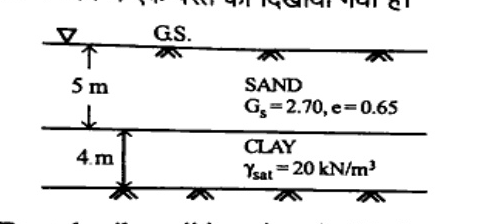
8 MarksbA strata has been shown in following figure. For subsoil condition given in this figure, plot the total, neutral and effective stress distribution upto the bottom of the clay layer, when
- i)Water table is 2m below the G.S. (take $S_r = 50\%$ above W.T.)
- ii)Water table is at ground surface
How to answer
- Compute bulk/saturated unit weights for sand and clay layers
- Compute total stress sigma at interfaces
- Compute pore pressure u for both WT cases
- Plot sigma, u and sigma-bar = sigma-u up to bottom of clay
-
6 MarksaExplain about flow nets. Write the characteristics of flow nets.
How to answer
- Define flow net: flow lines and equipotentials
- Explain construction and use for seepage
- List characteristics: orthogonal, curvilinear squares, constant discharge etc
-
4 MarksbWhat are the factors affecting the permeability of soil?
How to answer
- List grain size, void ratio, density, viscosity, structure etc
- Explain effect of each on k
- Mention temperature and degree of saturation
-
4 MarkscExplain the textural soil classification.
How to answer
- Define textural classification based on sand-silt-clay %
- Explain triangular chart usage
- Give examples like loam, clay loam
-
4 MarksaA flow net was drawn for estimating the seepage under the sheet piling. The number of flow channels $\eta_f = 5$ and number of equipotential drop $\eta_d = 12$ was estimated in the flow net. If the permeability of the sand is $5\times 10^{-3}$ cm/s and saturated unit weight of sand is 20 kN/m$^3$, what is the discharge through sand strata?
How to answer
- Write seepage formula q = k*H*Nf/Nd
- Convert k to m/s and compute head
- Calculate discharge per unit length
-
6 MarksbA footing carries a uniformly distributed load of 250 kN/m$^2$. The footing size is rectangular 2.5m $\times$ 2.0 m. Find the intensity of vertical pressure at a depth of 5.0 m below the center of the footing use equivalent point load method.
How to answer
- Compute total load Q = q*B*L
- Treat as point load at depth 5m
- Apply Boussinesq vertical stress formula sigma_z = 3Q/(2pi*z^2)
- Compute intensity
-
4 MarkscWrite the assumptions made in Boussinesq's equation formulation for stress distribution in soil.
How to answer
- State homogeneous, isotropic, elastic half-space
- Point load on surface, stress independent of E, mu
- List 4-5 Boussinesq assumptions
-
4 MarksaDefine the compaction. How it is different from consolidation?
How to answer
- Define compaction as mechanical densification
- Define consolidation as time-dependent pore pressure dissipation
- Compare mechanism, time, saturation, loading
-
4 MarksbDifferentiate between standard proctor test and modified proctor's test.
How to answer
- Compare hammer weight, drop, layers, energy
- Compare mould, application
- State use of each test
-
6 MarkscExplain the following terms:
- i)Zero air void line
- ii)Quick condition
- iii)Seepage pressure
How to answer
- Define zero air void line: Sr=100% dry density-moisture relation
- Define quick condition: upward seepage, effective stress zero
- Define seepage pressure: drag force per volume
-
4 MarksaA clay stratum is 6 m thick. Under a external loading of a building how many days would be required by this clay stratum to attain 50% of its ultimate settlement. Assume both end drainage allowed in clay strata. The coefficient of consolidation of clay soil is $50\times 10^{-4}$cm$^2$/sec.
How to answer
- Write Tv= Cv*t/d^2 with Tv=0.197 for 50%
- Use double drainage d=H/2
- Solve for t in days
-
6 MarksbDifferentiate between:
- i)Coefficient of consolidation and coefficient of compressibility
- ii)Coefficient of compression and compression index
- iii)Shear strength and shear stress
How to answer
- Define Cv vs k/(mv*gamma_w) and mv
- Define Cc slope vs compression index
- Define shear strength vs applied shear stress
-
4 MarkscWrite the assumptions made in the theory of consolidation.
How to answer
- Saturated clay, Darcy's law valid
- Homogeneous, small strains, one-dimensional flow
- Grain and water incompressible, etc
-
6 MarksaDescribe the unconfined compression test. For which type of soil this test is suitable.
How to answer
- Describe apparatus: no confining pressure, axial load only
- Procedure and Mohr circle with sigma3=0
- Suitable for saturated cohesive soils
-
4 MarksbTwo undrained triaxial tests were conducted on soil specimen and they gave the following results: Confining pressure 150 kN/m$^2$, 300 kN/m$^2$; Failure load 500 kN/m$^2$, 800 kN/m$^2$. Determine the value of apparent cohesion and friction angle of the soil.
How to answer
- Compute sigma1 = sigma3 + deviator stress from failure load
- Plot Mohr circles or solve c-phi equations
- Obtain phi from slope and c from intercept
-
4 MarkscExplain the phenomenon of "Liquefaction" is saturated fine sandy soil.
How to answer
- Define liquefaction: loss of strength due to pore pressure rise
- Conditions: loose saturated fine sand, dynamic loading
- Consequences and prevention
-
6 MarksaWrite the different type of soil stabilization. Discuss briefly about cement stabilization.
How to answer
- List mechanical, cement, lime, bitumen, chemical stabilization
- Explain cement mixing, hydration, dosage, curing
- Mention advantages and applications
-
MarksbExplain following:
- i)Function and application of Geosynthetics
- ii)Grain size distribution of soil
How to answer
- Functions of geosynthetics: separation, reinforcement, filtration, drainage
- Applications in roads, embankments
- Define grain size distribution and its determination
Go to where you left off?
Quick Add to Notes
Save questions, your own notes and screenshots into notes filed by unit. It takes a free account.
Create free accountHave an account? Log in
Notes Panel