CE-503 (A) · Structural analysis-II/Unsolved PYQ Paper
CE-503-A Structural Analysis - II - Jun 2025 Question Paper
Under each question, How to answer lists the points an answer should cover, outlined by CampusPrep from the syllabus. Check the details against your textbook.
-
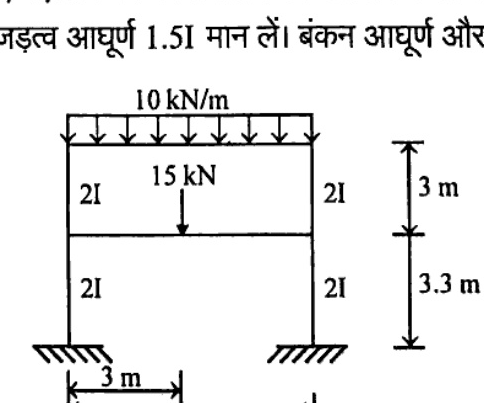
14 MarksAnalyze the frame shown in the figure using Kani's method. Assume moment of inertia for the beams as $1.5I$. Draw bending moment and elastic curve.
How to answer
- Compute fixed-end moments and rotation factors with beam I = 1.5I and column I = 2I
- Perform Kani's iteration for rotation contributions and storey sway if any
- Compute final end moments, reactions and draw BMD
- Draw deflected / elastic curve consistent with moments and supports
-
7 MarksaDiscuss the limitations and assumptions in a plastic analysis of beams and frames.
How to answer
- Define plastic analysis and idealised elastic-perfectly plastic behaviour
- List assumptions: plane sections, yield stress, small deflections, proportional loading
- Discuss limitations: stability, buckling, fatigue, strain hardening, deflections ignored
-
7 MarksbDescribe the formation of a plastic hinge in a fixed beam under uniform loading.
How to answer
- State fixed beam with UDL and elastic BMD with support and mid moments
- Explain first yield at supports then redistribution with load increase
- Formation of third hinge at midspan to form mechanism / collapse
- Sketch load-deflection and hinge sequence
-
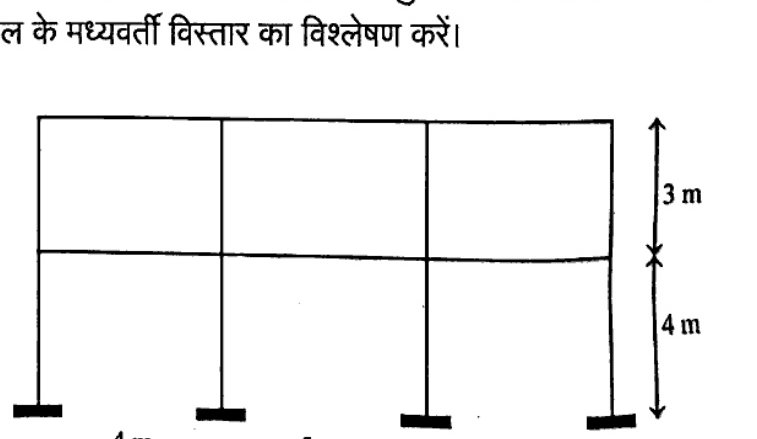
14 MarksIn a multistoried building the frames, as shown in the figure below, are spaced at $3.5\text{ m c/c}$. The dead and live loads carried by the slab are $1\text{ kN/m}^2$ and $2\text{ kN/m}^2$ respectively. Using substitute frame method, analyze an intermediate span of the first floor for maximum negative bending moment.
How to answer
- Compute slab load per m: dead + live times spacing 3.5 m c/c
- Select substitute frame for first floor intermediate span and loading for max negative moment
- Compute distribution factors, FEMs and analyse by moment distribution / slope deflection
- Report maximum negative bending moment at support
-
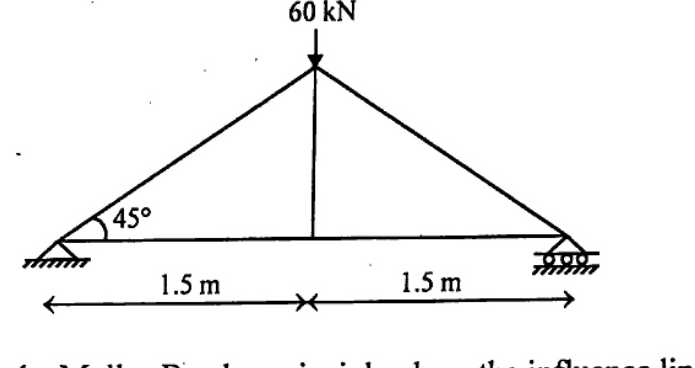
14 MarksAnalyze the pin-jointed plane frame supported and loaded as shown in Figure below, Use stiffness method.
How to answer
- Identify joints, members, degrees of freedom and coordinate system
- Form element stiffness matrices in global coordinates for 45-degree members
- Assemble structure stiffness matrix and apply 60 kN load at apex
- Solve for displacements and compute member axial forces
-
14 MarksUsing the Muller-Breslau principle, draw the influence line for shear force at mid span of a simply supported beam of length $4\text{ m}$.
How to answer
- State Muller-Breslau principle for influence lines
- Release shear at midspan and apply relative unit displacement
- Sketch deflected shape which is ILD for shear
- Mark ordinates (+0.5 to -0.5) for 4 m beam
-
14 MarksCalculate section modulus, Plastic modulus and shape factor for a circular section of radius $r$.
How to answer
- Define elastic section modulus Z = I/y_max and compute I for circle
- Define plastic modulus Zp as first moment about equal area axis
- Compute Zp = 4r^3/3 for solid circle
- Compute shape factor S = Zp/Z = 16/(3π) ≈ 1.698
-
7 MarksaExplain the matrix Force Method of structural analysis with a suitable example.
How to answer
- Define primary structure, redundants and compatibility
- Explain flexibility coefficients and matrix equation Delta = F*P + Delta_L
- Illustrate with simple propped cantilever / continuous beam example
-
7 MarksbDiscuss the steps involved and the formation of the flexibility matrix.
How to answer
- List steps: select redundants, release structure, compute displacements
- Define flexibility influence coefficients f_ij by unit load
- Show assembly and properties (symmetric) of flexibility matrix
- Write compatibility equations in matrix form
-
2 MarksaExplain the following terms. a) Redundant structure
How to answer
- Define redundant / indeterminate structure with examples
- Explain degree of redundancy and why analysis needs compatibility
-
4 MarksbExplain the following terms. b) Collapse load and plastic modulus
How to answer
- Define collapse load as load forming mechanism
- Define plastic modulus Zp and relation Mp = fy*Zp
- Give formula / example for beam
-
4 MarkscExplain the following terms. c) Shear wall and wind drift
How to answer
- Define shear wall function in lateral load resistance
- Define wind drift / lateral sway limits
- Explain importance in tall buildings
-
4 MarksdExplain the following terms. d) Compatibility equations and degree of Indeterminacy
How to answer
- Define compatibility as continuity / zero displacement conditions
- Define degree of indeterminacy (static and kinematic) with formula
- Give example counting indeterminacy
Go to where you left off?
Quick Add to Notes
Save questions, your own notes and screenshots into notes filed by unit. It takes a free account.
Create free accountHave an account? Log in
Notes Panel