CE-503 (A) · Structural analysis-II/Unsolved PYQ Paper
CE-503-A Structural Analysis-II - Dec 2025 Question Paper
Under each question, How to answer lists the points an answer should cover, outlined by CampusPrep from the syllabus. Check the details against your textbook.
-
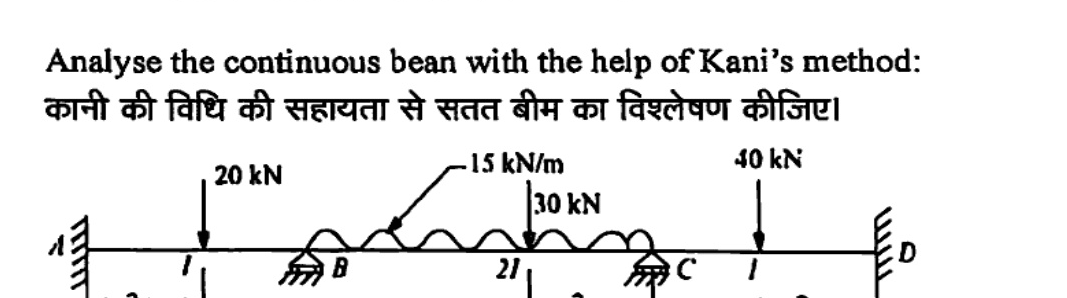
14 MarksAnalyse the continuous beam with the help of Kani's method:
How to answer
- Compute fixed-end moments for spans AB, BC, CD with given point, UDL loads
- Compute rotation factors / distribution factors at B and C for Kani's method
- Iterate rotation contributions and displacement if any to convergence
- Compute final end moments and draw SFD/BMD, reactions
-
14 MarksExplain the moment distribution method for analysis of frames with sway.
How to answer
- Define no-sway vs sway frames and sway mechanism
- Explain restraint, arbitrary sway, correction using equilibrium / shear condition
- Steps of moment distribution with sway: FEM, distribution, sway correction factor
- Illustrative example / diagram of sway frame
-
14 MarksDerive the shape factor for I section and circular section.
How to answer
- Define shape factor S = Mp/My = Zp/Ze
- Derive Ze and Zp for I-section using first moment of area
- Derive Ze = pi*D^3/32 and Zp = D^3/6 for solid circular section
- Give numerical values ~1.12-1.15 for I and 1.70 for circle
-
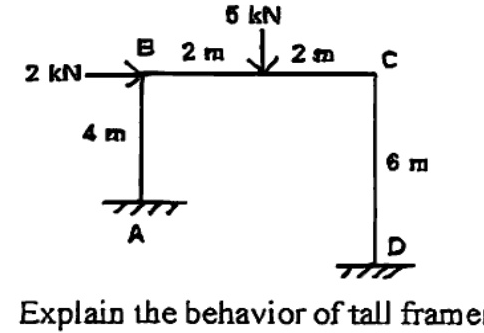
14 MarksFind the fully plastic moment required for the frame shown in figure, if all the members have same value of Mp.:
How to answer
- Identify possible collapse mechanisms: beam, sway, combined
- Compute external virtual work for each mechanism
- Compute internal work as sum Mp*theta at hinges
- Select maximum Mp as required fully plastic moment
-
14 MarksExplain the behavior of tall frames under wind and earthquake loads.
How to answer
- Describe wind load effects: lateral pressure, drift, P-Delta
- Describe earthquake effects: inertia, ductility, resonance, base shear
- Compare static vs dynamic response of tall frames
- Measures: bracing, shear walls, damping
-
14 MarksAnalyse continuous beam ABCD by slope deflection method and then draw bending Moment diagram. Take EI constant.

How to answer
- Write slope-deflection equations for AB, BC, CD with FEMs
- Apply equilibrium at joints B, C and solve for rotations
- Compute final end moments
- Draw bending moment diagram showing free and end moments
-
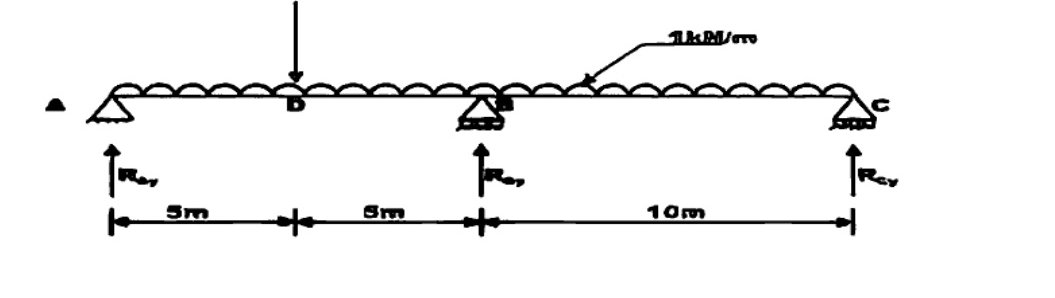
14 MarksA continuous beam ABC is carrying a uniformly distributed load of 1 kN/m in addition to a concentrated load of 10 kN as shown in Fig., Draw bending moment and shear force diagram. Assume EI to be constant for all members.
How to answer
- Compute degree of indeterminacy and select method (slope-deflection / moment distribution)
- Compute FEMs for 10m spans with UDL 1 kN/m plus 10 kN point
- Solve for support moments and reactions R_Av, R_Bv, R_Cv
- Draw SFD and BMD with values
-
OR Choice7 MarksaState and explain the Müller–Breslau principle with applications.
How to answer
- State Muller-Breslau principle for influence lines
- Explain procedure with release and unit displacement
- Give applications to beams, trusses, reactions, SF, BM
-
OR Choice7 MarksbDraw the ILD for shear force and bending moment for a section at 50m from the left hand support of a simply supported beam, 200m long, Hence calculate the maximum bending moment and shear force at the section due to an uniformly distributed rolling load of length 80m and intensity 100kN/m.
How to answer
- Draw ILD for shear and BM at 50m section of 200m simply supported beam
- Place 80m UDL 100 kN/m for max positive/negative SF and max BM
- Compute areas of ILD under loaded length
- Calculate max SF and max BM = intensity x area
Go to where you left off?
Quick Add to Notes
Save questions, your own notes and screenshots into notes filed by unit. It takes a free account.
Create free accountHave an account? Log in
Notes Panel