AL-601 · Theory of Computation/Unsolved PYQ Paper
AL-601 Theory of Computation - May 2023 Question Paper
Under each question, How to answer lists the points an answer should cover, outlined by CampusPrep from the syllabus. Check the details against your textbook.
-
7 MarksaWhat is Moore Machine? How Moore machine can be converted into Mealy Machine? Explain with the help of an example.
How to answer
- Define Moore machine (output associated with states).
- Define Mealy machine (output associated with transitions).
- Steps for Moore to Mealy conversion (move state output to incoming transitions).
- Illustrate with example transition table/diagram.
-
7 MarksbDescribe how Finite automata can be called a language acceptor?
How to answer
- Define finite automaton as 5-tuple.
- Explain input tape, reading and acceptance by final state.
- Explain language accepted / language acceptor concept.
- Give example of acceptance.
-
7 MarksaExplain briefly about the composite machine with an example.
How to answer
- Define composite / product machine concept.
- Explain construction combining two machines.
- Give example e.g. combining two DFAs.
- Mention application.
-
7 MarksbFind out the Regular Expression from given DFA.
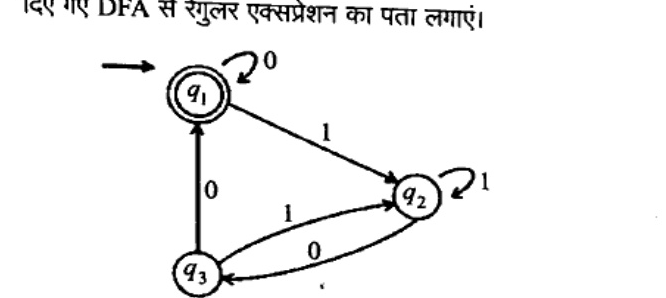
How to answer
- Write state equations using Arden's theorem / state elimination.
- Eliminate q3 and q2 to get equation for q1.
- Simplify to regular expression for final state q1.
- State final regular expression.
-
7 MarksaWhat do you mean by Closure properties of regular languages? Define some important closure properties.
How to answer
- Define closure property meaning.
- List union, concatenation, Kleene star closure.
- List intersection, complement, difference.
- Brief proof idea using automata/regular expressions.
-
7 MarksbObtain the regular expression for the following set:
- i)Set of all strings over $\Sigma = (a,b)$ with exactly two $a$.
- ii)$L = \{a^x \mid x \text{ is divisible by 3 or 5}\}$.
How to answer
- For (i) construct expression with exactly two a's: b* a b* a b*.
- For (ii) use union of multiples of 3 and 5: (aaa)* + (aaaaa)* expanded.
- Justify correctness of patterns.
- Write final regular expressions.
-
7 MarksaDifferentiate between Context-Free Grammar and Context-Sensitive Grammar.
How to answer
- Define CFG: productions A -> aA | ... and CSG: context-dependent.
- Compare production form, expressive power, languages.
- Compare automata (PDA vs LBA) and closure.
- Give examples.
-
7 MarksbShow that $L = \{a^n b^n c^n \mid n \ge 1\}$ is not CFL.
How to answer
- Assume L is CFL and apply pumping lemma for CFL.
- Choose string a^n b^n c^n and decomposition uvwxy.
- Show pumping violates equal counts.
- Conclude L is not CFL (context-sensitive).
-
7 MarksaWrite CFG for regular expression $(011 + 1)^*(01)^*$.
How to answer
- Introduce variables for (011+1)* and (01)* parts.
- Write productions for 011, 1, 01 using concatenation.
- Combine with start symbol S -> AB.
- Present final CFG.
-
7 MarksbDesign PDA to accept the language $L(G) = \{a^n b^m a^n \mid m,n \ge 1\}$
How to answer
- Define PDA 7-tuple and stack strategy.
- Push first a^n, read b^m, match second a^n.
- Give transition functions for each phase.
- Show acceptance by empty stack/final state.
-
7 MarksaDesign a PDA which recognizes the set of all even length palindromes over $\{a, b\}$.
How to answer
- Use non-determinism to guess middle of string.
- Push first half symbols onto stack.
- Pop and match second half in reverse.
- Accept even-length palindromes on empty stack.
-
7 MarksbWhat is PDA? Explain instantaneous description of PDA.
How to answer
- Define PDA as 7-tuple with stack.
- Define instantaneous description (state, input, stack).
- Explain move relation |- between IDs.
- Give example of ID sequence.
-
7 MarksaDesign a Turing Machine for the language $\{L(G) = a^n b^n \mid n \ge 1\}$
How to answer
- Define TM 7-tuple and tape strategy for a^n b^n.
- Steps: mark a, find matching b, repeat and return.
- Give transition diagram/table.
- Show acceptance for n>=1.
-
7 MarksbExplain P class problems in detail.
How to answer
- Define P as polynomial-time decidable problems.
- Explain deterministic TM and polynomial bound.
- Give examples (sorting, shortest path).
- Mention relation to NP.
-
14 MarksWrite short note on any two of the following:
- i)NP Hard
- ii)Petri Net Model
- iii)Halting problem of Turing machine
- iv)2-way DFA
How to answer
- Select any two topics from i)-iv).
- Give definition and key features for each.
- Give example/diagram where applicable.
- Mention significance in TOC.
Go to where you left off?
Quick Add to Notes
Save questions, your own notes and screenshots into notes filed by unit. It takes a free account.
Create free accountHave an account? Log in
Notes Panel