AL-601 · Theory of Computation/Unsolved PYQ Paper
AL-601 Theory of Computation - Jun 2025 Question Paper
Under each question, How to answer lists the points an answer should cover, outlined by CampusPrep from the syllabus. Check the details against your textbook.
-
7 MarksaDefine finite automata and list the features of finite automata with an example.
How to answer
- Formal 5-tuple definition (Q, Sigma, delta, q0, F)
- Explanation of components and transition function
- Key features: finite states, deterministic/nondeterministic, no memory, etc.
- Example automaton with diagram and accepted language
-
7 MarksbDesign a finite automata with Sum = {0,1} accepts those strings which starts with 1 and ends with 0.
How to answer
- Alphabet Sigma = {0,1}, start state and trap/dead state concept
- Construction for starts with 1 and ends with 0 (minimum 2 symbols)
- Transition table/diagram with 4 states
- Verification with example strings
-
7 MarksaDifferentiate between Mealy and Moore machines with a suitable example.
How to answer
- Definition of Mealy (output on transition) vs Moore (output on state)
- Comparison table: output timing, states required, etc.
- Example transducer for each
- Diagram of both machines
-
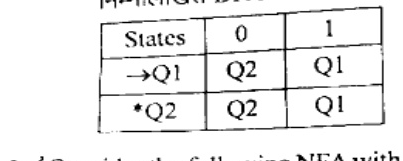
7 MarksbDesign a regular expression for the following DFA.
How to answer
- Interpret given DFA transition table with start Q1 and final Q2
- Apply state elimination / Arden's theorem to obtain equations
- Solve for language accepted (strings ending pattern)
- Write final regular expression
-
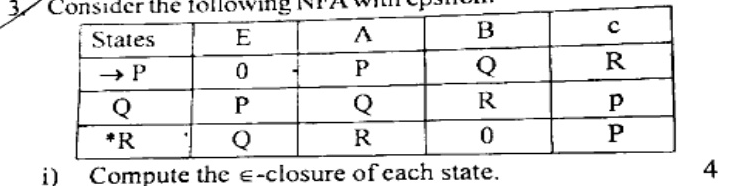
14 MarksConsider the following NFA with epsilon:
- i)Compute the $\epsilon$-closure of each state.
- ii)Give all the strings of length 4 or less accepted by the automation.
- iii)Convert the automation to DFA.
How to answer
- Compute epsilon-closure for P, Q, R using epsilon (E) transitions
- Enumerate strings length <=4 over {A,B,c} reaching final state *R
- Subset construction to convert epsilon-NFA to DFA
- DFA transition table and final states
-
7 MarksaShow that the languages $L=\{0^n1^m / n = m \text{ and } n \ge 1\}$ is deterministic context free language.
How to answer
- Define deterministic PDA / DCFL concept
- Construct DPDA for $L=\{0^n1^n/n\ge 1\}$ using stack to match counts
- Argue determinism: at most one move per configuration
- Conclude L is deterministic context-free
-
7 MarksbDefine parse tree and construct a parse tree for the string 'abaabb' from the following given grammar. $S \rightarrow SS/aSb/\epsilon$
How to answer
- Define parse tree: derivation tree from grammar
- Apply productions S -> SS / aSb / epsilon to derive 'abaabb'
- Draw hierarchical parse tree with leaves abaabb
- Show yield matches string
-
7 MarksaConvert the given CFG into GNF: $S \rightarrow ABA/AB/BA/AA/B$ $A \rightarrow aA/a$ $B \rightarrow bB/b$
How to answer
- Remove epsilon/unit productions and simplify given CFG
- Convert to Chomsky normal form as intermediate
- Convert to Greibach Normal Form: A -> a alpha form
- List final GNF productions
-
7 MarksbDefine pushdown automata and explain its model with a neat sketch.
How to answer
- Formal 7-tuple definition of PDA
- Explain components: states, input, stack, transitions
- Neat labelled sketch of PDA model with input tape, control, stack
- Working of push/pop with example
-
7 MarksaConstruct a PDA for the given language $L = \{ WW^R / W \in \{a,b\}^* \}$.
How to answer
- Idea: push W, guess middle, pop against W^R
- Define states, stack alphabet and transitions
- Show acceptance by final state/empty stack
- Test with example ww^R
-
7 MarksbConvert the following grammar into PDA which accepts the same language by empty stack. $S \rightarrow 0S1/A$ $A \rightarrow 1A0/S/\epsilon$
How to answer
- Standard construction from CFG to PDA with 3 states
- Transitions for variables and terminals with empty-stack acceptance
- Apply to S -> 0S1/A, A -> 1A0/S/epsilon
- List resulting PDA delta
-
7 MarksaDesign a turing machine over {0, 1} for the language $L = \{W/W \text{ is a multiple of 3 }\}$.
How to answer
- Interpret W as binary number multiple of 3 (states for remainder 0,1,2)
- Define TM transitions moving right computing remainder
- Accept in remainder-0 state
- State diagram/table of TM
-
7 MarksbFind whether the post correspondence problem $P = \{(ba, bab), (abb, bb), (bab, abb)\}$ has a match? Explain in detail.
How to answer
- Define Post Correspondence Problem and match condition
- Attempt to build correspondence sequence from given pairs
- Show whether sequence yields same top/bottom string
- Conclude match exists or not with reasoning
-
14 MarksWrite a short note on any two of the following
- a)Arden's theorem
- b)Chomsky hierarchy of the grammar
- c)NPDA
- d)N-P Complete problem
How to answer
- Choose any two topics with definition and statement
- Explain key theorem/steps with example
- Relevant diagram/hierarchy or proof sketch
- Applications and significance
Go to where you left off?
Quick Add to Notes
Save questions, your own notes and screenshots into notes filed by unit. It takes a free account.
Create free accountHave an account? Log in
Notes Panel