AL-601 · Theory of Computation/Unsolved PYQ Paper
AL-601 Theory of Computation - Dec 2024 Question Paper
Under each question, How to answer lists the points an answer should cover, outlined by CampusPrep from the syllabus. Check the details against your textbook.
-
7 MarksaDesign a Moore machine to determine the residue of mod 2 of the input treated as a binary string.
How to answer
- Define states for remainder 0 and 1 with output 0/1
- Show transition on binary input 0/1 updating mod 2 value
- Give transition table and state diagram
-
7 MarksbFind an equivalent $\epsilon$-NFA for the following regular expression $(0+1)^*011$.
How to answer
- Recall Thompson construction for union, concat, star
- Construct epsilon-NFA for $(0+1)^*$ then for $011$
- Combine and simplify with epsilon transitions
-
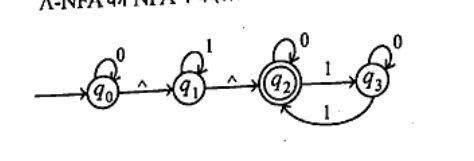
7 MarksaConvert the $\Lambda$-NFA to NFA.
How to answer
- Compute Lambda-closure of each state
- Compute NFA transitions on 0 and 1 without Lambda
- Give resulting NFA transition table and diagram
-
7 MarksbConvert the grammar $\{S \to ABaC|ABa, A \to Aa|a, B \to BaB|b, C \to CC\}$ Chomsky normal form.
How to answer
- Eliminate unit and useless productions and convert terminals to variables
- Break long productions $S \to ABaC$ etc. into binary form
- Introduce new variables and give final CNF productions
-
7 MarksaDefine formally Type 0, Type 1, Type 2 and Type 3 grammar. Show the corresponding automata for each class.
How to answer
- Give formal tuple definition for Type 0,1,2,3 grammars with restrictions
- State Chomsky hierarchy inclusion
- Map to Turing machine, LBA, PDA, finite automata
-
7 MarksbConstruct PDA for the language $wcw^R$ where $w$ is string of zeroes and ones.
How to answer
- Push w symbols onto stack
- Read center marker c without stack change
- Pop and match with w^R and accept
-
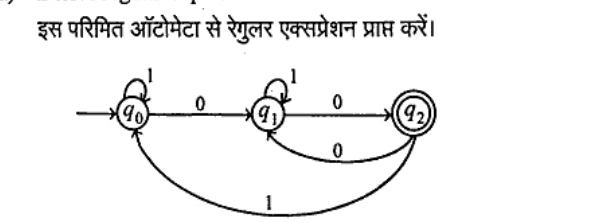
7 MarksaDerive regular expression from this Finite Automata.
How to answer
- Apply state elimination or Arden theorem to given DFA
- Eliminate q2 then q1 to get expression
- Simplify final regular expression
-
7 MarksbDefine regular language and regular expressions. Find regular expression for the following : Language of all string that do not end with 01.
How to answer
- Define regular language and regular expression operators
- Complement language of strings ending with 01
- Write expression e.g. (0+1)*(00+10+0+epsilon) and justify
-
14 MarksConstruct a PDA accepting by empty stack each of the following language.
- i)$a^n b^n c^m d^m$ where $n, m \ge 1$
- ii)$a^3 b^n n \ge 0$
How to answer
- Define PDA by empty stack acceptance
- Give construction for a^n b^n c^m d^m using stack counting
- Give construction for a^3 b^n with stack counting
-
7 MarksaConvert to Greibach normal form. $\{S \to AB, A \to SA|AA|a, B \to SB|b\}$
How to answer
- Order variables and eliminate left recursion
- Ensure productions start with terminal
- Introduce new variables to get GNF form
-
7 MarksbDerive any two representative strings with minimum length 4 from following context free grammar. $G = (\{S, A, B\}, \{a, b\}, P, S)$ $S \to bA | aB$ $A \to bAA | aS | a$ $B \to aBB | bS | b$
How to answer
- Interpret productions of G with start S
- Derive two distinct terminal strings of length >=4 step by step
- Show leftmost/rightmost derivation trees
-
7 MarksaDesign a Turing Machine that accepts the language $1^n 0^n$ where $n > 0$.
How to answer
- Explain tape, head, matching 1s with 0s by marking
- Give state transitions for scanning and crossing
- Show acceptance when all symbols matched
-
7 MarksbWhat is a Turing machine? Give the specification of a Turing machine and explain.
How to answer
- Define 7-tuple specification of Turing machine
- Explain tape, finite control, transition function
- Give example movement and operation
-
14 MarksWrite a short note (any three):
- i)Recursively Enumerable
- ii)GNF
- iii)Derivation Tree
- iv)Melay Machine
How to answer
- Define each chosen topic formally
- Give example/automata or grammar illustration
- Mention significance and application
Go to where you left off?
Quick Add to Notes
Save questions, your own notes and screenshots into notes filed by unit. It takes a free account.
Create free accountHave an account? Log in
Notes Panel