AL-401 · Introduction to Discrete Structure &Linear Algebra/Unsolved PYQ Paper
AL-401 Introduction to Discrete Structure and Linear Algebra - Jun 2024 Question Paper
Under each question, How to answer lists the points an answer should cover, outlined by CampusPrep from the syllabus. Check the details against your textbook.
-
7 MarksaLet T be the set of positive integers less than 10 and let "R be the relation on T defined by aRb if and only if $|a^2 - b^2|$ is a multiple of 5". Prove that R is reflexive, symmetric, but not transitive.
How to answer
- Define set $T = \{1, 2, 3, 4, 5, 6, 7, 8, 9\}$.
- Show reflexive: $|a^2 - a^2| = 0$, which is a multiple of 5 for all $a \in T$.
- Show symmetric: if $|a^2 - b^2|$ is a multiple of 5, $|b^2 - a^2| = |a^2 - b^2|$ is also a multiple of 5.
- Show not transitive by providing a counterexample: e.g., check $a^2 \pmod 5$ values or specific elements showing $aRb$ and $bRc$ do not imply $aRc$ if any, or verify if the claim holds/fails based on quadratic residues modulo 5.
-
7 MarksbConsider a set $C = \{1, 2, 3, 4, 5, 6, 8, 10, 12, 15\}$ ordered by divisibility. Draw its Hasse diagram.
How to answer
- List all elements and their covering relations under divisibility.
- Bottom element is 1.
- Level 1: Prime elements 2, 3, 5.
- Higher levels: 4, 6, 10, 15, and top elements 8, 12.
- Draw vertices and edges indicating transitive reduction without redundant edges or reflexive loops.
-
7 MarksaConsider two sets A and B. Let $A = \{2, 3, 4, 5\}$ and $B = \{4, 5, 6, 7\}$. Using Venn diagrams, prove the following statements: Prove that $(A \cup B)' = A' \cap B'$. Prove that $(A \cap B)' = A' \cup B'$.
How to answer
- Define universal set $U$ containing elements of $A$ and $B$.
- Draw Venn diagrams illustrating $A \cup B$ and its complement $(A \cup B)'$.
- Draw Venn diagrams showing $A'$, $B'$, and their intersection $A' \cap B'$; show equality.
- Draw Venn diagrams illustrating $A \cap B$ and its complement $(A \cap B)'$.
- Draw Venn diagrams showing $A' \cup B'$ and show regions are identical.
-
7 MarksbGiven the recurrence relation $a_n = a_{n-1} + 4a_{n-2}$ with initial conditions $a_0 = 2$ and $a_1 = 5$, determine the closed-form expression for the sequence.
How to answer
- Write characteristic equation: $r^2 - r - 4 = 0$.
- Find characteristic roots: $r = \frac{1 \pm \sqrt{17}}{2}$.
- Write general solution: $a_n = c_1 \left(\frac{1 + \sqrt{17}}{2}\right)^n + c_2 \left(\frac{1 - \sqrt{17}}{2}\right)^n$.
- Apply initial conditions: $a_0 = 2 \implies c_1 + c_2 = 2$.
- Use $a_1 = 5$ to solve for constants $c_1$ and $c_2$.
- Substitute constants back into the general solution to obtain the closed-form expression.
-
7 MarksaShow that the set $H = \{e, a, a^2, a^3\}$ is a subgroup of a group $G$ where $G = \{e, a, a^2, a^3, b, ab, a^2b, a^3b\}$.
How to answer
- State subgroup criteria (finite subgroup test or closure and inverse).
- Show closure: For any $a^i, a^j \in H$, $a^i \cdot a^j = a^{(i+j) \pmod 4} \in H$ since $a^4 = e$.
- Show identity: $e \in H$.
- Show inverse: Inverse of $a$ is $a^3 \in H$, inverse of $a^2$ is $a^2 \in H$, inverse of $e$ is $e \in H$.
- Conclude $H$ is a subgroup of $G$ (in fact, a cyclic subgroup generated by $a$).
-
7 MarksbLet $(A, *)$ be a semigroup. Show that, for $a, b, c$ in $A$, if $a * c = c * a$ and $b * c = c * b$, then $(a * b) * c = c * (a * b)$.
How to answer
- Start with left-hand side: $(a * b) * c$.
- Apply associativity: $(a * b) * c = a * (b * c)$.
- Substitute given commutativity $b * c = c * b$: $= a * (c * b)$.
- Apply associativity: $= (a * c) * b$.
- Substitute given commutativity $a * c = c * a$: $= (c * a) * b$.
- Apply associativity: $= c * (a * b)$, proving the statement.
-
7 MarksaLet G be a simple graph. Show that the relation R on the set of vertices of G such that $uRv$ if and only if there is an edge associated to $\{u, v\}$ is a symmetric, irreflexive relation on G.
How to answer
- Define simple graph: contains no self-loops and no parallel edges, edges are unordered pairs $\{u, v\}$.
- Show irreflexivity: A simple graph has no self-loops, so for any vertex $u$, there is no edge $\{u, u\}$. Hence $(u, u) \notin R$, so $R$ is irreflexive.
- Show symmetry: Edges are undirected, so the edge $\{u, v\}$ is identical to $\{v, u\}$. Therefore $uRv \implies vRu$, making $R$ symmetric.
-
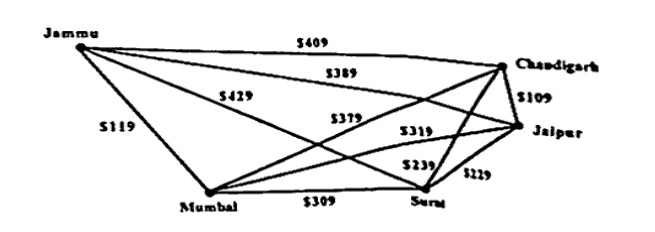
7 MarksbFind a route with the least total airfare that visits each of the cities in this graph, where the weight on an edge is the least price available for a flight between the two cities.
How to answer
- Identify vertices: Jammu, Mumbai, Surat, Jaipur, Chandigarh.
- List all possible Hamiltonian circuits starting from a fixed vertex (e.g., Jammu).
- Calculate the sum of airfares for each possible cycle.
- Compare total costs of the circuits.
- State the optimal sequence of cities and the minimum total airfare.
-
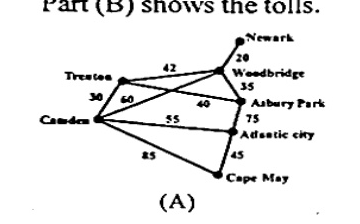
7 MarksaThe weighted graphs in the figures here show some major roads in New Jersey. Part (A) shows the distances between cities on these roads; Part (B) shows the tolls. Find a shortest route in distance between Newark and Camden, and between Newark and Cape May, using these roads.
How to answer
- Apply Dijkstra's algorithm or inspection on Graph (A) starting from Newark.
- Determine paths to Camden: Newark -> Woodbridge -> Trenton -> Camden (20 + 42 + 30 = 92) vs Newark -> Woodbridge -> Camden (20 + 60 = 80) vs Newark -> Woodbridge -> Asbury Park -> Camden (20 + 35 + 40 = 95). Shortest to Camden is via Woodbridge (distance = 80).
- Determine paths to Cape May from Newark via Camden or Atlantic City.
- Calculate total minimum distance and state the full shortest routes.
-
7 MarksbFind a least expensive route in terms of total tolls using the roads in the graph between the pairs of cities in part (A).
How to answer
- Consider Graph (B) edge weights representing tolls.
- Find minimum toll route from Newark to Camden: calculate Newark -> Woodbridge ($0.60) -> Camden ($0.00) = $0.60.
- Find minimum toll route from Newark to Cape May: evaluate routes continuing from Camden (e.g., Camden -> Atlantic City ($0.00) -> Cape May ($0.75), total toll = $0.60 + $0.00 + $0.75 = $1.35).
- State the optimal least-toll routes and their total toll values.
-
7 MarksaCalculate the gradient of the function $f(X) = \text{Tr}(X^T X)$, where $X$ is a matrix.
How to answer
- Express the trace function in component form: $f(X) = \text{Tr}(X^T X) = \sum_{i} (X^T X)_{ii} = \sum_{i} \sum_{j} X_{ji} X_{ji} = \sum_{i,j} X_{ij}^2$.
- Compute partial derivative with respect to an arbitrary element $X_{ij}$: $\frac{\partial f}{\partial X_{ij}} = 2X_{ij}$.
- Combine the scalar partial derivatives into matrix form: $\nabla_X f(X) = \left[\frac{\partial f}{\partial X_{ij}}\right] = 2X$.
- Alternatively, use differential notation: $d(\text{Tr}(X^T X)) = \text{Tr}(d(X^T) X + X^T dX) = 2\text{Tr}(X^T dX) \implies \nabla_X f(X) = 2X$.
-
7 MarksbWrite a short note on Cholesky Decomposition.
How to answer
- Define Cholesky decomposition: Factorization of a Hermitian/symmetric positive-definite matrix $A$ into $A = L L^T$ (or $L L^*$), where $L$ is a lower triangular matrix with real and positive diagonal entries.
- State necessary and sufficient condition: $A$ must be symmetric (or Hermitian) and positive definite.
- Provide algorithmic formula for elements: $L_{jj} = \sqrt{A_{jj} - \sum_{k=1}^{j-1} L_{jk}^2}$ and $L_{ij} = \frac{1}{L_{jj}} \left(A_{ij} - \sum_{k=1}^{j-1} L_{ik} L_{jk}\right)$.
- List applications: Solving linear systems, Monte Carlo simulations, Kalman filters, optimization.
-
7 MarksaDefine Hypothesis. Write a short note on Null Hypothesis and Alternative Hypothesis.
How to answer
- Define statistical hypothesis: An assumption or proposition about a population parameter.
- Define Null Hypothesis ($H_0$): A statement of no effect, no difference, or status quo to be tested for possible rejection.
- Define Alternative Hypothesis ($H_1$ or $H_a$): The claim that contradicts $H_0$, indicating existence of an effect or difference.
- Briefly contrast their roles in decision making and error types (Type I and Type II).
-
7 MarksbSuppose the average salary of a principal in a college in the private sector is Rs. 45,000 per month, and a sample of 50 principals has a mean of Rs. 48,326 with a significance level of $\alpha = 0.05$. Can we claim that principals earn Rs. 45,000 per month, given that the standard deviation of the population is Rs. 1,523?
How to answer
- Set up hypotheses: $H_0: \mu = 45000$ vs $H_1: \mu \neq 45000$.
- Compute test statistic: $z = \frac{48326 - 45000}{1523 / \sqrt{50}} = \frac{3326}{215.38} \approx 15.44$.
- State critical value for two-tailed test at $\alpha = 0.05$: $z_{critical} = \pm 1.96$.
- Compare: $|z| = 15.44 > 1.96$, so reject $H_0$.
- Conclusion: Reject the null hypothesis; we cannot claim that principals earn Rs. 45,000 per month.
-
14 MarksWrite short note on any two: a) Recurrence Relation b) Tautologies and Contradiction c) Time Series Analysis
How to answer
- For (a) Recurrence Relation: Definition, homogeneous vs non-homogeneous, degree, examples (Fibonacci relation).
- For (b) Tautologies and Contradiction: Definition of tautology (always true) and contradiction (always false), truth tables and simple propositional examples.
- For (c) Time Series Analysis: Definition of time series, four components (trend, seasonal, cyclical, irregular variations), applications in forecasting.
Go to where you left off?
Quick Add to Notes
Save questions, your own notes and screenshots into notes filed by unit. It takes a free account.
Create free accountHave an account? Log in
Notes Panel