BT-204 · Basic Civil Engineering & Mechanics/Unsolved PYQ Paper
BT-204 Basic Civil Engineering and Engineering Mechanics - Dec 2024 Question Paper
Under each question, How to answer lists the points an answer should cover, outlined by CampusPrep from the syllabus. Check the details against your textbook.
-
7 MarksaWrite on the characteristics of concrete's chemical and physical state.
How to answer
- Chemical state: hydration process, formation of C-S-H gel, heat of hydration, alkali-aggregate reaction
- Physical state: fresh state workability, setting time, segregation, bleeding
- Hardened state: compressive strength, density, permeability, durability
-
7 MarksbUse a sketch to illustrate each Theodolite component.
How to answer
- Neat labeled diagram of a transit theodolite
- Label components: telescope, vertical circle, horizontal vernier/plates, upper and lower clamps/tangent screws, levelling screws, tribrach, plumb bob attachment
- Brief explanation of the main functional parts
-
7 MarksaGive a brief explanation of remote sensing and how it is used in the building industry.
How to answer
- Definition of remote sensing and working principle (sensors, electromagnetic radiation)
- Applications in construction/building industry: site selection, terrain mapping, progress monitoring, structural deformation monitoring
- Environmental impact assessment and resource management
-
7 MarksbBriefly talk about the concrete preparation procedure.
How to answer
- Batching of materials (by volume or weight)
- Mixing (hand mixing vs machine mixing)
- Transportation of fresh concrete
- Placing and compaction of concrete
- Finishing and initial curing
-
7 MarksaDescribe in brief about the different types of RCC footing.
How to answer
- Classification of RCC footings: Isolated (pad, stepped, sloped)
- Combined footing (rectangular, trapezoidal)
- Strap/cantilever footing
- Raft/Mat foundation and pile caps
- Sketches of common footing types
-
7 MarksbBriefly discuss the compaction and curing process.
How to answer
- Purpose and methods of compaction (hand compaction, mechanical vibrators)
- Effects of improper compaction (honeycombing, loss of strength)
- Purpose and significance of curing (maintaining moisture and temperature)
- Common methods of curing (ponding, wet covering, spraying, membrane curing)
-
6 MarksaExplain in briefly about the Reciprocal levelling.
How to answer
- Principle of reciprocal levelling across obstacles (river, ravine)
- Elimination of instrument error (collimation error) and combined error due to earth curvature and refraction
- Procedure and derivation: $h = \frac{(a_1 - b_1) + (a_2 - b_2)}{2}$
- Accompanying sketch showing instrument setups at stations A and B
-
8 MarksbThe following are the consecutive reading were taken with a levelling instrument at intervals of $20\text{ m}$. $3.375$, $2.730$, $1.615$, $2.450$, $3.835$, $5.070$, $4.835$, $2.985$, $4.435$, $2.630$, $4.255$ and $5.630\text{ m}$. The instrument was shifted after the fourth and eight reading. The last reading was taken on a BM of RL $125.250\text{ m}$. Find the RLs of all the point using Rise and Fall method and satisfy the answer with arithmetic Check.
How to answer
- Identify BS, IS, FS: Setup 1: BS=3.375, IS=2.730, 1.615, FS=2.450; Setup 2: BS=3.835, IS=5.070, 4.835, FS=2.985; Setup 3: BS=4.435, IS=2.630, 4.255, FS=5.630
- Calculate Rise and Fall between consecutive readings
- Back-calculate RL of initial and intermediate stations using the given last station RL = 125.250 m
- Tabulate Station, BS, IS, FS, Rise, Fall, RL, Remarks
- Apply arithmetic check: $\sum BS - \sum FS = \sum Rise - \sum Fall = Last RL - First RL$
-
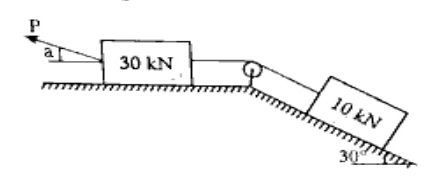
6 MarksaFind the least value of P required to cause the system of blocks shown in Figure to have impending motion to the left. The coefficient of friction under each block is $0.20$.
How to answer
- Draw free body diagram for the 10 kN block on 30° incline moving up the plane (since system moves left)
- Determine normal force $N_2 = 10 \cos 30^\circ$ and friction $F_2 = 0.2 N_2$ pointing down the incline; solve for cable tension $T = 10 \sin 30^\circ + 0.2 (10 \cos 30^\circ)$
- Draw free body diagram for the 30 kN block moving left; normal force $N_1 = 30 - P\sin\alpha$, friction $F_1 = 0.2 N_1$ pointing right
- Set up equilibrium equation $\sum F_x = 0 \implies P\cos\alpha = T + 0.2(30 - P\sin\alpha)$
- Find minimum $P$ with respect to angle $\alpha$ ($ an\alpha = \mu = 0.2$) and compute least value of $P$
-
8 MarksbThe following offset were taken from a line to an irregular boundary line at an interval of $10\text{ m}$. $0$, $3.500$, $2.550$, $5.250$, $6.650$, $4.250$, $0\text{ m}$. Compute the area between the chain line, the irregular boundary line and the end offsets by i) Mid-Ordinate Rule ii) Average-Ordinate Rule iii) The Trapezoidal Rule iv) Simpson's Rule
How to answer
- i) Mid-ordinate rule: Calculate mid-ordinates $h_i = (O_{i-1}+O_i)/2$; Area = $d \sum h_i = 10 \times (1.75 + 3.025 + 3.9 + 5.95 + 5.45 + 2.125) = 222\text{ m}^2$
- ii) Average ordinate rule: $\sum O = 22.2\text{ m}$, $N=7$; Area = $L \times (\sum O / 7) = 60 \times (22.2 / 7) \approx 190.29\text{ m}^2$
- iii) Trapezoidal rule: Area = $10 \times [0 + 3.500 + 2.550 + 5.250 + 6.650 + 4.250] = 222.0\text{ m}^2$
- iv) Simpson's rule: Area = $\frac{10}{3} [ (0+0) + 4(3.500 + 5.250 + 4.250) + 2(2.550 + 6.650) ] = \frac{10}{3} [ 52 + 18.4 ] = 234.67\text{ m}^2$
-
4 MarksaWrite down the assumption used in Method of the joints.
How to answer
- All members are connected at their ends by frictionless smooth pins or hinges
- Loads and reactions act only at the joints (nodes)
- The centroidal axis of each member coincides with the line connecting joint centers
- The self-weight of the members is neglected or lumped equally at adjacent joints
- All members are perfectly straight two-force members carrying only axial tension or compression
-
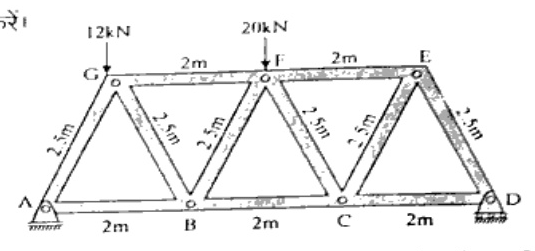
10 MarksbSolve the force in all the member using the using method of joint.
How to answer
- Determine truss geometry: panel length = 2 m, diagonal = 2.5 m $\implies$ height $h = \sqrt{2.5^2 - 1^2} = \sqrt{5.25} \approx 2.291\text{ m}$, $\cos\theta = 1/2.5 = 0.4$, $\sin\theta = \sqrt{5.25}/2.5 \approx 0.9165$
- Calculate support reactions: taking moments about A: $R_D \times 6 = 12 \times 1 + 20 \times 3 \implies R_D = 12\text{ kN}$, $R_A = 20\text{ kN}$
- Analyze joints sequentially using $\sum F_x = 0, \sum F_y = 0$: Joint A, Joint G, Joint B, Joint F, Joint C, Joint E, Joint D
- Tabulate the member forces indicating magnitude and nature (Tension/Compression)
-
6 MarksaProvide the detailed procedure to draw the shear force and bending moment diagram under point load, U.D.L. and Couple.
How to answer
- Sign conventions for shear force and bending moment
- Step 1: Calculate reactions using equations of static equilibrium ($\sum F_y = 0, \sum M = 0$)
- Step 2: Variation under point load: sudden vertical jump in SFD; linear variation in BMD
- Step 3: Variation under UDL: inclined straight line in SFD; parabolic curve in BMD
- Step 4: Variation under concentrated couple: no change in SFD; sudden vertical jump/drop in BMD
- Step 5: Identify points of zero shear and maximum bending moment, and points of contraflexure
-
8 MarksbDraw the shear force and bending moment diagram for the simple supported beam of the length "L" carrying U.D.L. of "W" kN/m throughout its length of the beam and also find the max bending moment and shear force.
How to answer
- Find reactions: $R_A = R_B = \frac{WL}{2}$
- Derive SF equation at section $x$: $V(x) = \frac{WL}{2} - Wx$; linearly decreasing from $+WL/2$ at $x=0$ to $-WL/2$ at $x=L$
- Maximum shear force $V_{\max} = \frac{WL}{2}$
- Derive BM equation at section $x$: $M(x) = \frac{WL}{2}x - \frac{Wx^2}{2}$; parabolic profile with zero at supports
- Find maximum bending moment at $x = L/2$: $M_{\max} = \frac{WL^2}{8}$
- Draw neat sketches of the beam, SFD, and BMD
-
14 MarksExplain in brief about the any two: i) Principle Axes with the example ii) Product of inertia with the example iii) Moment of inertia of Rectangular Shape
How to answer
- i) Principal Axes: definition (axes about which product of inertia is zero; maximum and minimum moment of inertia), orientation formula $\tan 2\theta = -\frac{2I_{xy}}{I_x - I_y}$, example with symmetrical section
- ii) Product of Inertia: definition $I_{xy} = \int xy\, dA$, sign significance, theorem of parallel axes for product of inertia, example of an unsymmetrical section (e.g. angle section)
- iii) Moment of inertia of rectangular shape: derivation using strip of thickness $dy$ at distance $y$, $I_{xx} = \int_{-d/2}^{d/2} b y^2 dy = \frac{bd^3}{12}$, and about base $I_{\text{base}} = \frac{bd^3}{3}$
Go to where you left off?
Quick Add to Notes
Save questions, your own notes and screenshots into notes filed by unit. It takes a free account.
Create free accountHave an account? Log in
Notes Panel