BT-204 · Basic Civil Engineering & Mechanics/Unsolved PYQ Paper
BT-204 Basic Civil Engineering and Engineering Mechanics - Dec 2023 Question Paper
Under each question, How to answer lists the points an answer should cover, outlined by CampusPrep from the syllabus. Check the details against your textbook.
-
7 MarksaWhat are the contour lines and explain its various properties?
How to answer
- Definition of contour line (imaginary line joining points of equal elevation)
- Key characteristics/properties: contours never cross except at overhanging cliff
- Closely spaced contours indicate steep slope, widely spaced indicate gentle slope
- Concentric closed contours with higher values inside indicate a hill, lower inside indicate a depression
- Contours cross a ridge or valley line at right angles
-
7 MarksbWhat do you understand by the term moment of inertia and radius of gyration?
How to answer
- Definition of moment of inertia (second moment of area/mass) and mathematical expression ($I = \int r^2 dA$ or $\sum m r^2$)
- Physical significance and units (mm$^4$ or kg$\cdot$m$^2$)
- Definition of radius of gyration ($k$): distance from reference axis where entire area/mass is assumed to be concentrated
- Formula: $k = \sqrt{I/A}$ or $k = \sqrt{I/M}$ and units (m or mm)
-
7 MarksaWrite short notes on any four of the followings:
- i)Shallow foundation
- ii)Survey stations
- iii)Indian Remote Sensing Satellite
- iv)Geodetic surveying
- v)Free body diagram
How to answer
- Shallow foundation: definition ($D_f \le B$), types (isolated, combined, strap, raft)
- Survey stations: main stations, subsidiary stations, tie stations and their marking/selection
- IRS: Indian Remote Sensing Satellite series (IRS-1A, Cartosat, Resourcesat), civilian remote sensing applications
- Geodetic surveying: accounts for curvature of Earth, large areas (> 250 km$^2$), high precision
- Free body diagram: isolated sketch of body showing all external active and reactive forces
-
7 MarksbWhat is the workability of concrete? Explain those factors that affecting the workability of concrete.
How to answer
- Definition of workability: ease of mixing, placing, compacting, and finishing concrete without segregation
- Water content/water-cement ratio: higher water increases workability
- Aggregate size and shape: rounded aggregates require less water than angular ones
- Aggregate grading and surface texture: smooth/well-graded improves workability
- Use of admixtures: plasticizers/superplasticizers increase workability without extra water
- Environmental factors: temperature, wind, transit time
-
7 MarksaExplain nominal and design mix concrete in details.
How to answer
- Definition of nominal mix: fixed volumetric proportions specified by codes (e.g., M15, M20) without lab design
- Definition of design mix: proportions determined through laboratory trials based on actual material characteristics for target strength
- Comparison: nominal mix uses volume batching, design mix uses weigh batching
- Economy: design mix is more economical and ensures required durability and strength
- Applications: nominal for minor/low-grade works ($≤$ M20), design mix for high-strength/structural works
-
7 MarksbWhat are the principle and applications of the remote sensing in the Civil Engineering?
How to answer
- Working principle of remote sensing: interaction of EMR with target, reflection/emission, sensor detection, and data processing
- Components: energy source, transmission path, target, sensor, receiving station
- Applications in Civil Engineering:
- - Site selection for dams, highways, bridges
- - Water resource management and flood mapping
- - Urban planning and land use/land cover mapping
- - Disaster management and environmental impact assessment
-
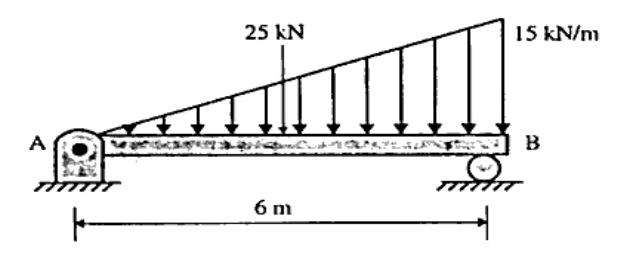
7 MarksaDraw the shear force and bending moment diagram for simply supported beam, which carries a uniformly varying load of $15\text{ kN/m}$ and a point load of $25\text{ kN}$ on its center having span of $6\text{ m}$.
How to answer
- Calculate total UVL = $\frac{1}{2} \times 15 \times 6 = 45\text{ kN}$, acting at $2/3 \times 6 = 4\text{ m}$ from support A
- Taking moments about A: $R_B \times 6 = 25 \times 3 + 45 \times 4 = 75 + 180 = 255 \implies R_B = 42.5\text{ kN}$
- Vertical equilibrium: $R_A = (45 + 25) - 42.5 = 27.5\text{ kN}$
- Plot Shear Force Diagram: parabolic variation from UVL plus vertical jump of $25\text{ kN}$ downward at mid-span
- Find point of zero shear to locate maximum bending moment
- Plot Bending Moment Diagram: cubic curves, maximum value calculated and marked
-
7 MarksbDefine any two-field test; those are conducted on cement and sand.
How to answer
- Cement field test 1: Color test (uniform greenish-grey) and touch/feeling test (smooth feeling, not gritty)
- Cement field test 2: Temperature test (hand plunged into cement feels cool) or sink test (paste floats before sinking)
- Sand field test 1: Silt content test (mixing sand with saline water in a measuring cylinder to observe silt layer)
- Sand field test 2: Presence of organic impurities (rubbing on palm) or bulking test
-
7 MarksaWhat is the composition of cement? Explain in detail.
How to answer
- List oxide constituents and typical percentages: Lime (CaO, 60-67%), Silica (SiO$_2$, 17-25%), Alumina (Al$_2$O$_3$, 3-8%), Iron Oxide (Fe$_2$O$_3$, 0.5-6%), Magnesia (MgO, 0.1-4%), Alkalies, Sulfur trioxide
- Functions of each ingredient (Lime imparts strength, Silica imparts strength, Alumina quick setting, Gypsum retards flash setting)
- Harmful effects of excess lime, silica, or magnesia
- Brief mention of Bogue's compounds formed ($C_3S$, $C_2S$, $C_3A$, $C_4AF$)
-
7 MarksbDefine any four of the following terms:
- i)Law of machine
- ii)Initial and final setting time of cement
- iii)Efflorescence
- iv)Curing of concrete
- v)Plastering and pointing
How to answer
- Law of machine: linear relationship between effort ($P$) and load ($W$), $P = mW + C$
- Initial and final setting time: Initial time ($\ge 30$ min) when cement starts losing plasticity; final time ($\le 600$ min) when paste completely hardens
- Efflorescence: whitish powdery deposit on masonry surface due to soluble salts crystallizing after evaporation of water
- Curing of concrete: process of maintaining moisture and temperature conditions for continued hydration and strength gain
- Plastering and pointing: Plastering is covering entire wall surface with mortar; Pointing is finishing only the exposed joints of masonry
-
7 MarksaWhat is the local attraction in surveying? How is it detected at any survey station?
How to answer
- Definition: magnetic disturbance of the compass needle from magnetic meridian due to external magnetic materials (iron ore, steel poles, electric cables)
- Detection: by checking the difference between fore bearing (FB) and back bearing (BB) of a line
- If $|FB - BB| = 180^\circ$, both stations are free from local attraction
- If $|FB - BB| \ne 180^\circ$, one or both stations are affected by local attraction
- Correction methods: method of included angles or correction calculation per station
-
7 MarksbWhat are the various types of doors and windows used in the building construction?
How to answer
- Doors classified by arrangement of components: paneled, battened and ledged/braced, glazed/sash
- Doors classified by operation: hinged, revolving, sliding, swing, rolling shutter, collapsible
- Types of windows: casement window, sash window, sliding window, clerestory window, bay window, skylight, dormer window, louvered window
- Criteria for selection: light, ventilation, security, and aesthetics
-
7 MarksaDefine and derive an expression for parallel axis theorem.
How to answer
- Statement of Parallel Axis Theorem: The moment of inertia of an area about any axis is equal to the moment of inertia about a parallel centroidal axis plus the product of the area and the square of the distance between the two axes ($I_{AB} = I_G + Ah^2$)
- Neat sketch showing area $A$, centroidal axis $G$, parallel axis $AB$ at distance $h$, and elemental area $dA$
- Mathematical setup: $I_{AB} = \int (y + h)^2 dA = \int (y^2 + 2yh + h^2) dA$
- Expansion: $I_{AB} = \int y^2 dA + 2h \int y dA + h^2 \int dA$
- Since $\int y dA = 0$ (centroidal axis) and $\int y^2 dA = I_G$, $\int dA = A$, result follows: $I_{AB} = I_G + Ah^2$
-
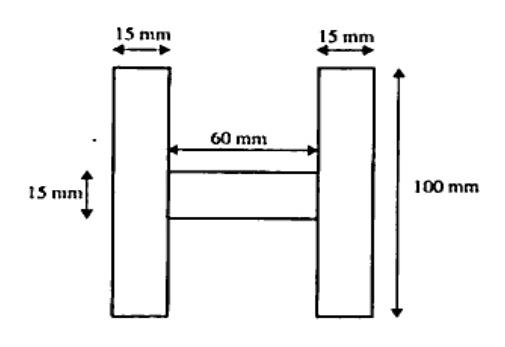
7 MarksbDetermine the moment of inertia of the given plane lamina about its centroidal axis as shown in the figure below:
How to answer
- Identify symmetry: The H-section is symmetric about both horizontal and vertical axes passing through the center
- Total width = $15 + 60 + 15 = 90\text{ mm}$, total depth = $100\text{ mm}$
- Calculation of $I_{xx}$:
- - Two vertical flanges: $2 \times [\frac{1}{12} \times 15 \times 100^3] = 2.5 \times 10^6\text{ mm}^4$
- - One central web: $\frac{1}{12} \times 60 \times 15^3 = 16,875\text{ mm}^4$
- - Total $I_{xx} = 2.5 \times 10^6 + 16,875 \approx 2.517 \times 10^6\text{ mm}^4$
- Calculation of $I_{yy}$:
- - Web: $\frac{1}{12} \times 15 \times 60^3 = 270,000\text{ mm}^4$
- - Flanges: $2 \times [\frac{1}{12} \times 100 \times 15^3 + (100 \times 15) \times (30 + 7.5)^2] = 2 \times [28,125 + 1500 \times 37.5^2] = 4.275 \times 10^6\text{ mm}^4$
- - Total $I_{yy} = 270,000 + 4.275 \times 10^6 = 4.545 \times 10^6\text{ mm}^4$
-
7 MarksaWrite short notes on any four of the following terms:
- i)Magnetic declination
- ii)Bow's notation
- iii)Plane tables
- iv)D-Alembert's principle
- v)Types of staircase
How to answer
- Magnetic declination: horizontal angle between true north/meridian and magnetic north/meridian (east/west)
- Bow's notation: method of lettering spaces between forces/members in a truss in clockwise order
- Plane tables: graphical surveying equipment where field observation and plotting are done simultaneously
- D-Alembert's principle: dynamic equilibrium principle where inertia force ($-ma$) is applied converting dynamic problem into equivalent static problem ($\sum F - ma = 0$)
- Types of staircase: straight, dog-legged, open well, spiral, helical, geometrical
-
7 MarksbWhat do you understand by support reactions and its type? Explain shear force and bending moment for a cantilever beam.
How to answer
- Support reactions: reactive forces and moments exerted by supports to keep a structure in static equilibrium
- Types of supports: roller (1 vertical reaction), hinged/pinned (2 reactions: horizontal and vertical), fixed (3 reactions: horizontal, vertical, and moment)
- Cantilever beam definition: fixed at one end and free at the other
- SF and BM for cantilever: usually subjected to negative (hogging) bending moment throughout
- Example sketch: cantilever under point load or UDL with corresponding SFD and BMD shapes
Go to where you left off?
Quick Add to Notes
Save questions, your own notes and screenshots into notes filed by unit. It takes a free account.
Create free accountHave an account? Log in
Notes Panel