ME-801 · Refrigeration & Air Conditioning/Unsolved PYQ Paper
ME-801 Refrigeration and Air Conditioning - Jun 2025 Question Paper
Under each question, How to answer lists the points an answer should cover, outlined by CampusPrep from the syllabus. Check the details against your textbook.
-
7 MarksaExplain the term "tonne of refrigeration". Discuss the advantages of the dense air refrigerating system over an open air refrigeration system.
How to answer
- Define 1 tonne of refrigeration as 210 kJ/min / 3.5 kW cooling effect
- Explain basis of ice melting from 0C in 24 hrs
- List features of dense air system - closed, high pressure, smaller size
- Advantages over open system - no moisture entry, smaller compressor/expander, higher COP, less frost
-
7 MarksbThe capacity of a refrigerator is 400 TR when working between $-12^{\circ}C$ and $35^{\circ}C$. Determine the mass of ice produced per day from water at $25^{\circ}C$. Also find the power required to drive the unit. Assume that the cycle operates on reversed Carnot cycle and latent heat of ice is 335 kJ/Kg.
How to answer
- Calculate reversed Carnot COP = TL/(TH-TL)
- Calculate refrigerating effect = 400 TR in kJ/s
- Calculate heat to remove per kg: sensible water 25C to 0C + latent 335 kJ/Kg
- Divide total daily refrigeration by per kg to get ice mass and power = RE/COP
-
7 MarksaThe temperature limits of an ammonia refrigerating system are $25^{\circ}C$ and $-10^{\circ}C$. If the gas is dry at the end of compression, calculate the coefficient of performance of the cycle assuming no under-cooling of the liquid ammonia. Use the following table for properties of ammonia:
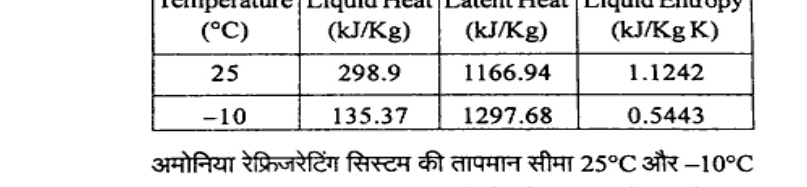
How to answer
- Identify states: dry saturated vapour after compression at 25C condenser
- Use entropy balance to find dryness after expansion/throttling
- Calculate refrigerating effect = h1 - h4 and work = h2 - h1
- Compute COP = RE / work using table values
-
7 MarksbExplain the function liquid intercooler in multistage compression system.
How to answer
- Define liquid intercooler / flash intercooler location between stages
- Explain subcooling of high pressure liquid by flash vapour
- Explain reduction in flash gas and increase in refrigerating effect
- Mention reduction in power and improved COP
-
7 MarksaWhat is the basic function of a compressor in vapour compression refrigeration system? How this function is achieved in vapour absorption refrigeration system?
How to answer
- State compressor function: raise pressure/temperature and circulate refrigerant
- Explain suction of low pressure vapour and discharge to condenser
- Explain equivalent in VARS: generator + absorber + pump as thermal compressor
- Mention pressure rise by heating and pumping solution
-
7 MarksbDefine Primary refrigerant. What are the desirable properties of a primary refrigerant? Give the refrigerant number for the following: $CHClF_{2}$, $CH_{2}F-CF_{3}$ and $NH_{3}$.
How to answer
- Define primary refrigerant as working fluid undergoing phase change
- List desirable properties: thermodynamic, chemical, physical, safety
- Assign R-22 to CHClF2, R-134a to CH2F-CF3, R-717 to NH3
- Explain numbering logic briefly
-
7 MarksaAtmospheric air at dry bulb temperature of $16^{\circ}C$ and 25% relative humidity passes through a furnace and then through a humidifier, in such a way that the final dry bulb temperature is $30^{\circ}C$ and 50% relative humidity. Find the heat and moisture added to the air. Also determine the sensible heat factor of the process.
How to answer
- Locate initial state 16C 25% RH and final state 30C 50% RH on psychrometric chart
- Calculate enthalpy difference for heat added per kg dry air
- Calculate humidity ratio difference for moisture added
- Compute sensible heat factor = sensible heat / total heat
-
7 MarksbWhat is fog? Show on the psychometric chart when two air streams yield fogged state of air.
How to answer
- Define fog as suspended water droplets due to supersaturation
- Explain mixing of two unsaturated streams resulting in fog
- Sketch psychrometric chart with mixing line crossing saturation curve
- Mark fog region and mist state
-
7 MarksaWhat is the basic difference between the requirements for Comfort and Industrial air conditioning?
How to answer
- Define comfort AC for human occupancy vs industrial for process/product
- Compare temperature, humidity, air motion, purity requirements
- Compare control precision, operating hours, load variation
- Give examples of each
-
7 MarksbAn air conditioning plant is required to supply 60 $m^{3}$ of air per minute at a DBT of $21^{\circ}C$ and 55% RH. The outside air is at DBT of $28^{\circ}C$ and 60% RH. Determine the mass of water drained and capacity of the cooling coil. Assume the air conditioning plant first to dehumidify and then to cool the air.
How to answer
- Locate outside 28C 60% RH and supply 21C 55% RH on chart, get w and h
- Calculate mass flow of air from 60 m3/min and specific volume
- Mass of water drained = m_dot*(w_outside - w_supply)
- Cooling coil capacity = m_dot*(h_outside - h_supply)
-
14 MarksWrite short notes on any three:
- i)Steam jet refrigeration.
- ii)Environment friendly refrigerants.
- iii)Leak detection methods
- iv)By pass factor of coil.
How to answer
- Explain principle, components and working for each selected topic
- Give neat sketch / equation where relevant
- Mention applications / advantages / limitations
- Conclude with significance in RAC
-
7 MarksaWhat is multi-stage vapour compression refrigeration system? Compare it with cascade refrigeration system.
How to answer
- Define multistage VCRS with multiple compression stages and intercooling
- Define cascade with separate circuits and cascade condenser
- Compare on refrigerant, temperature range, heat exchanger, applications
- Mention COP and complexity differences
-
7 MarksbDefine the terms:
- i)Cooling and dehumidification process.
- ii)Sensible heating and sensible cooling process.
How to answer
- Define cooling and dehumidification with psychrometric line and coil ADP
- Define sensible heating as DBT rise at constant w
- Define sensible cooling as DBT fall at constant w
- Show processes on psychrometric sketch
-
7 MarksaA machine working on a Carnot cycle operates between 305 K and 260 K Determine the C.O.P. when it is operand as
- i)A refrigerating machine
- ii)A heat pump
- iii)A heat engine
How to answer
- Write Carnot COP formulas for refrigerator, heat pump, engine
- Substitute TH=305 K, TL=260 K
- Compute COP_ref = TL/(TH-TL), COP_hp = TH/(TH-TL)
- Compute engine efficiency = (TH-TL)/TH
-
7 MarksbExplain the applications of refrigeration for food preservation. Explain how refrigeration controls the spoilage of food.
How to answer
- List refrigeration applications in food: chilling, freezing, cold storage, transport
- Explain microbial, enzymatic and chemical spoilage factors
- Explain how low temperature slows bacteria and enzyme action
- Mention shelf life, nutritional and quality preservation
Go to where you left off?
Quick Add to Notes
Save questions, your own notes and screenshots into notes filed by unit. It takes a free account.
Create free accountHave an account? Log in
Notes Panel