ME-504 (C) · Finite Element Method/Unsolved PYQ Paper
ME-504-C Finite Element Method - Dec 2024 Question Paper
Under each question, How to answer lists the points an answer should cover, outlined by CampusPrep from the syllabus. Check the details against your textbook.
-
7 MarksaDifferentiate between the Local coordinates, Global coordinates and Natural coordinates in Finite Element Method (FEM).
How to answer
- Define local coordinates (element-level system)
- Define global coordinates (whole-structure system) and transformation
- Define natural coordinates (normalized intrinsic system, e.g., xi-eta)
- Compare purpose, range, and use in FEM formulation/integration
-
7 MarksbWhat is the Stiffness Matrix? Write the Stiffness Matrix for the beam element.
How to answer
- Define stiffness matrix as force-displacement relation k
- Explain physical meaning and properties
- Write beam element stiffness matrix in terms of EI, L
- Mention DOF (transverse deflection and rotation)
-
7 MarksaDescribe the use of Skeletal and continuum structures in Finite Element Method.
How to answer
- Define skeletal (frame/truss/beam) structures
- Define continuum (2D/3D solid) structures
- Explain element choice and modelling approach for each
- Give examples of FEM application
-
7 MarksbMention the difference between Finite element method and Classical method? Write down the element Stiffness matrix for 2-D beam element.
How to answer
- List differences: discretization, accuracy, complexity, applicability
- Explain classical (closed-form) vs FEM (piecewise approximation)
- Write 2-D beam element stiffness matrix (axial + bending combined)
- Mention DOF per node
-
7 MarksaDerive the Shape functions for a 4 Node (corner) rectangular element using Lagrange method.
How to answer
- State Lagrange interpolation in natural coordinates
- Form 1-D linear functions in xi and eta
- Multiply to get four $N_i$ for corner nodes
- Verify Kronecker delta property $N_i=1$ at node i
-
7 MarksbDescribe Galerkin approach and how to use in FEM analysis? Explain the features of Hermitian interpolation function with an example.
How to answer
- Describe Galerkin weighted-residual approach ($w = N$)
- Explain formation of weak form and element equations
- Define Hermitian interpolation (C1 continuity for deflection and slope)
- Give beam element example with features
-
7 MarksaDiscuss the steps involved in the finite element formulation of a physical system. What are its major advantages and limitations?
How to answer
- List steps: discretization, shape functions, element matrices, assembly, BCs, solution
- Explain formulation for physical system
- List major advantages (complex geometry, boundary conditions)
- List limitations (approximation error, computational cost)
-
7 MarksbDescribe 2D rectangular and Triangular elements in Finite element problem formulation.
How to answer
- Describe 2D rectangular element (4-node, bilinear)
- Describe triangular element (3-node CST)
- Explain DOF, shape functions and applications
- Compare meshing suitability
-
7 MarksaA steel rod subjected to compression is modeled by two bar elements, as shown in figure. Determine the nodal displacement and the axial stress in each element. What other concern should be examined?
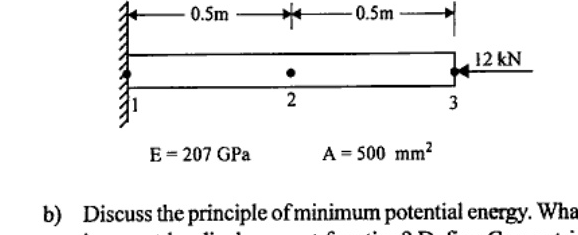
How to answer
- Assemble two bar element stiffness matrices with $E, A, L$
- Apply fixed BC at node 1 and $12\,kN$ load at node 3
- Solve for nodal displacements $u_2, u_3$
- Compute element stresses $\sigma = E\,du/dx$ and discuss buckling/other concern
-
7 MarksbDiscuss the principle of minimum potential energy. What is meant by displacement function? Define Geometric Variance.
How to answer
- State principle of minimum potential energy ($\Pi$ stationary)
- Define displacement (interpolation) function
- Define geometric variance / invariance concept
- Explain relevance to convergence
-
7 MarksaDerive the Constant Strain Triangle (CST) infinite element modeling isoperimetric representation.
How to answer
- Define CST element and isoparametric concept
- Write displacement and geometry interpolation with same shape functions
- Derive strain-displacement and element matrices
- Discuss modelling aspects
-
7 MarksbDerive the Jacobian for a four-node rectangular element having coordinates $(0, 0)$, $(4, 0)$, $(4, 2)$ and $(0, 2)$.
How to answer
- Write isoparametric mapping $x=\sum N_i x_i$, $y=\sum N_i y_i$
- Compute derivatives w.r.t. $\xi,\eta$ for given rectangle
- Form Jacobian matrix and evaluate determinant
- State constant Jacobian result for rectangle
-
7 MarksaDiscuss the errors involved in finite element solution with the example of a model second order differential equation in one dimension.
How to answer
- Define discretization, interpolation and integration errors
- Use 1D second-order ODE model to illustrate
- Explain convergence, mesh refinement effect
- Discuss error estimation and control
-
7 MarksbA composite plane wall consists of three materials with conduction and convective coefficient given as $(k_1, k_2, k_3)$ and $(h_1, h_2, h_3)$ with cross sectional area 'A' each. Find the effective resistance with an analogy to thermal circuit. Develop global matrix for temperature change from $400^{\circ}C$ to $100^{\circ}C$ from one side of wall to other side.
How to answer
- Draw thermal circuit analogy for three-layer wall
- Combine conductive $L/kA$ and convective $1/hA$ resistances
- Find effective resistance expression
- Assemble global conductivity matrix for $400^{\circ}C$ to $100^{\circ}C$
-
7 MarksaWrite a detailed note on Derivation of mass matrices for 1D elements with the help of a related examples.
How to answer
- Define consistent vs lumped mass matrix
- Derive 1D bar/beam mass matrix using $m=\int \rho N^T N dV$
- Give explicit $2\times2$ matrix example
- Discuss application in dynamics
-
7 MarksbState Kirchhoff's theory and Mindlin theory for plate bending problem. Using four corner nodes plate, explain displacement, rotation, strain force and moments for both.
How to answer
- State Kirchhoff (thin plate, normals remain normal) assumptions
- State Mindlin (shear deformable) assumptions
- Explain 4-corner-node plate DOF: w, rotations
- Compare strain, force and moment resultants for both
Go to where you left off?
Quick Add to Notes
Save questions, your own notes and screenshots into notes filed by unit. It takes a free account.
Create free accountHave an account? Log in
Notes Panel