ME-503 (B) · Dynamics of Machine/Unsolved PYQ Paper
ME-503-B Dynamics of Machine - Nov 2023 Question Paper
Under each question, How to answer lists the points an answer should cover, outlined by CampusPrep from the syllabus. Check the details against your textbook.
-
7 MarksaIn a pin jointed four bar mechanism ABCD, the lengths of various links are as follows: $AB = 25\ mm$; $BC = 87.5\ mm$; $CD = 50\ mm$ and $AD = 80\ mm$. The link AD is fixed and the angle $BAD = 135^{\circ}$. If the velocity of B is $1.8\ m/s$ in the clockwise direction, find:
- i)Velocity and acceleration of the mid point of BC
- ii)Angular velocity and angular acceleration of link CB and CD.
How to answer
- State given link lengths AB, BC, CD, AD and configuration angle BAD = 135 deg with AD fixed.
- Draw space diagram and velocity diagram to get velocity of mid-point of BC and angular velocities.
- Draw acceleration diagram including tangential and centripetal components.
- Report magnitude and direction of mid-point velocity/acceleration and angular velocity/acceleration of CB and CD.
-
7 MarksbDerive the following expressions, for an uncoupled two cylinder locomotive engine:
- i)Swaying couple
- ii)Hammer blow
How to answer
- Define uncoupled two-cylinder locomotive with cranks at 90 deg and reciprocating masses.
- Derive unbalanced primary force along and across stroke leading to swaying couple expression.
- Derive vertical unbalanced force variation leading to hammer blow expression.
- State formulas with $m, r, \omega, a$ (distance between cylinders) and angle $\theta$.
-
10 MarksaIn a turning moment diagram, the areas above and below the mean torque line taken in order are $4400$, $1150$, $1300$ and $4550\ mm^2$ respectively. The scales of the turning moment diagram are: Turning moment, $1\ mm = 100\ N\text{-}m$; Crank angle, $1\ mm = 1^{\circ}$ Find the mass of the flywheel required to keep the speed between $297$ and $303\ r.p.m.$, if the radius of gyration is $0.525\ m$.
How to answer
- Compute energy from areas above/below mean torque line using given scales.
- Find maximum fluctuation of energy $\Delta E$.
- Use $\Delta E = I\omega^2 C_s$ with speed range 297-303 r.p.m. and $k=0.525 m$.
- Solve for flywheel mass $m = I/k^2$.
-
4 MarksbExplain the terms 'fluctuation of energy' and 'fluctuation of speed' as applied to flywheels.
How to answer
- Define fluctuation of energy as maximum variation from mean during cycle.
- Define fluctuation of speed / coefficient $C_s = (N1-N2)/N$.
- Explain role of flywheel in storing/releasing energy.
-
14 MarksA Porter governor has links $150\ mm$ long and are attached to pivots at a radial distance of $30\ mm$ from the vertical axis of the governor. The mass of each ball is $1.75\ kg$ and the mass of the sleeve is $25\ kg$. The governor sleeve begins to rise at $300\ r.p.m.$ when the links are at $30^{\circ}$ to the vertical. Assuming the friction force to be constant, find the minimum and maximum speed of rotation when the inclination of the links is $45^{\circ}$ to the vertical.
How to answer
- Write Porter governor height and speed relation with sleeve mass and friction.
- Find friction force from condition that sleeve begins to rise at 300 r.p.m. at 30 deg.
- Apply $N^2 = (m+M)/m \times 895/h$ with +/- friction to get min and max speeds at 45 deg.
- Calculate heights $h = l\cos\alpha$ with pivot offset correction.
-
14 MarksA single cylinder engine runs at $250\ r.p.m.$ and has a stroke of $180\ mm$. The reciprocating parts has a mass of $120\ kg$ and the revolving parts are equivalent to a mass of $70\ kg$ at a radius of $90\ mm$. A mass is placed opposite to the crank at a radius of $150\ mm$ to balance the whole of the revolving mass and two-thirds of the reciprocating mass. Determine the magnitude of the balancing mass and the resultant residual unbalance force when the crank has turned $30^{\circ}$ from the inner dead centre, neglect the obliquity of the connecting rod.
How to answer
- Calculate balancing mass from $m_b r_b = m_{rev}r + (2/3)m_{rec}r$.
- Resolve primary unbalanced forces along and perpendicular to stroke at theta=30 deg.
- Combine revolving residual and reciprocating residual to get resultant.
- Neglect connecting rod obliquity as stated.
-
14 MarksA conical pivot supports a load of $20\ kN$, the cone angle is $120^{\circ}$ and the intensity of normal pressure is not to exceed $0.3\ N/mm^2$. The external diameter is twice the internal diameter. Find the outer and inner radii of the bearing surface. If the shaft rotates at $200\ r.p.m.$ and the coefficient of friction is $0.1$, find the power absorbed in friction. Assume uniform pressure.
How to answer
- Use uniform pressure relation $W = \pi p (R^2+r^2?) $ corrected for cone: $W = \pi p (R^2 - r^2)$ with $D=2d$.
- Solve for outer and inner radii with $p_{max}=0.3 N/mm^2$ and cone angle 120 deg.
- Compute frictional torque $T = (2/3)\mu W (R^3-r^3)/(R^2-r^2) cosec(alpha)$.
- Find power $P = T\omega$ at 200 r.p.m.
-
14 MarksDetermine the maximum, minimum and average pressure in plate clutch when the axial force is $4\ kN$. The inside radius of the contact surface is $50\ mm$ and the outside radius is $100\ mm$. Assume uniform wear.
How to answer
- State uniform wear condition $p\cdot r = C$ for plate clutch.
- Derive $p_{max}$ at inner radius, $p_{min}$ at outer radius, $p_{avg}=W/\pi(R^2-r^2)$.
- Substitute $W=4 kN, r=50 mm, R=100 mm$.
- Report max, min and average pressures.
-
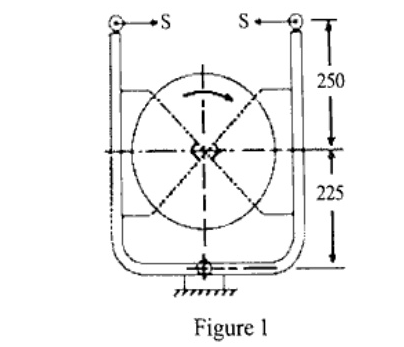
14 MarksThe layout and dimensions of a double shoe brake is shown in Fig. 1. The diameter of the brake drum is $300\ mm$ and the contact angle for each shoe is $90^{\circ}$. If the coefficient of friction for the brake lining and the drum is $0.4$, find the spring force necessary to transmit a torque of $30\ N\text{-}m$. Also determine the width of the brake shoes, if the bearing pressure on the lining material is not to exceed $0.28\ N/mm^2$.
How to answer
- Draw free-body of double shoe brake using Fig.1 dimensions 250 mm and 225 mm.
- Apply moment equilibrium for leading and trailing shoes with $\mu=0.4$ and drum $D=300 mm$.
- Solve for spring force S to transmit $30 N\text{-}m$ torque.
- Find shoe width from $p_{max}=0.28 N/mm^2$ with $90^{\circ}$ contact angle.
-
4 MarksaWhat is the function of a flywheel? How does it differ from that of a governor?
How to answer
- Define flywheel function: store kinetic energy and reduce fluctuation.
- Contrast with governor: regulates mean speed by fuel control vs energy storage.
- Give examples of use.
-
5 MarksbWhat is the difference between absorption and transmission dynamometers? What are torsion dynamometers?
How to answer
- Define absorption dynamometer: absorbs and dissipates power as heat/friction.
- Define transmission dynamometer: transmits power while measuring torque.
- Explain torsion dynamometers measuring twist of shaft to get torque/power.
-
5 MarkscWhat are in-line engines? How are they balanced? It is possible to balance them completely.
How to answer
- Define in-line engine: cylinders in single row along crankshaft.
- Explain primary/secondary force and couple balancing by crank arrangement.
- Discuss possibility of complete balance and residual couples.
Go to where you left off?
Quick Add to Notes
Save questions, your own notes and screenshots into notes filed by unit. It takes a free account.
Create free accountHave an account? Log in
Notes Panel