IT-504 (A) · Artificial Intelligence/Unsolved PYQ Paper
IT-504-A Artificial Intelligence - Dec 2024 Question Paper
Under each question, How to answer lists the points an answer should cover, outlined by CampusPrep from the syllabus. Check the details against your textbook.
-
7 MarksaExplain breadth first search algorithm. Give an example of a problem for which breadth first search would work better than depth first search.
How to answer
- Definition of BFS using queue, level-by-level expansion
- Algorithm steps / pseudocode and time-space complexity
- Example problem e.g. shortest path in unweighted graph / shallow goal
- Comparison why BFS better than DFS for shallowest / optimal solution
- Diagram of example search tree
-
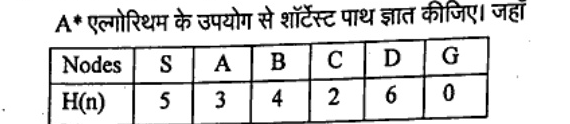
7 MarksbFind the shortest path using A* algorithm. Where
How to answer
- Note heuristic H(n) and edge costs g(n)
- Compute f(n)=g(n)+h(n) iteration-wise with open/closed lists
- Expand minimum f(n) node from S to G
- Trace optimal path and total cost
- Conclude shortest path found by A*
-
7 MarksaApply resolution theorem to prove the following theorem. $P \lor Q, P \to R, Q \to R \Rightarrow R$
How to answer
- Convert premises to clause form and negate conclusion ~R
- Show clauses: (P v Q), (~P v R), (~Q v R)
- Apply resolution steps to derive contradiction / empty clause
- Conclude R follows
- State resolution theorem principle
-
7 MarksbRewrite the following sentences in first order logic
- i)Coconut crunchy is a Biscuit.
- ii)Mary is a child who takes Coconut crunchy.
- iii)John loves children who take biscuits.
- iv)Jay loves Kites.
How to answer
- Identify constants, predicates: Biscuit, Child, Takes, Loves
- Use quantifiers and connectives for each sentence
- Distinguish specific individuals Mary, John, Jay, Coconut crunchy
- Write well-formed FOL formulas i)-iv)
- Maintain consistency of predicate names
-
7 MarksaRepresent each of the following sentences of knowledge by a semantic net
- i)loves (mary, john)
- ii)loves (mary, john) $\land$ Hates (john, mita)
- iii)loves (mary, john) $\to$ Hates (mita, john)
How to answer
- Define nodes for Mary, John, Mita and relation links
- Draw semantic net for loves(mary,john)
- Add Hates link for conjunction case
- Show implication link for conditional case
- Label arcs with relation names
-
7 MarksbConsider the following set of statements. Make a Bayesian network by constructing necessary conditional probability matrix.
- i)Patient has spots.
- ii)Patient has measles.
- iii)Patient has high fever.
- iv)Patient has rocky mountain spotted fever.
- v)Patient has previously been inoculated against measles.
- vi)Patient was recently bitten by a tick.
- vii)Patient has an allergy.
How to answer
- Identify causal variables: measles, inoculation, tick bite, allergy, fevers, spots
- Draw DAG with dependencies and conditional independence
- Construct conditional probability tables for each node
- Explain diagnostic inference from symptoms
- Show example CPT structure
-
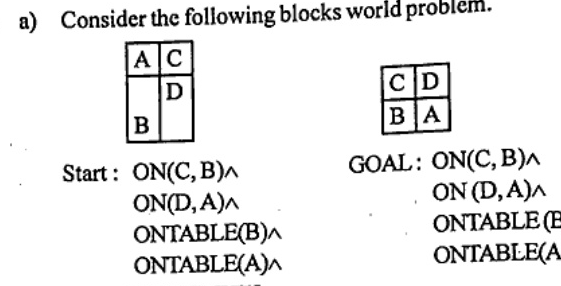
7 MarksaConsider the following blocks world problem. Start : $ON(C,B) \land ON(D,A) \land ONTABLE(B) \land ONTABLE(A) \land ARMEMPTY$ GOAL : $ON(C,B) \land ON(D,A) \land ONTABLE(B) \land ONTABLE(A)$
- i)Show how STRIPS would solve this problem.
- ii)Show how TWEAK would solve this problem.
How to answer
- Describe Start state ON(C,B), ON(D,A), ONTABLE(B), ONTABLE(A), ARMEMPTY and GOAL
- Show STRIPS operators: Pickup, Putdown, Stack, Unstack with preconditions/add/delete
- Give linear plan solving the blocks problem
- Show TWEAK partial-order planning with constraints and threats
- Compare linear vs non-linear planning
-
7 MarksbHow would the minimax procedure have to be modified to be used by a program playing a three or four person game rather than a two person one?
How to answer
- Recall two-player minimax with max-min levels
- Need vector evaluation for 3-4 players, each maximizing own utility
- Propagate utility tuples up the game tree
- Explain alliances / no single opponent assumption
- Discuss pruning limitations
-
7 MarksaGive one domain in which the expert system approach would be more promising and neural network approach would also be more promising.
How to answer
- Define expert system vs neural network strengths
- Give domain e.g. medical diagnosis / rule-based vs pattern recognition
- Justify why expert system promising: explicit rules, explanation
- Justify why neural network promising: learning from data, noisy inputs
- Conclude with example
-
7 MarksbExplain basic model of ANN. What is the difference between biological neurons and artificial neural net?
How to answer
- Describe basic ANN model: inputs, weights, summation, activation, output
- Give neuron output formula and activation functions
- Draw artificial neuron vs biological neuron diagram
- Compare: dendrites/axon/synapse vs inputs/outputs/weights
- List differences in learning, speed, fault tolerance
-
7 MarksaDefine Hill climbing algorithm with its limitations and their solutions.
How to answer
- Define hill climbing as local search, greedy ascent
- Explain algorithm steps with current state evaluation
- List limitations: local maxima, plateau, ridge
- Give solutions: backtracking, random restart, simulated annealing
- Illustrate with state-space diagram
-
7 MarksbWhat is knowledge representation? Explain its approaches and issues.
How to answer
- Define knowledge representation and its role
- Explain approaches: logic, semantic nets, frames, scripts, production rules
- Discuss issues: adequacy, expressiveness, reasoning efficiency
- Give examples for each approach
- Conclude with desirable properties
-
7 MarksaWhat is control strategy? What are the characteristics of a good control strategy?
How to answer
- Define control strategy in search
- List characteristics: systematic, efficient, flexible, optimal
- Explain forward vs backward, depth vs breadth control
- Give role in deciding next state / rule to apply
- Example of good strategy
-
7 MarksbIf two fuzzy sets are $A = \{1/2 + 0.5/3 + 0.3/4 + 0.2/5\}$ and $B = \{0.5/2 + 0.7/3 + 0.2/4 + 0.4/5\}$. Find
- i)$A \cup B$.
- ii)$A \cap B$
- iii)$A'$
- iv)$B'$
How to answer
- Recall fuzzy union = max, intersection = min, complement = 1-mu
- Compute membership for elements 2,3,4,5
- List results for $A \cup B$ and $A \cap B$
- List results for $A'$ and $B'$
- Present in fuzzy set notation
-
14 MarksWrite short notes on following (any two)
- i)Monotonic and Non-monotonic Reasoning
- ii)NLP phases and fundamental problems
- iii)Script
How to answer
- Define monotonic vs non-monotonic / NLP phases / script
- Give key characteristics and examples
- Explain importance in AI reasoning / language / understanding
- Compare / list steps with diagram if needed
- Conclude with applications
Go to where you left off?
Quick Add to Notes
Save questions, your own notes and screenshots into notes filed by unit. It takes a free account.
Create free accountHave an account? Log in
Notes Panel