IT-503 (A) · Theory of Computation/Unsolved PYQ Paper
IT-503-A Theory of Computation - Dec 2024 Question Paper
Under each question, How to answer lists the points an answer should cover, outlined by CampusPrep from the syllabus. Check the details against your textbook.
-
7 MarksaWhat are the components of finite automata model?
How to answer
- Define 5-tuple (Q, Sigma, delta, q0, F)
- Role of finite set of states, input alphabet, transition function
- Start state and set of final/accepting states
- Diagram of FA model block
-
7 MarksbConstruct deterministic finite automata to recognize odd number of 1's and even number of 0's.
How to answer
- Take 4 states for parity of 0s and 1s: (even-even, even-odd, odd-even, odd-odd)
- Define transitions on 0 toggling 0-parity, on 1 toggling 1-parity
- Mark odd-1s and even-0s state as final
- Draw DFA transition diagram
-
7 MarksaConvert the Regular expression $(a+b)^*abb$ directly into a DFA.
How to answer
- Construct NFA/epsilon-closure or syntax tree for $(a+b)^*abb$
- Apply subset construction / direct DFA method with positions
- Obtain minimal 4-state DFA for suffix abb
- Show transition table and diagram
-
7 MarksbConsider the FA and construct regular expressions that are accepted by it.
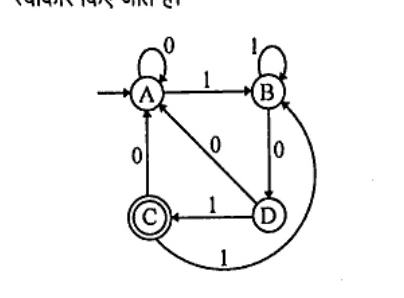
How to answer
- Identify states, start A, final C, alphabet {0,1}
- Apply Arden's theorem / state elimination
- Solve equations for R_A, R_B, R_C, R_D
- Write final regular expression for strings reaching C
-
7 MarksaShow $id + id * id$ can be generated by two distinct leftmost derivative in the grammar. $E \rightarrow E + E / E * E / (E) / id.$
How to answer
- State grammar E -> E+E / E*E / (E) / id
- Give first leftmost derivation grouping as id+(id*id)
- Give second leftmost derivation grouping as (id+id)*id
- Conclude two distinct parse trees hence ambiguous
-
7 MarksbCan an ambiguous CFG be converted into Chomsky Normal Form. Explain briefly your answer.
How to answer
- Define ambiguous CFG and Chomsky Normal Form restrictions
- CNF conversion preserves language but may change derivations
- Ambiguity is property of grammar not language; conversion possible
- Conclude yes with brief justification
-
7 MarksaConstruct PDA for the language $L = \{a^n b^{n+m} c^m,$ where $n \geq 0, m \geq 0\}$.
How to answer
- Note need |b| = |a|+|c| split as n+m
- Push a's then b's, pop for b's matching and c's
- Define PDA states, stack alphabet, transitions
- Show acceptance by empty stack / final state
-
7 MarksbConstruct the PDA for the following grammar. $X \rightarrow 0X3$ $X \rightarrow 0A3$ $A \rightarrow 1A2$ $A \rightarrow 12$
How to answer
- Interpret productions X->0X3, X->0A3, A->1A2, A->12
- Use standard CFG to PDA construction with stack
- Define push/pop transitions for variables and terminals
- Show acceptance trace
-
7 MarksaDesign a TM to accept the string $L = (a, b)^*$, where $N(a) + N(b) = even$.
How to answer
- Idea: TM toggles parity while scanning (a,b)*
- Define states for even/odd count of N(a)+N(b)
- Give transition table for a,b,blank with moves
- Accept in even state on blank
-
7 MarksbGive the tuple definition of Turing machine and explain the significance of movement of R/W head.
How to answer
- Define 7-tuple (Q, Sigma, Gamma, delta, q0, B, F)
- Explain components especially transition and R/W head
- Significance: bidirectional movement gives memory/computation power
- Contrast with FA/PDA head movement
-
7 MarksaConvert the following Mealy machine to an equivalent Moore machine by the tabular format.
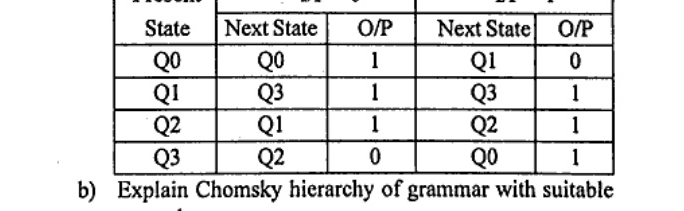
How to answer
- Note Mealy outputs on transitions vs Moore on states
- Split states Q0-Q3 by distinct output pairs
- Construct Moore table with next states and state outputs
- Draw Moore diagram/table
-
7 MarksbExplain Chomsky hierarchy of grammar with suitable example.
How to answer
- State four types Type-0 to Type-3 with grammars
- Give example language and automaton for each
- Show inclusion hierarchy
- Diagram of hierarchy
-
7 MarksaConvert CFG to GNF $A \rightarrow BB / 1$ $B \rightarrow AA / 0$
How to answer
- Check CNF then eliminate terminals from long RHS
- Break RHS longer than 2 and remove unit/epsilon
- Apply to A->BB/1, B->AA/0
- Present final GNF productions
-
7 MarksbConstruct the context free grammar equivalent to a regular expression $(01 + 1)^* (00 + 1)$.
How to answer
- Build FA/DFA for $(01+1)^*(00+1)$
- Introduce variable per state
- Write regular grammar productions for transitions
- Add terminal productions for final states
-
14 MarksWrite short note on: (Any three)
- i)2-way Finite Automata
- ii)Properties of Regular Grammar
- iii)Multi Tape TM
- iv)Arden's Theorem
How to answer
- Select any three topics
- Give definition, diagram/model and key properties for each
- Give example/application
- Conclude with significance
Go to where you left off?
Quick Add to Notes
Save questions, your own notes and screenshots into notes filed by unit. It takes a free account.
Create free accountHave an account? Log in
Notes Panel