IT-502 · Computer Networks/Unsolved PYQ Paper
IT-502 Computer Networks - Nov 2023 Question Paper
Under each question, How to answer lists the points an answer should cover, outlined by CampusPrep from the syllabus. Check the details against your textbook.
-
6 MarksaExplain Personal Area Network (PAN), Local Area Network (LAN), Wide Area Network (WAN) and Internetwork. Your answer should highlight key differences between them as well. 6
How to answer
- Define PAN, LAN, WAN, Internetwork with range, ownership and example
- Compare on coverage, data rate, ownership, cost and technology
- Highlight key differences in tabular form
- Give typical uses for each type
-
8 MarksbDescribe TCP/IP reference model. List advantages and disadvantages of using TCP/IP model. 6+2=8
How to answer
- Describe 4-layer TCP/IP reference model and function of each layer
- List advantages like open, scalable, routable
- List disadvantages like no clear service/interface distinction
- Conclude with comparison to OSI
-
6 MarksaWhat is congestion control? How hosts can regulate the rate at which they send packets into the network for congestion control? 4+2=6
How to answer
- Define congestion and congestion control
- Explain need to regulate sending rate
- Describe host-based mechanisms like windowing, AIMD, slow-start
-
8 MarksbExplain the differences between TCP and UDP protocols. The answer should cover diverse aspects separately with a clear description. 8
How to answer
- Define TCP and UDP with connection orientation
- Compare on reliability, ordering, overhead, speed, use cases
- Give examples of applications for each
- Summarize in table
-
4 MarksaWhat is store-and-forward switching and cut-through switching? 4
How to answer
- Define store-and-forward switching with full packet buffering
- Define cut-through switching with header-only forwarding
- Compare delay, error checking
-
10 MarksbExplain OSI reference model with a brief description of all of its layers. Highlight the critique of the OSI model and protocols. 8+2=10
How to answer
- Describe 7 layers of OSI with functions
- Draw layered diagram with protocols
- Explain critique: bad timing, bad technology, bad implementation
- Contrast OSI model vs protocols
-
6 MarksaExplain Simple Mail Transfer Protocol (SMTP) and its extension (ESMTP). 6
How to answer
- Define SMTP role in email transfer
- Explain commands, responses and mail transaction
- Describe ESMTP extensions and features
-
8 MarksbWhat is File Transfer Protocol (FTP)? Briefly describe FTP Connection, Communication and Command processing. 8
How to answer
- Define FTP and dual connections
- Describe control and data connection establishment
- Explain communication and command processing with replies
-
4 MarksaWhat is the difference between broadcast and multicast routing? 4
How to answer
- Define broadcast vs multicast routing
- Compare delivery, group management, tree types
- Give examples and protocols
-
10 MarksbFor the below graph in (a), find out the shortest paths from vertex J to all the other vertices of the graph using Bellman-Ford algorithm. Assume that delay is used as a metric and that J knows the delay to each of its neighbors A, I, H and K as 8, 10, 12 and 6 m sec. respectively. The delay vectors received from the neighbors of J are shown in (b). 10
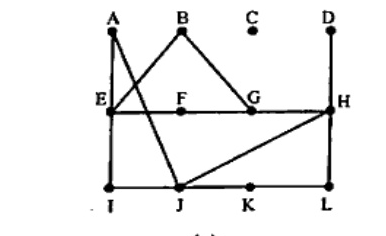
How to answer
- Parse topology (a) and delay vectors (b) with JA=8, JI=10, JH=12, JK=6 msec
- Apply Bellman-Ford / distance-vector update: min over neighbors
- Compute shortest delay from J to A-L iteratively
- List final shortest paths and next hops
-
6 MarksaWhat is Token Ring? How it is advanced in Fiber Distributed Data Interface (FDDI)? 4+2=6
How to answer
- Define Token Ring access and token operation
- Describe FDDI dual ring, timing and capacity
- Explain advancements: fiber, 100 Mbps, fault tolerance
-
8 MarksbBriefly explain ALOHA protocol. Write major differences between pure and slotted ALOHA. 5+3=8
How to answer
- Describe ALOHA operation and vulnerable period
- Derive throughput for pure vs slotted
- Compare in table: synchronization, efficiency 18% vs 37%
-
6 MarksaExplain the IPv4 protocol header. 6
How to answer
- List IPv4 header fields with sizes
- Explain version, IHL, TOS, length, TTL, protocol, checksum, addresses
- Draw header format diagram
-
8 MarksbGiven an infinite population slotted ALOHA system where probability that the slot will be idle is 0.1. Considering this scenario, you are required to calculate channel throughput and discuss whether this is the case of overload or underload. 5+3=8
How to answer
- Use idle probability 0.1 to find offered load G
- Calculate slotted ALOHA throughput $S = G e^{-G}$
- Compare G with 1 to decide overload vs underload
-
6 MarksaDescribe error correcting codes. What are the problems with the parity bit and how to overcome them? 3+3=6
How to answer
- Define error correcting codes and redundancy
- Explain parity bit limitations: single-bit, burst errors
- Describe Hamming code / CRC to overcome
-
8 MarksbExplain Go-Back-N protocol. How link utilization is evaluated with the Go-Back-N protocol? 6+2=8
How to answer
- Explain Go-Back-N sliding window and retransmission
- Derive link utilization with window size and RTT
- Give efficiency formula and example
Go to where you left off?
Quick Add to Notes
Save questions, your own notes and screenshots into notes filed by unit. It takes a free account.
Create free accountHave an account? Log in
Notes Panel