IT-501 · Operating System/Unsolved PYQ Paper
IT-501 Operating System - Dec 2024 Question Paper
Under each question, How to answer lists the points an answer should cover, outlined by CampusPrep from the syllabus. Check the details against your textbook.
-
7 MarksaList and explain services provided by an operating system that are designed to make using computer systems more convenient for users.
How to answer
- List user-oriented services: user interface, program execution, I/O operations, file-system manipulation, communications
- List system-oriented aspects: resource allocation, accounting, error detection, protection and security
- Explain how each makes computer use more convenient with examples
-
7 MarksbDefine Operating System and explain the various types of Operating Systems?
How to answer
- Define operating system as resource manager and extended machine
- Explain types: batch, multiprogrammed, time-sharing, distributed, real-time, etc.
- Give characteristics and examples of each type
-
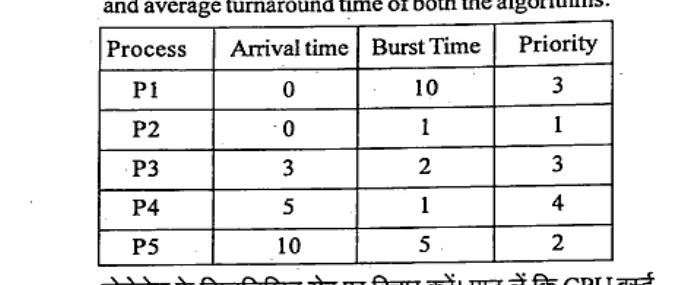
7 MarksaConsider the following set of processes. Assume the length of the CPU burst time is given in mille seconds. Draw Gantt charts illustrating the execution of these processes using FCFS and pre-emptive priority scheduling algorithms. Assume highest priority = 1 and lowest priority = 4. Also, calculate average waiting time and average turnaround time of both the algorithms.
How to answer
- Draw FCFS Gantt chart in arrival order P1,P2,P3,P4,P5
- Draw preemptive priority Gantt chart with priority 1 highest
- Calculate completion, turnaround and waiting times for each process
- Compute average waiting time and average turnaround time for both algorithms
-
7 MarksbWhat is meant by Indefinite Blocking or Starvation? Show that, if the wait() and signal() semaphore operations are not executed atomically, then mutual exclusion may be violated.
How to answer
- Define indefinite blocking/starvation in priority scheduling
- Show wait() and signal() pseudocode and non-atomic interleaving
- Explain how mutual exclusion is violated when not atomic
- Conclude need for atomic execution
-
7 MarksaConsider the deadlock situation that could occur in the dining-philosophers problem when the philosophers obtain the chopsticks one at a time. Discuss how the four necessary conditions for deadlock indeed hold in this setting. Discuss how deadlocks could be avoided by eliminating any one of the four conditions?
How to answer
- Describe dining-philosophers with 5 philosophers and 5 chopsticks
- Show how mutual exclusion, hold-and-wait, no preemption, circular wait hold
- Discuss breaking each condition to avoid deadlock
- Give deadlock-free solutions e.g., odd-even, monitor
-
7 MarksbWhat are the conditions for deadlock? Explain deadlock detection and recovery in detail.
How to answer
- List four Coffman conditions: mutual exclusion, hold and wait, no preemption, circular wait
- Explain deadlock detection: resource-allocation graph, wait-for graph, Banker's algorithm
- Explain recovery: process termination, resource preemption
- Give examples of each
-
7 MarksaWhat is demand paging? Explain it with address translation mechanism used. What are its specific advantages? How a page table is implemented?
How to answer
- Define demand paging and lazy loading with valid-invalid bit
- Explain address translation with page table, TLB and page fault handling
- List advantages: less memory, multiprogramming, faster startup
- Explain page table implementation: registers, TLB, multilevel
-
7 MarksbExplain the difference between logical and physical addresses.
How to answer
- Define logical address as CPU-generated virtual address
- Define physical address as actual RAM location
- Differentiate on binding time, MMU mapping, visibility
- Give example with base and limit mapping
-
7 MarksaDescribe various directory structures.
How to answer
- Describe single-level, two-level, tree-structured and acyclic-graph directories
- Explain operations and path names
- Compare searching, sharing and efficiency
- Give Unix-like examples
-
7 MarksbSuppose that a disk drive has 5000 cylinders numbered 0 to 4999. The drive is currently serving a request at cylinder 143. The queue of pending requests in FIFO order 86, 1470, 913, 1774, 948, 1509, 1022, 1750, 130 starting from current head position. What is the total distance that disk arm moves to satisfy all the pending request for FCFS and SSTF disk scheduling algorithm?
How to answer
- List head start 143 and request queue order
- Compute FCFS total head movement as sum of absolute differences
- Order requests by SSTF nearest-first and compute total movement
- Compare distances for FCFS vs SSTF
-
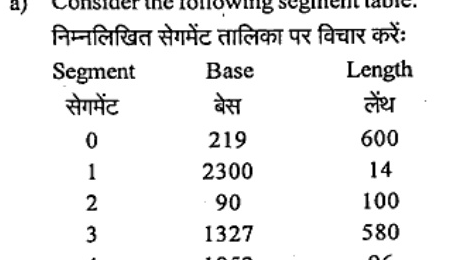
7 MarksaConsider the following segment table: What are the physical addresses for the following logical addresses?
- i)0,430
- ii)1,10
- iii)2,500
- iv)3,400
- v)4,112
How to answer
- Recall segmentation formula: physical = base + offset if offset < length else trap
- Check each logical address (segment, offset) against table
- Compute valid physical addresses and flag illegal 2,500 and 4,112
- List results for i to v
-
7 MarksbGiven five memory partitions of 100 KB, 500 KB, 200 KB, 300 KB and 600 KB (in order), how would each of the first-fit, best-fit and worst-fit algorithms place processes of 212 KB, 417 KB, 112 KB and 426 KB (in order)? Which algorithm makes the most efficient use of memory?
How to answer
- List partitions 100,500,200,300,600 and processes 212,417,112,426
- Simulate first-fit placement in order
- Simulate best-fit smallest sufficient and worst-fit largest
- Identify most efficient algorithm with least wastage
-
7 MarksaDiscuss Remote Procedure Call in detail.
How to answer
- Define RPC and stub mechanism for client-server
- Explain marshalling, binding and call semantics
- Describe sequence diagram of remote call
- Discuss transparency and failure handling
-
7 MarksbWrite difference between Batch and Multi-programming Operation System.
How to answer
- Define batch OS with job queue and no interaction
- Define multiprogramming with multiple jobs in memory
- Compare on basis of CPU utilization, interaction, turnaround
- Give examples of each
-
14 MarksWrite a short notes on: (Any three)
- a)Spooling and Buffering
- b)Precedence Graph
- c)Cache Memory Organization
- d)File Management in Linux
How to answer
- Explain spooling vs buffering with diagrams
- Explain precedence graph for ordering
- Explain cache organization levels and mapping
- Explain Linux file management and inodes
Go to where you left off?
Quick Add to Notes
Save questions, your own notes and screenshots into notes filed by unit. It takes a free account.
Create free accountHave an account? Log in
Notes Panel