IT-405 · Data Base Management System/Unsolved PYQ Paper
IT-405 Data Base Management System - Jun 2023 Question Paper
Under each question, How to answer lists the points an answer should cover, outlined by CampusPrep from the syllabus. Check the details against your textbook.
-
7 MarksaDescribe the three levels of schema architecture. Why do we need mappings between different schema levels?
How to answer
- Define external, conceptual and internal levels
- Describe mappings: external-conceptual and conceptual-internal
- Explain purpose of mappings for data independence
- Diagram of three-schema architecture
-
7 MarksbExplain how the data is organized in a network DBMS? How it is different from Hierarchical DBMS.
How to answer
- Define network model with records and sets
- Explain many-to-many via owner-member set types
- Contrast with hierarchical tree one-to-many structure
- Give example diagram for each
-
7 MarksaWhat is the impact of weak entity set in database design? Discuss with an example.
How to answer
- Define weak entity set and partial key
- Explain dependency on identifying owner entity
- Discuss impact on keys, participation and design
- Give example e.g. Dependent of Employee
-
7 MarksbDevelop an Entity Relationship diagram for Indian movies. It should include where it was shot, details of the actors, directors, producers, the movie language and so on.
How to answer
- Identify entities: Movie, Actor, Director, Producer, Location, Language
- Define relationships and cardinalities
- Add attributes for each entity
- Present neat ER diagram
-
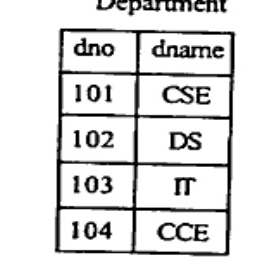
7 MarksaConsider the following two tables. Department and Employee tables as given. Discuss the foreign key and referential integrity constraints on above tables.
How to answer
- Define foreign key and referential integrity
- Identify Employee.dno referencing Department.dno
- Discuss NULL and missing 103, 104 cases
- State constraint violations and enforcement
-
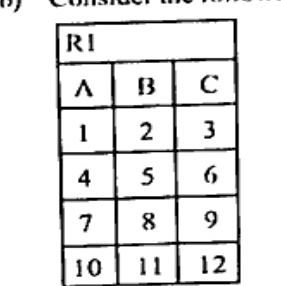
7 MarksbConsider the following two tables as following. Show the output for the following Relational Algebra Operators:
- i)$\Pi_A(R1 * R2)$ where $*$ denotes natural join
- ii)$\Pi_B(R1 \text{ left outer join } R2)$ where denotes left outer join
- iii)$\Pi_C(R1 \text{ left outer join } R2)$ where denotes left outer join
How to answer
- Compute natural join R1 * R2 on common attribute C
- Compute left outer join and project required attributes
- List output tuples for i, ii, iii
- Explain use of NULL for non-matching rows
-
7 MarksaGive an example of two relations that would give a meaningful result of carrying out a full outer join. Formulate the full outer join using SQL.
How to answer
- Give two relations with overlapping and non-overlapping keys
- Show FULL OUTER JOIN result with NULLs
- Formulate SQL using FULL OUTER JOIN ... ON
- Explain meaningfulness of result
-
7 MarksbAssume the following employee and department table and write the SQL queries- Emp ($\underline{EID}$, Ename, DOJ, Salary, Dname) Dept($\underline{DID}$, Dname)
- i)List the employees having salary between 10,000 and 20,000
- ii)Update the salaries of all employees in marketing department and hike it by 10%
- iii)Get the gross salaries of all employees
- iv)Display the department that has no employee
- v)Find the number of employees in the marketing department
- vi)Find the name of employee having maximum salary
- vii)Find the second maximum salary in the employee table
How to answer
- Use SELECT with BETWEEN for salary range
- Use UPDATE with 10% hike and aggregate functions
- Use NOT IN / LEFT JOIN for department with no employee
- Use MAX and subquery for max and second max salary
-
7 MarksaIdentify the Highest Normal Form of the Relation R (A, B, C, D, E, F, G, H) and Functional Dependency set F = {$AB \rightarrow CD, D \rightarrow EG, F \rightarrow H, C \rightarrow EF, H \rightarrow A, G \rightarrow B, A \rightarrow B$}.
How to answer
- Compute attribute closures to find candidate keys
- Check 2NF, 3NF and BCNF violations from FDs
- Identify highest form satisfied
- Justify with dependency analysis
-
7 MarksbConsider the following employee table. Suppose that employees assigned to multiple projects and can have multiple jobs. Normalize the table to the possible extent.

How to answer
- Identify multivalued non-atomic Skill and Pno values
- Convert to 1NF by unnesting repeating groups
- Remove partial/transitive dependencies to higher forms
- Present normalized tables
-
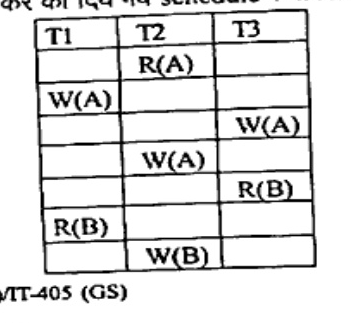
7 MarksaIdentify the given schedule is conflict serializable or not.
How to answer
- List conflicting operations on same data item
- Draw precedence graph for T1,T2,T3
- Check for cycle to decide conflict serializability
- State equivalent serial order if exists
-
7 MarksbConsider the following two transactions T1 and T2 as following T1 : Transfer of Rs. 1,000 from Account A to Account B T2 : Transfer of 10% amount from Account A to Account B The Initial value of Account A is 2000 and Account B is 3000. Create any one concurrent schedule with T1 and T2 and calculate the final values of A and B.
How to answer
- Define T1 transfer 1000 and T2 transfer 10%
- Interleave operations to form concurrent schedule
- Compute A=2000 and B=3000 updates step-wise
- Give final values showing non-serializable effect
-
7 MarksaDiscuss with an example when concurrent execution of two transactions lead to conflict?
How to answer
- Define conflict: RW, WR, WW on same item
- Give example of two transactions with conflicting ops
- Show non-serializable result / inconsistency
- Explain conflict vs non-conflict operations
-
7 MarksbIllustrate the concept of two-phase locking protocol and its variants with an example.
How to answer
- Define growing and shrinking phases
- Explain Strict, Conservative and Rigorous 2PL
- Illustrate locking-unlocking with example
- State guarantees for serializability and deadlock handling
-
14 MarksWrite short note on (any two):
- i)Oracle Application Express (APEX)
- ii)Database Anomalies
- iii)Distributed Databases
- iv)Views
How to answer
- Define chosen two topics with key features
- Explain architecture / causes / uses with examples
- Mention advantages and applications
- Give concise structured short notes
Go to where you left off?
Quick Add to Notes
Save questions, your own notes and screenshots into notes filed by unit. It takes a free account.
Create free accountHave an account? Log in
Notes Panel