IT-403 · Analysis and Design of Algorithm/Unsolved PYQ Paper
IT-403 Analysis and Design of Algorithm - Jun 2026 Question Paper
Under each question, How to answer lists the points an answer should cover, outlined by CampusPrep from the syllabus. Check the details against your textbook.
-
7 MarksaIllustrate the operation of merge-sort on array A= (38, 27, 43, 3, 9, 82, 10). Also drive the time complexity of merge sort.
How to answer
- Divide array recursively into halves down to single elements
- Merge step with comparisons to produce sorted subarrays, trace for given A
- Final sorted array
- Recurrence T(n)=2T(n/2)+O(n)
- Solution O(n log n) in all cases
-
7 MarksbExplain the steps involved in designing and analyzing algorithms. Discuss the criteria used to evaluate the efficiency of an algorithm.
How to answer
- Definition of algorithm design and analysis
- Steps: problem understanding, model, design, correctness, analysis, implementation, testing
- Efficiency criteria: time, space, optimality, simplicity
- Measures: asymptotic, best/worst/average case
-
7 MarksaWrite quick-sort partition algorithm. Drive best and worst-case time complexity of quick sort.
How to answer
- Partition pseudocode with pivot and indices i, j
- Correctness of partitioning
- Recurrence for best case balanced partition
- Recurrence for worst case unbalanced partition
- Best $O(n \log n)$, worst $O(n^2)$
-
7 Marksb
For the given set of items and knapsack capacity = 60 kg, find the optimal solution for the fractional knapsack problem making use of greedy approach.
Item 1 2 3 4 5 6 7 Weight 5 10 15 22 25 31 36 Value 30 40 45 77 90 98 105 How to answer
- Compute value/weight ratio for each item
- Sort items by decreasing ratio
- Take items greedily up to capacity 60 kg
- Take fraction of next item
- Compute maximum total value
-
7 MarksaWhat is Greedy algorithm? How greedy methods can be used to solve the optimization problem?
How to answer
- Definition of greedy algorithm and greedy choice
- Components: greedy choice property, optimal substructure
- General procedure for optimization problems
- Example of application
-
7 MarksbExplain the job sequencing with deadlines problem with suitable example. demonstrate how the Greedy algorithm schedules jobs to maximize profit.
How to answer
- Define jobs with deadlines and profits
- Greedy rule: sort by profit descending
- Schedule in latest free slot before deadline
- Worked example
- Profit maximization demonstration
-
7 MarksaExplain the reliability design problem using the dynamic programming approach. Discuss the steps involved in obtaining an optimal solution with a suitable example.
How to answer
- Definition of reliability design problem
- Dynamic programming formulation with stages
- Recurrence for maximizing reliability
- Steps to obtain optimal solution
- Suitable example
-
7 Marksb
Apply the Floyd-Warshall algorithm to determine the shortest distances between all pair of vertices for the following weighted cost matrix:
A B C D A 0 5 $\infty$ 10 B $\infty$ 0 3 $\infty$ C $\infty$ $\infty$ 0 1 D $\infty$ $\infty$ $\infty$ 0 How to answer
- Initialize distance matrix D0 from cost matrix
- Iterative update Dk[i][j]=min(Dk-1[i][j], Dk-1[i][k]+Dk-1[k][j]) for k=A,B,C,D
- Show intermediate matrices
- Final all-pairs shortest distances
-
7 MarksaFind the optimal solution to the 0/1 Knapsack instances with n=4 and Knapsack capacity m=8 where profits and weights as follows: P= {1, 2,5,6} and W= {2, 3, 4, 5}.
How to answer
- Formulate 0/1 knapsack DP table for n=4, m=8
- Recurrence f[i][w]=max(f[i-1][w], p_i+f[i-1][w-w_i])
- Fill table and traceback
- Optimal profit and selected items
-
7 MarksbDescribe the graph coloring problem and explain how the backtracking approach is used to solve it.
How to answer
- Definition of graph coloring and chromatic number
- Backtracking state space and bounding
- Algorithm steps with m-colorability
- Example coloring
-
7 MarksaIllustrate the N-queens problem? Draw "state space tree" for 8-queen problem using backtracking.
How to answer
- Rules: no two queens share row, column, diagonal
- Backtracking placement row by row
- State space tree pruning
- Tree for 8-queen up to solution
-
7 MarksbExplain the concept of lower bound theory. Also, describe the fundamentals of parallel algorithm.
How to answer
- Definition of lower bound and its use
- Methods: comparison trees, oracle, etc.
- Definition of parallel algorithm
- Fundamentals: PRAM, speedup, efficiency
-
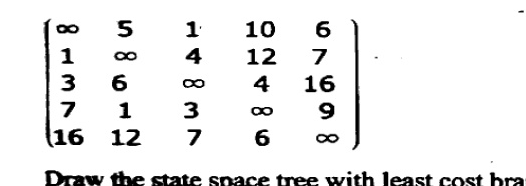
7 MarksaConsider the travelling salesman instance defined by the following cost matrix: $$\begin{pmatrix} \infty & 5 & 1 & 10 & 6 \\ 1 & \infty & 4 & 12 & 7 \\ 3 & 6 & \infty & 4 & 16 \\ 7 & 1 & 3 & \infty & 9 \\ 16 & 12 & 7 & 6 & \infty \end{pmatrix}$$ Draw the state space tree with least cost branch & bound and show the reduced matrices corresponding to each of the node.
How to answer
- Reduce initial cost matrix and compute root cost
- Branch on next city, compute reduced matrices and bounds
- Draw state space tree with LC values
- Select least-cost live node to optimal tour
-
7 MarksbConstruct a BST by inserting the keys 45, 25, 60, 15, 35, 50, 70, 30 in the given order. Perform inorder, preorder, and postorder traversals of the resulting tree.
How to answer
- Insert keys in order maintaining BST property
- Show resulting BST structure
- Write inorder, preorder, postorder sequences
- Verify traversals
-
7 MarksaShow the result of inserting keys 25,31,38,76,5,60,38,8, 30,15,35,17 in order into an empty B-tree of order 5.
How to answer
- Definition of B-tree order 5
- Insert keys stepwise with node splits
- Show intermediate trees
- Final B-tree structure
-
7 MarksbExplain P, NP, NP -Complete and NP-Hard complexity classes. How they are related to each other.
How to answer
- Define P, NP, NP-Complete, NP-Hard
- Deterministic vs nondeterministic polynomial time
- Reducibility and completeness
- Relationship diagram P subset NP, NPC subset NP
Go to where you left off?
Quick Add to Notes
Save questions, your own notes and screenshots into notes filed by unit. It takes a free account.
Create free accountHave an account? Log in
Notes Panel