IT-403 · Analysis and Design of Algorithm/Unsolved PYQ Paper
IT-403 Analysis and Design of Algorithm - Jun 2023 Question Paper
Under each question, How to answer lists the points an answer should cover, outlined by CampusPrep from the syllabus. Check the details against your textbook.
-
7 MarksaExplain algorithm design technique? How do you measure the algorithm running time?
How to answer
- Define algorithm design technique and list major techniques
- Define running time and input size
- Explain measurement via time complexity, asymptotic notations
- Mention experimental vs theoretical analysis and best/worst/average case
-
7 MarksbGive the divide and conquer solution for binary search and analyze the time complexity for it.
How to answer
- State divide and conquer principle for binary search
- Write pseudocode/recurrence for binary search
- Analyze recurrence T(n)=T(n/2)+O(1)
- Conclude O(log n) time complexity
-
7 MarksaExplain the quick sort algorithm, simulate it with the following data 20, 35, 10, 16, 54, 21, 25.
How to answer
- Explain quick sort partition and recursive steps
- Show pivoting steps on given data
- Trace subarrays and swaps to sorted order
- State average/worst case complexity
-
7 MarksbCompute the optimal solution for job sequencing with deadlines using greedy method. $N = 4$, profits $(p_1, p_2, p_3, p_4) = (100, 10, 15, 27)$, deadlines $(d_1, d_2, d_3, d_4) = (2, 1, 2, 1)$.
How to answer
- Sort jobs by profit descending
- Check deadline feasibility for slots
- Construct optimal sequence and compute total profit
- Show greedy steps for N=4 instance
-
7 MarksaConsider the following instance of the knapsack problem and solve it using greedy method $n = 7, m = 15, (p_1, p_2, p_3, p_4, p_5, p_6, p_7) = (10, 5, 15, 7, 6, 18, 3)$ and $(w_1, w_2, w_3, w_4, w_5, w_6, w_7) = (2, 3, 5, 7, 1, 4, 1)$.
How to answer
- Compute profit/weight ratios
- Sort items by ratio and take fractionally up to m=15
- Calculate total profit and selection vector
- State greedy knapsack steps
-
7 MarksbApply the kruskal algorithm for the following graph and explain.
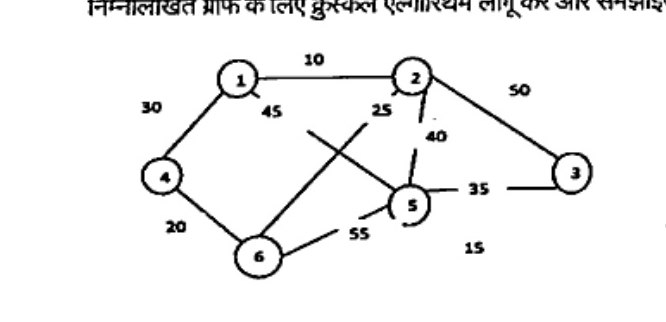
How to answer
- State Kruskal's rule: sort edges and avoid cycles
- List edges of given graph in increasing weight
- Select edges step-by-step forming MST
- Compute MST cost and show tree
-
7 MarksaSolve the following 0/1 Knapsack problem using dynamic programming $P = (11, 21, 31, 33), W = (2, 12, 23, 15), C = 42, n = 4$.
How to answer
- Formulate 0/1 knapsack DP table for n=4, C=42
- Fill profit table using recurrence
- Trace back optimal item selection
- State maximum profit and selected items
-
7 MarksbDesign a three stage reliability system with device types $d_1, d_2$ and $d_3$. The costs are $\$30, \$15$ and $\$20$ respectively. The cost of the system is to be no more than $\$105$. The reliability of each device is 0.9, 0.8 and 0.5 respectively.
How to answer
- State reliability optimization model with cost constraint $105
- Use DP for device redundancy allocation
- Evaluate reliability for stage counts
- Give optimal numbers of devices per stage
-
7 MarksaOn which type of problem we apply multi stage graph technique? Explain with example.
How to answer
- Define multistage graph and its structure
- State shortest/longest path type problems solved
- Explain forward/backward DP recurrence
- Give example graph and solution
-
7 MarksbBriefly explain 8-queen problem using backtracking with algorithm.
How to answer
- State 8-queen constraints and backtracking idea
- Explain placement and bounding / kill test
- Outline recursive algorithm steps
- Mention solution tree search
-
7 MarksaIdentify the Hamiltonian cycle from the following graph.
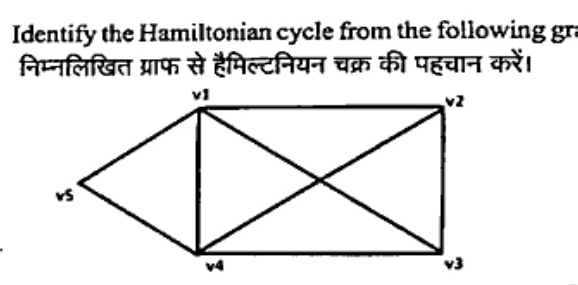
How to answer
- Define Hamiltonian cycle condition
- Examine adjacency of v1-v5 graph
- Trace a cycle visiting all vertices once
- State identified Hamiltonian cycle
-
7 MarksbWrite an algorithm for traveling salesperson problem using check bounds.
How to answer
- State TSP branch and bound / check bounds principle
- Explain bounding function and state space tree
- Write stepwise algorithm / pseudocode
- Mention complexity and pruning
-
7 MarksaDiscuss the operations performed on the binary search tree for the following data : 20, 49, 41, 93, 69, 90, 76, 62, 81, 75, 10, 79, 87, 38 and delete 41 and 76.
How to answer
- Show BST insertions for 20,49,41,93,69,90,76,62,81,75,10,79,87,38
- Draw tree after insertions
- Show deletion of 41 and 76 with cases
- Show final BST structure
-
7 MarksbDifferentiate between BFS and DFS.
How to answer
- Define BFS queue-based level order traversal
- Define DFS stack/recursion-based depth traversal
- Compare on data structure, time/space, applications
- Give example traversal difference
-
14 MarksWrite short notes on any two of the following.
- a)2-3 trees
- b)Merge sort
- c)Optimal merge patterns
- d)Floyd Warshall algorithm
How to answer
- Select any two topics from list
- Give definition, working and steps for each
- Mention time complexity and application
- Give example/diagram if applicable
Go to where you left off?
Quick Add to Notes
Save questions, your own notes and screenshots into notes filed by unit. It takes a free account.
Create free accountHave an account? Log in
Notes Panel