IT-303 · Data Structure/Unsolved PYQ Paper
IT-303 Data Structure - Dec 2023 Question Paper
Under each question, How to answer lists the points an answer should cover, outlined by CampusPrep from the syllabus. Check the details against your textbook.
-
7 MarksaDefine Data Structures. With the aid of a neat diagram describe the classification of data structures.
How to answer
- Define data structure as a specialized format for organizing, processing, retrieving, and storing data.
- Draw hierarchical taxonomy tree: Primitive (int, float, char, pointer) vs Non-Primitive.
- Subdivide Non-Primitive into Linear (Arrays, Linked Lists, Stacks, Queues) and Non-Linear (Trees, Graphs).
- Briefly describe characteristics of linear vs non-linear structures.
-
7 MarksbWhat is asymptotic analysis? Explain Big-oh notation. Analyse and write the running time complexity of the following function. ```c A() { int i, j, k, n; for(i=1; i<=n; i++) for(j=1; j2<=n; j++) for(k=1; 2k<=n; k++) printf("*"); } ```
How to answer
- Define asymptotic analysis as evaluating performance of an algorithm as input size n grows towards infinity.
- Provide formal mathematical definition of Big-O: $f(n) \le c \cdot g(n)$ for $n \ge n_0$.
- Analyze loop 1: runs $n$ times.
- Analyze loop 2: condition `j2<=n` (interpreted either as $j^2 \le n \implies \sqrt{n}$ or $j \times 2 \le n \implies n/2$).
- Analyze loop 3: condition `2k<=n` runs $n/2$ times.
- Multiply loop bounds to give overall Big-O bound.
-
7 MarksaGiven an array with both positive and negative numbers, find the two elements such that their sum is closest to zero. For the below array, algorithm should give $-80$ and $85$. Example: $1, 60, -10, 70, -80, 85$ Also discuss the complexity of the process and suggest and alternate way to optimize the complexity.
How to answer
- State naive/brute force approach: compare every pair $(i, j)$ in $O(n^2)$ time.
- Propose optimized approach: sort the array in $O(n \log n)$ time.
- Use two pointers (left at start, right at end); update minimum absolute sum and move left or right based on whether sum is negative or positive.
- Demonstrate on example: sorted array is `[-80, -10, 1, 60, 70, 85]`, showing pair $(-80, 85)$ gives sum $5$.
- Complexity analysis: $O(n \log n)$ time and $O(1)$ extra space.
-
7 MarksbConsider a two-dimensional array $A$ of order $[20 * 5]$. The base address of the array is $840$, words per memory cell is $8$. Find the address of $A[15, 3]$ using row major and column major addressing.
How to answer
- State given values: $BA = 840$, $w = 8$, $m = 20$, $n = 5$, target $(i, j) = (15, 3)$ (assuming 0-indexed or 1-indexed, clearly stated).
- Formula for Row Major: $Address = BA + w \times (i \times n + j)$ (for 0-based indexing: $840 + 8 \times (15 \times 5 + 3) = 840 + 8 \times 78 = 1464$; if 1-based: $840 + 8 \times (14 \times 5 + 2) = 1416$).
- Formula for Column Major: $Address = BA + w \times (j \times m + i)$ (for 0-based indexing: $840 + 8 \times (3 \times 20 + 15) = 840 + 8 \times 75 = 1440$; if 1-based: $840 + 8 \times (2 \times 20 + 14) = 1272$).
- Provide explicit calculation steps and final numerical values.
-
7 MarksaWhat is a link list? Discuss the advantages of using link list; also write about the various operations which can be performed on link list with their time complexities.
How to answer
- Define linked list as a linear collection of data elements (nodes) where each points to the next.
- List advantages: dynamic size, ease of insertion/deletion without shifting.
- Tabulate operations and time complexities: Insertion at head $O(1)$, Insertion at tail $O(n)$ or $O(1)$ with tail pointer, Deletion at head $O(1)$, Search $O(n)$, Traversal $O(n)$.
-
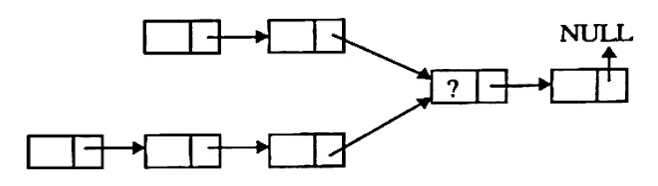
7 MarksbSuppose there are two singly linked lists both of which intersect at some point and become a single linked list as shown below: The head pointers of both the lists are known. Give an algorithm for finding the merging point and write the running time complexity.
How to answer
- State the algorithm: 1) Count lengths $L_1$ and $L_2$ of both linked lists.
- 2) Find the absolute difference $d = |L_1 - L_2|$.
- 3) Advance the pointer of the longer list by $d$ steps.
- 4) Move both pointers simultaneously one node at a time until they point to the same node.
- 5) The meeting node is the intersection/merging point.
- State time complexity: $O(L_1 + L_2)$ time, and $O(1)$ auxiliary space.
-
7 MarksaDefine Stack. What are the different operations, which can be performed on stack. Explain why Stack is a recursive data structure?
How to answer
- Define stack as a linear data structure following LIFO (Last In First Out).
- List basic operations: Push, Pop, Peek/Top, IsEmpty, IsFull.
- Explain why stack is recursive: a stack can either be empty, or consist of a top element followed by a stack; alternatively, function call stack implements recursion.
-
7 MarksbWrite an algorithm for evaluating a postfix expression and apply the same for the given postfix expression: $2 \ 8 \ 4 - 5 * + 7 \ 7 / +$, showing the content of stack at each step.
How to answer
- State algorithm: scan left to right; if operand, push to stack; if operator, pop top two operands, evaluate, and push result back.
- Step-by-step trace of expression `2 8 4 - 5 * + 7 7 / +` in a table with columns: Symbol, Action, Stack content.
- `8 4 -` $\implies 4$; stack: `[2, 4]`.
- `4 5 *` $\implies 20$; stack: `[2, 20]`.
- `2 20 +` $\implies 22$; stack: `[22]`.
- `7 7 /` $\implies 1$; stack: `[22, 1]`.
- `22 1 +` $\implies 23$; stack: `[23]`.
- Final evaluated result is 23.
-
7 MarksaExplain the importance of queue. Describe why it is a bad idea to implement a linked list version a queue which uses the head of the list as the rear of the queue.
How to answer
- Explain importance of queue: scheduling processes, asynchronous data transfer (buffers, IO queues), breadth-first search.
- Analyze using head as rear (enqueue at head): inserting at head takes $O(1)$.
- However, dequeue must happen at the front, which corresponds to the tail of the singly linked list.
- Deleting the tail node in a singly linked list requires finding the node preceding the tail, which takes $O(n)$ time.
- Conclude that dequeue becomes $O(n)$ instead of $O(1)$, which is inefficient.
-
7 MarksbWhat is the advantage of circular queue over ordinary queue? Write a C program to simulate the working of circular queue of integers using array. Provide the following operations: i) Insert ii) Delete iii) Display
How to answer
- Advantage: avoids memory wastage in linear queues where space vacated by deleted items cannot be reused without shifting.
- Modulo arithmetic $(rear + 1) \% MAX$ allows wrap-around.
- Provide C code defining array, `front`, `rear` initialized to -1.
- Implement `insert(val)` checking for full condition: `(rear + 1) % MAX == front`.
- Implement `delete()` checking for empty condition: `front == -1`.
- Implement `display()` to print elements from `front` to `rear` circularly.
-
7 MarksaShow the steps of quick sort on the following set of elements. $26, 56, 47, 36, 13, 95, 85, 32$ Assume the last element as the pivot element.
How to answer
- Initial array: `[26, 56, 47, 36, 13, 95, 85, 32]`, pivot = 32.
- Partitioning pass: compare elements with 32; elements $\le 32$ are 26, 13. Swapping places 32 at its correct sorted position (index 2): `[26, 13, 32, 36, 56, 95, 85, 47]`.
- Show recursive call on left sub-array `[26, 13]` with pivot 13 $\implies [13, 26]$.
- Show recursive call on right sub-array `[36, 56, 95, 85, 47]` with pivot 47.
- Continue recursive partitioning for remaining sub-arrays until the array is completely sorted: `[13, 26, 32, 36, 47, 56, 85, 95]`.
-
7 MarksbDesign a data representation which sequentially map '$n$' data objects into an array $a[1, n]$, $n_1$ of these data objects are stacks and the remaining are queues. Write algorithms to add and delete elements from these objects.
How to answer
- Divide array $a[1, n]$ into multiple segments: allocate fixed/proportional slices or use top/base pointer arrays for the $n_1$ stacks and front/rear pointers for the remaining $k - n_1$ queues.
- Define boundary array $B[i]$ and top/rear pointers $T[i]$ for each structure.
- Write algorithm for Push (stack): check overflow against boundary $B[i+1]$, increment $T[i]$, insert.
- Write algorithm for Pop (stack): check underflow against base $B[i]$, retrieve and decrement $T[i]$.
- Write algorithm for Enqueue and Dequeue using front and rear pointers for queue segments.
- Mention memory shift / reallocation strategy when an individual segment overflows.
-
7 MarksaWhat is collision? What are the methods to resolves collision? Using the hash function 'key mod 7', insert the following sequence of keys in the hash table- $32, 50, 700, 140, 76, 85, 46, 92, 70, 73$ and $101$ Use separate chaining technique for collision resolution.
How to answer
- Define collision: when two distinct keys map to the same hash index.
- List collision resolution methods: Separate Chaining (Open Hashing) and Open Addressing (Linear Probing, Quadratic Probing, Double Hashing).
- Calculate $k \pmod 7$ for each key:
- $32 \% 7 = 4$; $50 \% 7 = 1$; $700 \% 7 = 0$; $140 \% 7 = 0$; $76 \% 7 = 6$; $85 \% 7 = 1$; $46 \% 7 = 4$; $92 \% 7 = 1$; $70 \% 7 = 0$; $73 \% 7 = 3$; $101 \% 7 = 3$.
- Show separate chaining linked list at each index (0 to 6):
- Index 0: $700 \to 140 \to 70$
- Index 1: $50 \to 85 \to 92$
- Index 2: empty
- Index 3: $73 \to 101$
- Index 4: $32 \to 46$
- Index 5: empty
- Index 6: $76$
-
7 MarksbWhat are L-L, L-R and R-R rotation? Write procedure for adding and deleting a node from the balanced tree and leave the resulting tree balanced.
How to answer
- Explain LL rotation: single right rotation applied when insertion is into the left subtree of the left child.
- Explain RR rotation: single left rotation applied when insertion is into the right subtree of the right child.
- Explain LR rotation: double rotation (left rotation on left child followed by right rotation on parent).
- Provide steps for insertion: standard BST insertion, update balance factors, perform appropriate rotation on lowest unbalanced ancestor.
- Provide steps for deletion: standard BST deletion, backtrack upwards updating balance factors and perform rotations (LL, RR, LR, RL) as needed.
-
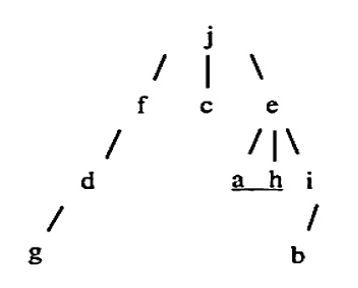
7 MarksaWhat is the sequence of nodes visited for the following tree for a preorder, postorder, and breadth first traversal?
How to answer
- Identify tree hierarchy: Root is `j`; children of `j` are `f`, `c`, `e`. Under `f`: `d`, under `d`: `g`. `c` has no children. Under `e`: `a`, `h`, `i`; under `i`: `b`.
- Preorder (Root, Left, Right): `j, f, d, g, c, e, a, h, i, b`.
- Postorder (Left, Right, Root): `g, d, f, c, a, h, b, i, e, j`.
- Breadth-first / Level-order: Level 0: `j`; Level 1: `f, c, e`; Level 2: `d, a, h, i`; Level 3: `g, b` $\implies$ `j, f, c, e, d, a, h, i, g, b`.
-
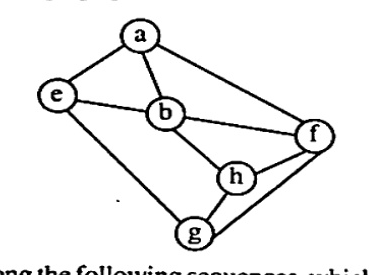
7 MarksbWhat is Graph traversal? Discuss the difference between traversing a graph and a tree. Consider the following graph, Among the following sequences, which are the depth-first traversals of the above graph? Justify your answer by showing the adjacency list and stack contents for the traversals. i) a b e g h f ii) a b f e h g iii) a b f h g e iv) a f g h b e
How to answer
- Define graph traversal as visiting all vertices systematically.
- Compare tree vs graph traversal: graphs can contain cycles, requiring a `visited` array to prevent infinite loops, whereas trees are acyclic and start at a unique root.
- Construct adjacency list from the diagram: vertices are {a, b, e, f, g, h} with undirected edges (a-b, a-e, a-f, e-b, e-g, b-h, b-f, f-h, f-g, h-g).
- Trace DFS for each of the 4 candidate sequences using the stack.
- Verify valid paths and determine which sequence(s) represent valid DFS orders with justification.
Go to where you left off?
Quick Add to Notes
Save questions, your own notes and screenshots into notes filed by unit. It takes a free account.
Create free accountHave an account? Log in
Notes Panel