EC-405 · Analog Circuits/Unsolved PYQ Paper
EC-405 Analog Circuits - Jun 2022 Question Paper
Under each question, How to answer lists the points an answer should cover, outlined by CampusPrep from the syllabus. Check the details against your textbook.
-
7 MarksaExplain the concept of positive and negative feedback with suitable waveform? Discuss Barkhausen criterion.
How to answer
- Define positive feedback with in-phase feedback waveform
- Define negative feedback with out-of-phase feedback waveform
- State Barkhausen criterion magnitude and phase condition
- Explain role in oscillators vs amplifiers
-
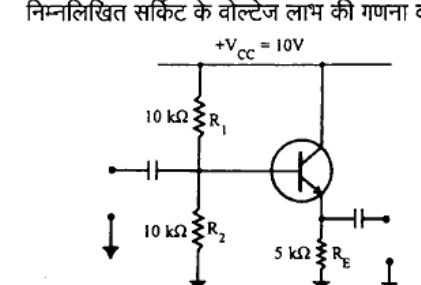
7 MarksbCalculate the voltage gain of the following circuit:
How to answer
- Identify biasing topology from circuit R1, R2, RE
- Calculate emitter / voltage gain formula
- Substitute R1=10 kΩ, R2=10 kΩ, RE=5 kΩ, +Vcc=10V
- Obtain voltage gain value
-
7 MarksaWhat is an integrated circuit? Discuss the relative advantages and disadvantages of ICs over discrete assembly.
How to answer
- Define integrated circuit
- List advantages over discrete assembly
- List disadvantages/limitations
- Conclude comparison
-
7 MarksbWith a neat diagram, explain the action of Hartley's oscillators. A phase shift oscillator uses $8\text{ pF}$ capacitors. Find the value of Resistor (R) to produce a frequency of $600\text{ kHz}$.
How to answer
- Draw neat Hartley oscillator circuit with tapped inductor
- Explain feedback action and Barkhausen condition
- State frequency formula f=1/(2π√(Leq·C))
- Calculate R for phase-shift oscillator with C=8pF, f=600kHz using f=1/(2πRC√6)
-
7 MarksaDiscuss Input offset voltage, offset current, Input bias current, Output offset voltage.
How to answer
- Define input offset voltage
- Define input offset current and input bias current
- Define output offset voltage
- Explain causes and effects
-
7 MarksbExplain in brief Butterworth $2^{nd}$ order Low pass FILTER.
How to answer
- State Butterworth maximally flat response concept
- Show 2nd order low-pass topology with op-amp
- Give transfer function and cutoff frequency
- Mention roll-off -40 dB/decade
-
7 MarksaDiscuss the operation of Fixed and Adjustable Voltage Regulators.
How to answer
- Explain fixed regulator e.g. 78XX operation
- Explain adjustable regulator e.g. LM317 operation
- Show block/circuit diagrams
- Compare regulation method
-
7 MarksbDerive an expression for the common-mode voltage gian of a differential amplifier.
How to answer
- Define differential and common-mode inputs
- Draw common-mode half-circuit analysis
- Derive voltage gain expression Acm
- State significance of CMRR
-
7 MarksaDifferentiate Monostable, Bistable and Astable Multivibrator.
How to answer
- Define stable states concept
- Distinguish monostable one stable state
- Distinguish bistable two stable and astable zero stable
- Give examples/applications
-
7 MarksbExplain in brief Zero Crossing Detector.
How to answer
- Define zero crossing detector principle
- Show op-amp comparator circuit with waveforms
- Explain output switching at zero crossing
-
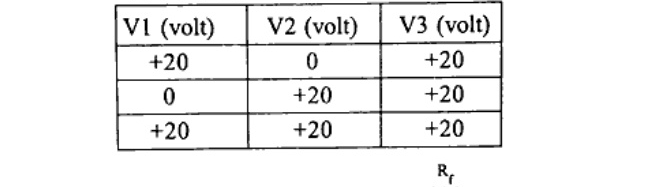
7 MarksaFind the output voltage ($V_{out}$) for each of the following combinations:
How to answer
- Write summing amplifier formula Vout = -(Rf/R1·V1+Rf/R2·V2+Rf/R3·V3)
- Substitute V1,V2,V3 for each row with R1=1kΩ,R2=2kΩ,R3=4kΩ,Rf=1kΩ
- Compute ideal Vout and check saturation at ±20V
- Give final Vout for three combinations
-
7 MarksbDiscuss the operation of OP-AMP as integrator.
How to answer
- Show integrator circuit with R input and C feedback
- Derive Vout = -1/RC ∫Vin dt
- Explain frequency response and limitations
- Give output waveform example
-
7 MarksaDiscuss the Effect of variation in power supply voltage of an OP-AMP. Explain the importance of gain bandwidth product.
How to answer
- Explain effect of supply variation on saturation and bias
- Define gain-bandwidth product GBP = Gain × BW
- Explain constant GBP and frequency limitation
- Mention stability importance
-
7 MarksbDiscuss the application of OP-AMP as Voltage-shunt feedback amplifier.
How to answer
- Show voltage-shunt feedback topology
- Derive gain with feedback and input resistance
- Explain virtual ground operation
- Mention applications
-
14 MarksWrite short note on :
- a)VCO
- b)Slew rate and its effect on OP-AMP
- c)Dual input balanced output DA
How to answer
- Define VCO and its voltage-frequency relation
- Define slew rate formula and its effect on distortion/bandwidth
- Explain dual input balanced output differential amplifier
- Give circuit/diagram and applications for each
Go to where you left off?
Quick Add to Notes
Save questions, your own notes and screenshots into notes filed by unit. It takes a free account.
Create free accountHave an account? Log in
Notes Panel