EC-403 · Analog Communication/Unsolved PYQ Paper
EC-403 Analog Communication - Jun 2023 Question Paper
Under each question, How to answer lists the points an answer should cover, outlined by CampusPrep from the syllabus. Check the details against your textbook.
-
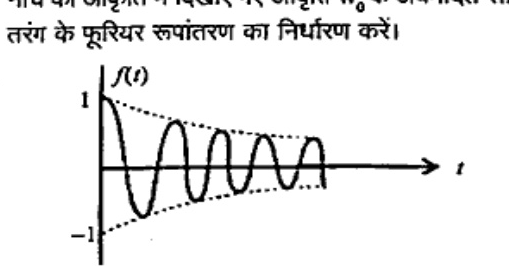
7 MarksaDetermine the Fourier transform of the damped sinusoidal waveform of frequency $w_0$ shown in figure below.
How to answer
- Write time-domain expression for damped sinusoid e.g. $f(t)=e^{-at}\sin w_0t\,u(t)$
- Apply Fourier transform integral $F(w)=\int_{-\infty}^{\infty}f(t)e^{-jwt}dt$
- Evaluate integral to get frequency-shifted low-pass form
- Give magnitude and phase spectrum interpretation
-
7 MarksbWhat is a Gate function? Find the Fourier Transform of Gate Function.
How to answer
- Define Gate function rect(t/T) in time domain
- Set up Fourier integral for Gate pulse
- Evaluate to get $T\,\mathrm{sinc}$ / $\mathrm{Sa}$ function
- Sketch amplitude spectrum
-
7 MarksaState and prove the following properties of Fourier Transform.
- i)Time shifting
- ii)Frequency Shifting
How to answer
- State time-shifting: $F[f(t-t_0)]=F(w)e^{-jwt_0}$
- Prove using substitution in Fourier integral
- State frequency-shifting: $F[f(t)e^{jw_0t}]=F(w-w_0)$
- Prove using combination of exponentials
-
7 MarksbWhat is the principle of Amplitude modulation? Derive expression for the AM wave and draw its spectrum.
How to answer
- Explain principle of amplitude modulation with carrier and message
- Derive $s(t)=A_c[1+\mu m(t)]\cos 2\pi f_c t$ and expand sidebands
- Give modulation index and frequency-domain spectrum
- Sketch AM spectrum with carrier and sidebands
-
7 MarksaCalculate the percentage power saving when the carrier and one of the sidebands are suppressed in an AM wave modulated to a depth of 100% and 50%.
How to answer
- Write total AM power $P_t=P_c(1+\mu^2/2)$
- Compute power in carrier + one sideband removed case
- Calculate % saving for $\mu=1$ (100%)
- Calculate % saving for $\mu=0.5$ (50%)
-
7 MarksbWhat is vestigial sideband? Explain the process of generation and detection of VSB modulated wave using a carrier $A_c \cos 2\pi f_c t$.
How to answer
- Define vestigial sideband and need for it
- Explain VSB filter for generation using $A_c\cos 2\pi f_c t$
- Explain coherent detection / demodulation of VSB
- Give applications e.g. TV transmission
-
7 MarksaWhat are the different demodulation techniques of FM? Explain the demodulation of FM signal with the help of PLL.
How to answer
- List FM demodulators: slope detector, Foster-Seely, ratio detector, PLL, etc.
- Explain PLL blocks: phase detector, LPF, VCO
- Explain how PLL locks and recovers message from FM
- Mention advantages of PLL demodulation
-
7 MarksbA carrier is frequency modulated by a sinusoidal signal of frequency 2 kHz resulting in a maximum frequency deviation of 6 kHz.
- i)Calculate the modulation index and band width
- ii)If the amplitude of the message signal is increased by a factor of 3 and its frequency is decreased to 2 kHz. Calculate the modulation index and B.W
How to answer
- Compute modulation index $\beta=\Delta f/f_m$
- Compute FM bandwidth by Carson's rule $BW=2(\Delta f+f_m)$
- Recompute $\Delta f$ for 3x amplitude and new $f_m$
- Compute new $\beta$ and new bandwidth
-
7 MarksaDerive the expression and explain how pre-emphasis/de-emphasis filtering improves the signal to noise ratio?
How to answer
- Define pre-emphasis at transmitter and de-emphasis at receiver
- Derive transfer characteristics and SNR improvement factor
- Explain boosting high frequencies before noise addition
- Show overall flat response with improved high-frequency SNR
-
7 MarksbWrite about image frequency and derive expression for the Image Frequency Rejection Ratio in radio receivers.
How to answer
- Define image frequency $f_{si}=f_s+2f_{IF}$ concept
- Explain image interference in superheterodyne receiver
- Derive image frequency rejection ratio expression with Q factor
- Discuss methods to improve rejection
-
7 MarksaAn AM superhet receiver is tuned to 600 kHz, if the 'Q' of the RF amplifier tank circuit is 60 and the IF is 455 kHz. Find image frequency and its rejection ratio.
How to answer
- Compute image frequency $f_{image}=f_s+2IF$ or $|f_s-2IF|$
- Use Q of RF tank to get selectivity factor $\alpha$
- Calculate rejection ratio $=\sqrt{1+Q^2\rho^2}$
- Express ratio in numeric / dB form
-
7 MarksbWith the aid of the block diagram explain TRF receiver. List out the advantages and disadvantages of TRF receiver.
How to answer
- Draw block diagram of TRF receiver: antenna, RF stages, detector, audio stages
- Explain working of each block at RF frequency
- List advantages e.g. simplicity, high gain, sensitivity
- List disadvantages e.g. poor selectivity, tracking, instability
-
7 MarksaDefine the following:
- i)Noise figure
- ii)Noise temperature
- iii)Noise Bandwidth
- iv)Noise figure measurement
How to answer
- Define noise figure F as input/output SNR ratio
- Define noise temperature Te and noise bandwidth Bn
- Describe noise figure measurement using Y-factor / hot-cold method
- Give formulas relating F, Te
-
7 MarksbExplain the noise performance in DSB-SC system and obtain necessary expression for figure of merit.
How to answer
- Describe DSB-SC coherent detection with channel noise
- Derive output signal and noise powers
- Define figure of merit $(SNR_o/SNR_c)$
- Show figure of merit result for DSB-SC
-
14 MarksWrite a short note on any two:
- i)Convolution Theorem
- ii)SSB-SC
- iii)AFC
- iv)Sources of Noise
How to answer
- Select any two topics from list
- Give definition/principle with relevant expressions
- Add block diagram / formula where applicable
- Mention applications / significance
Go to where you left off?
Quick Add to Notes
Save questions, your own notes and screenshots into notes filed by unit. It takes a free account.
Create free accountHave an account? Log in
Notes Panel