BT-104 · Basic Electrical & Electronics Engineering/Unsolved PYQ Paper
BT-104 Basic Electrical and Electronics Engineering - Dec 2024 Question Paper
Under each question, How to answer lists the points an answer should cover, outlined by CampusPrep from the syllabus. Check the details against your textbook.
-
7 MarksaWhat do you understand by dependent and Independent sources? Explain with neat sketches. How we can convert a Voltage source into a current source? Discuss.
How to answer
- Define dependent and independent sources with classification
- Neat sketches for voltage/current, ideal/practical, dependent types
- Source transformation / conversion steps with diagram
- Discussion of equivalence condition
-
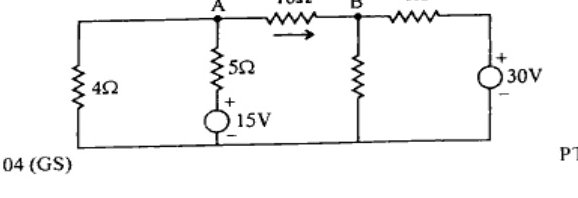
7 MarksbUsing Nodal Analysis, find the current through the $10\Omega$ resistor in the figure shown below.
How to answer
- Select reference node and assign nodal voltages at A and B
- Write KCL nodal equations with 15V and 30V sources
- Solve for node voltages
- Calculate current through 10 ohm resistor using voltage difference
-
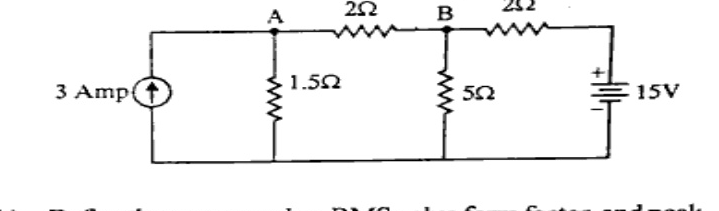
7 MarksaFind the value of current in branch AB by using Super position Theorem.
How to answer
- State superposition theorem steps
- Consider 3 Amp source alone with 15V shorted
- Consider 15V alone with current source opened
- Add branch AB currents algebraically
-
7 MarksbDefine the average value, RMS value form factor, and peak factor of an AC quantity. How are these parameters calculated for a sinusoidal waveform?
How to answer
- Define average, RMS, form factor, peak factor
- Give mathematical expressions for sinusoidal waveform
- Derive values: average 0.637 Im, RMS 0.707 Im, form factor 1.11, peak factor 1.414
- Explain significance
-
7 MarksaA coil of resistance 100 and inductance 0.1H is connected in series with 150pF capacitor across a 200V, 50Hz supply calculate:
- i)Inductive reactance
- ii)Capacitive reactance
- iii)Impedance
- iv)Current
- v)Power factor
- vi)Voltage across the coil
- vii)Voltage across capacitor
How to answer
- Calculate inductive reactance $X_L=2\pi fL$
- Calculate capacitive reactance $X_C=1/(2\pi fC)$
- Find impedance $Z$ and current $I=V/Z$
- Find power factor, coil voltage and capacitor voltage
-
7 MarksbA $3$-$\phi$ balanced system supplies 110V to a delta connected load whose phase impedance is equal to $(3.54 + j3.54)\Omega$. Determine the line current and draw the phasor diagram.
How to answer
- Convert delta phase impedance to magnitude and angle
- Calculate phase current $V_{ph}/Z_{ph}$
- Find line current $\sqrt{3} I_{ph}$ for delta
- Draw phasor diagram showing line vs phase quantities
-
7 MarksaWhat do you understand by self inductance and mutual inductance? Derive the relation between self inductance and mutual inductance.
How to answer
- Define self and mutual inductance
- Explain flux linkage with two coils
- Derive coefficient of coupling relation $M=k\sqrt{L_1L_2}$
- Give expression for total inductance
-
7 MarksbDiscuss about the laws of electromagnetic Induction.
How to answer
- State Faraday's laws of electromagnetic induction
- Explain Lenz's law with expression
- Give examples of statically and dynamically induced emf
- Mention applications
-
7 MarksaOpen circuit and short circuit test on a single phase transformer gave the following results. $V_0 = 200V, I_0 = 0.7A, W_0 = 20$ Watt test from primary side $V_s = 10V, I_s = 10A, W_s = 40$ Watt test from secondary side. Determine the equivalent circuit parameter referred to primary side.
How to answer
- Use OC test data to find $R_0$, $X_0$ shunt parameters
- Use SC test data to find $R_{eq}$, $X_{eq}$ series parameters
- Refer secondary side values to primary side
- Present equivalent circuit with values
-
7 MarksbDiscuss the construction and working principle of the three phase induction motor. Draw the torque slip characteristic of the above. Why this motor cannot operate on synchronous speed?
How to answer
- Describe stator, rotor, windings and construction
- Explain rotating magnetic field and induction principle
- Draw torque-slip characteristic and mark regions
- Explain why synchronous speed gives zero slip and zero torque
-
7 MarksaDescribe D.C. machine with suitable sketches in viewing of main parts and construction details.
How to answer
- List main parts: yoke, poles, armature, commutator, brushes
- Provide labelled sketches of DC machine
- Explain construction details of each part
- Mention function of each component
-
7 MarksbA three phase 440 volt, 50 hp, 50 Hz induction motor delivers rated output power at 1440 rpm. Find the following:
- i)No of poles of machine
- ii)Synchronous speed
- iii)Slip
- iv)Slip rpm
- v)Rotor speed w.r.t 1) Rotor structure 2) Stator 3) Stator rotating mmf.
- vi)Rotor emf at operating speed if stator to rotor turn ration is 1: 0.5 Assume winding factor is unity.
How to answer
- Determine poles from synchronous speed near 1440 rpm
- Calculate synchronous speed $N_s=120f/P$
- Compute slip $s=(N_s-N)/N_s$ and slip rpm
- Find rotor speeds w.r.t. structures and rotor emf with turns ratio
-
7 MarksaSolve for $x$
- i)$(257)_8 = (x)_2$
- ii)$(21.625)_{10} = (x)_8$
- iii)$(BC.2)_{16} = (x)_8$
- iv)$(33)_{10} = (201)_x$
How to answer
- Convert octal/hex/decimal fractions to binary/octal
- Show stepwise base conversion method
- Solve $(33)_{10}=(201)_x$ for base x
- Verify results
-
7 MarksbWith the help of input and output characteristics, explain the operation of BJT in Common emitter Configuration.
How to answer
- Describe common-emitter biasing and circuit
- Explain input characteristics $I_B$ vs $V_{BE}$
- Explain output characteristics $I_C$ vs $V_{CE}$
- Describe active, saturation and cut-off operation
-
14 MarksWrite a short note on any two:
- a)Star Delta Transformation
- b)J-K Flip-Flop
- c)Magnetization Characteristics of Ferromagnetic Material
- d)Power in balanced and Unbalanced Three Phase System
How to answer
- Select any two topics from list
- Give definition, diagram/formula and working
- Mention applications and key points
- Conclude briefly
Go to where you left off?
Quick Add to Notes
Save questions, your own notes and screenshots into notes filed by unit. It takes a free account.
Create free accountHave an account? Log in
Notes Panel