CY-405 · Data base Management System/Unsolved PYQ Paper
CY-405 Database Management System - Jun 2023 Question Paper
Under each question, How to answer lists the points an answer should cover, outlined by CampusPrep from the syllabus. Check the details against your textbook.
-
7 MarksaExplain the various levels of data abstraction in a database management system.
How to answer
- Define physical, logical/conceptual and view/external levels
- Describe schema vs instance at each level
- Explain data independence with diagram of three-schema architecture
-
7 MarksbExplain different types of relationships amongst tables in a DBMS. Explain different types of attributes in a DBMS.
How to answer
- Define one-to-one, one-to-many, many-to-one, many-to-many relationships with examples
- Define simple, composite, single-valued, multi-valued, stored, derived, key attributes
- Give table examples for relationships and attributes
-
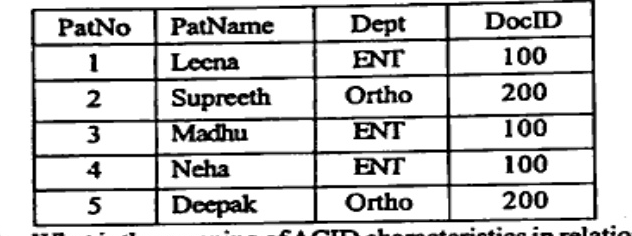
7 MarksaDefine degree and cardinality. Based upon the given table write degree and cardinality. Patients
How to answer
- Define degree as number of attributes/columns and cardinality as number of tuples/rows
- From Patients table count degree = 4
- From Patients table count cardinality = 5
-
7 MarksbWhat is the meaning of ACID characteristics in relational databases? Define the structure of a relational database schema.
How to answer
- Expand ACID: Atomicity, Consistency, Isolation, Durability with definitions
- Explain each property with transaction example
- Define relational database schema: relation, attributes, domains, constraints
-
7 MarksaDescribe the different types of keys. Explain different operations in Relational algebra.
How to answer
- List key types: primary, candidate, super, foreign, alternate, composite, unique
- Define each key with example
- List relational algebra ops: select, project, union, set-difference, cartesian-product, rename, join
-
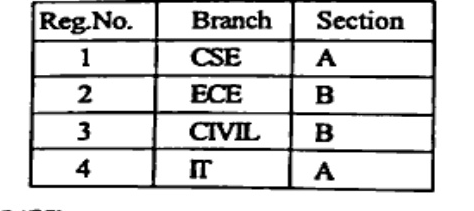
7 MarksbConsider the student table given below. Write commands (using relational algebra operations), and outputs for the followings:
- i)To display all the records of student table.
- ii)To display all the records of CSE branch in student table.
- iii)To display the record of ECE branch section B students.
- iv)To display the records of section B CSE and IT branch.
- v)To display all the records in student tables whose regno>2.
How to answer
- Use student table with Reg.No., Branch, Section and 4 rows as input
- Write selection/projection expressions for each of i)-v)
- Show expected output tables for each query
-
7 MarksaWhat does Normalization mean? Explain different normal forms with examples.
How to answer
- Define normalization and need to remove redundancy/anomalies
- Explain 1NF, 2NF, 3NF, BCNF rules
- Give example tables for each normal form conversion
-
7 MarksbSuppose you are given a relation $R = (A, B, C, D, E)$ with the following functional dependencies. $\{CE\to D, D\to B, C\to A\}$.
- i)Find all candidate keys.
- ii)Identify the best normal form that R satisfies (1NF, 2NF, 3NF, or BCNF).
- iii)If the relation is not in BCNF, decompose it until it becomes BCNF. At each step, identify a new relation, decompose and re-compute the keys and the normal forms they satisfy.
How to answer
- Compute attribute closures to find candidate keys containing CE
- Test partial and transitive dependencies for 2NF/3NF
- Decompose on violating FDs e.g. D->B and C->A until BCNF and re-evaluate keys
-
7 MarksaLet $R = (A, B, C, D, E, F)$ be a relation scheme with the following dependencies: $C\to F$, $E\to A$, $EC\to D$, $A\to B$. Find candidate key for R?
How to answer
- List given FDs C->F, E->A, EC->D, A->B
- Compute closure of EC to show it determines all attributes
- Conclude EC is candidate key and check minimality/uniqueness
-
7 MarksbThe following functional dependencies are given: $AB\to CD, AF\to D, DE\to F, C\to G, F\to E, G\to A$. Find the closure of CF, BG, AB and AF.
How to answer
- Apply Armstrong axioms iteratively starting from CF, BG, AB, AF
- Expand using AB->CD, AF->D, DE->F, C->G, F->E, G->A
- List final closures for each set
-
7 MarksaWhat do you mean by Serializability? Discuss the conflict and view serializability with suitable example.
How to answer
- Define serializability and need for concurrent correctness
- Explain conflict serializability using precedence graph
- Explain view serializability with example schedules
-
7 MarksbWhat do you mean by Multiple granularities? How is it implemented in transaction system?
How to answer
- Define granularity: database, table, page, tuple level locks
- Explain intention locks IS, IX, SIX and protocol
- Explain implementation via lock hierarchy in transaction manager
-
7 MarksaWhat are the methods used for deadlock prevention in DBMS? What is difference between blocking and deadlock?
How to answer
- List prevention schemes: wait-die, wound-wait, timeout, ordering
- Explain detection vs prevention approach
- Differentiate blocking (waiting) vs deadlock (circular wait)
-
7 MarksbWhat is Checkpoint in DBMS? Why is Checkpoint used in database? How Checkpoint works in DBMS?
How to answer
- Define checkpoint as point of synchronised log and buffers
- Explain purpose: reduce recovery time, establish consistency
- Describe fuzzy vs sharp checkpoint working steps
-
7 MarksaWhat is Secondary storage? Explain types of data storage in DBMS and describe storage hierarchy.
How to answer
- Define secondary storage vs primary storage
- Explain types: magnetic disk, SSD, optical, tape
- Describe storage hierarchy pyramid with speed/cost/capacity
-
7 MarksbDistinguish between:
- i)Primary and Secondary indexing.
- ii)Ordered indexing and hashing.
How to answer
- Define primary vs secondary index on ordering vs non-ordering field
- Define ordered indexing vs hashing on search key
- Tabulate differences on basis, structure, access and use
Go to where you left off?
Quick Add to Notes
Save questions, your own notes and screenshots into notes filed by unit. It takes a free account.
Create free accountHave an account? Log in
Notes Panel