CS-405 · Operating Systems/Unsolved PYQ Paper
CS-405 Operating Systems - Jun 2024 Question Paper
Under each question, How to answer lists the points an answer should cover, outlined by CampusPrep from the syllabus. Check the details against your textbook.
-
7 MarksaIn a multiprogramming and time sharing environment several users share system simultaneously. This situation can result in various security problems.
- i)What are two such problems?
- ii)Can we ensure the same degree of security in a time shared machine as we have in a dedicated machine? Explain your answer?
How to answer
- Two security problems in shared systems e.g. unauthorized access, data leakage, denial of service
- Discussion of protection, authentication and isolation mechanisms
- Comparison of dedicated vs time-shared security level
- Conclusion with reasoning whether same degree possible
-
7 MarksbWhat are the five major activities of an operating system in regards to process management?
How to answer
- Definition of process management in OS
- List five activities: creation/deletion, scheduling, synchronization, communication, deadlock handling
- Brief explanation of each activity
- Role of PCB and scheduler
-
7 MarksaWhy do some systems keep track of the type of file, while others leave it to the user or simply do not implement multiple file types? Which system is better?
How to answer
- Meaning of file type awareness
- Advantages of tracking type: protection, correct operation mapping
- Advantages of leaving to user: flexibility, simplicity
- Judgement on which system is better with justification
-
7 MarksbConsider a file system on a disk that has both logical and physical block sizes of 512 bytes. Assume that the information about each file is already in memory. For each of three allocation strategy (continuous, linked and indexed), how is the logical to physical address mapping accomplished in this system? (for indexed allocation assume that a file is always less than 512 blocks long).
How to answer
- Assumption: logical and physical block 512 bytes, file info in memory
- Contiguous: logical block + start address = physical
- Linked: traverse linked list pointers to reach block
- Indexed: use index block entry, file <512 blocks so single index
-
7 MarksaWhat resources are used when a thread is created? How do they differ from those when a process is created?
How to answer
- Resources for thread: stack, registers, PC, thread-specific state sharing address space
- Resources for process: address space, PCB, page tables, open files
- Difference: threads share code/data/files, lightweight
- Overhead comparison for creation and context switch
-
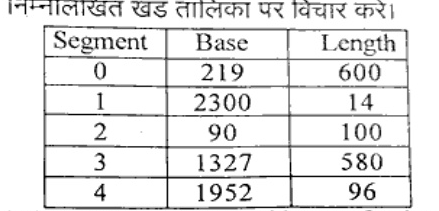
7 MarksbConsider the following segment table. What are the physical addresses for the following logical address?
- i)0430
- ii)110
- iii)2500
- iv)3400
How to answer
- Segmentation formula: physical = base + offset if offset < length else trap
- Check each logical address segment number and offset
- Compute 0430, 110, 2500, 3400 cases
- Identify illegal references exceeding length
-
7 MarksaWhat is the meaning of the term busy waiting? What another kind of waiting are there in an operating system? Can busy waiting be avoided altogether? Explain your answer.
How to answer
- Definition of busy waiting / spinlock
- Other waiting: blocking / sleep-wait with wait queues
- Whether busy waiting can be fully avoided
- Examples where busy waiting needed e.g. short critical sections
-
7 MarksbCan a system detect that some of its processes are starving? If your answer "Yes" explain how it can? If your answer no, explain how the system can deal with the starvation problem.
How to answer
- Definition of starvation and aging
- Detection via waiting time / priority monitoring
- If yes: how system tracks starvation
- Remedies: aging, priority adjustment, fair scheduling
-
7 MarksaWhat are the advantages and disadvantages of making the computer network transparent to the user?
How to answer
- Meaning of network transparency
- Advantages: ease of use, resource sharing, location independence
- Disadvantages: overhead, security, complexity, loss of control
- Examples of transparency types
-
7 MarksbTo build a robust distributed systems, you must know what kinds of failures can occurs. List three possible types of failures in a distributed system.
How to answer
- Need to know failure models for robust design
- Three types: crash, omission, timing, Byzantine, network partition
- Brief description of each failure
- Impact on distributed system reliability
-
7 MarksaWhat are the benefits of mapping objects into virtual memory? Explain in detail.
How to answer
- Concept of memory-mapped objects
- Benefits: simplified I/O, sharing, demand paging
- Reduced memory usage and faster access
- Example of mmap usage
-
7 MarksbWhat are the benefits of a DFS when compared to a file system in a centralized system?
How to answer
- Definition of DFS vs centralized file system
- Benefits: scalability, fault tolerance, availability, performance
- Comparison on sharing and replication
- Examples of DFS advantages
-
7 MarksaWhy Semaphore is important in OS? Explain Binary and counting semaphores with suitable example.
How to answer
- Importance of semaphore for mutual exclusion and synchronization
- Definition of binary semaphore with example
- Definition of counting semaphore with example
- P and V operations explanation
-
7 MarksbWhat is Overlay? How to dynamic linking and loading perform in memory management?
How to answer
- Definition of overlay
- Concept of dynamic linking vs static linking
- Concept of dynamic loading
- How they save memory and aid memory management
-
14 MarksWrite short notes on following (any two):
- a)Synchronization
- b)Paging
- c)System Calls
How to answer
- For chosen two: definition and purpose
- Key mechanisms / steps / structures
- Advantages and example/diagram
- Conclusion on OS role
Go to where you left off?
Quick Add to Notes
Save questions, your own notes and screenshots into notes filed by unit. It takes a free account.
Create free accountHave an account? Log in
Notes Panel