BT-204 · Basic Civil Engineering & Mechanics/Unsolved PYQ Paper
BT-204 Basic Civil Engineering and Engineering Mechanics - Jun 2023 Question Paper
Under each question, How to answer lists the points an answer should cover, outlined by CampusPrep from the syllabus. Check the details against your textbook.
-
7 MarksaWhat do you understand by the term 'levelling'? Explain 'reciprocal levelling' in details.
How to answer
- Define levelling as the art of determining relative heights of points on earth surface
- Explain purpose and principle of reciprocal levelling across obstructions like rivers
- State equations eliminating instrument collimation error and earth curvature/refraction errors: $h = \frac{(h_a - h_b) + (h'_a - h'_b)}{2}$
- Provide schematic diagram showing instrument positions and staff readings at points A and B
-
7 MarksbWhat is the purpose to provide the foundation and describe its various types in details?
How to answer
- Define foundation and state its main purposes (load distribution, stability against overturning, preventing differential settlement)
- Classify foundations into shallow and deep foundations
- Explain types of shallow foundations: isolated footing, combined footing, strip footing, raft/mat foundation
- Explain types of deep foundations: pile foundation, pier foundation, caisson/well foundation
- Provide sketches of common foundation types
-
7 MarksaWrite short notes on any four of the followings: i) Remote sensing ii) Contour lines iii) Type of surveying iv) EDM v) Survey station
How to answer
- Remote sensing: data acquisition from a distance via sensors and electromagnetic radiation
- Contour lines: imaginary lines connecting points of equal elevation, characteristics of contours
- Type of surveying: based on instrument (chain, compass, plane table, theodolite) and purpose (geodetic, plane, cadastral, topographical)
- EDM: principle of electronic distance measurement using modulated light/microwaves
- Survey station: main, subsidiary, and tie stations used in surveying network
-
7 MarksbExplain the 'auto level' with a neat sketch.
How to answer
- Define auto level (automatic level) and its operating principle
- Explain internal optical compensator (pendulum prism system) that maintains a horizontal line of sight automatically
- Describe key components: telescope, circular bubble, leveling screws, compensator, horizontal circle
- Draw a neat labeled sketch of an auto level
-
7 MarksaWrite notes on the following with neat sketch: i) Mid ordinate rule ii) Average ordinate rule iii) Trapezoidal rule iv) Simpson's rule
How to answer
- Mid-ordinate rule: formula $\text{Area} = d \sum h_m$ with sketch
- Average ordinate rule: formula $\text{Area} = \frac{\sum O}{n+1} \times L$ with sketch
- Trapezoidal rule: formula $\text{Area} = d \left[ \frac{O_0 + O_n}{2} + O_1 + O_2 + \dots + O_{n-1} \right]$ with sketch
- Simpson's one-third rule: conditions (odd number of ordinates) and formula $\text{Area} = \frac{d}{3} [ (O_0 + O_n) + 4\sum O_{\text{even}} + 2\sum O_{\text{odd}} ]$ with parabolic boundary sketch
-
7 MarksbExplain concurrent and non-concurrent co-planer forces in details.
How to answer
- Define coplanar forces (forces lying in the same plane)
- Explain concurrent coplanar forces: lines of action meet at a single point; state equilibrium conditions ($\sum F_x = 0, \sum F_y = 0$)
- Explain non-concurrent coplanar forces: lines of action lie in same plane but do not intersect at a common point; state equilibrium conditions ($\sum F_x = 0, \sum F_y = 0, \sum M = 0$)
- Illustrate both systems with neat force diagrams
-
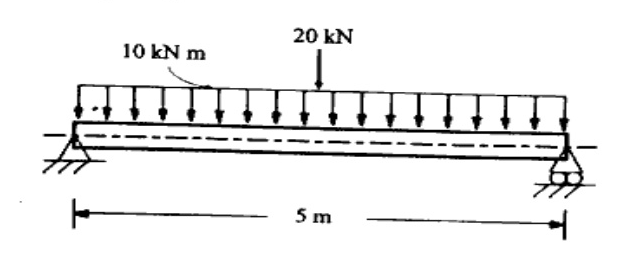
7 MarksaDraw the shear force and bending moment diagram for simply supported beam, which carries a uniformly distributed load of $10\text{ kN/m}$ and a point load of $20\text{ kN}$ on its center having span of $5\text{ m}$.
How to answer
- Calculate support reactions: by symmetry, $R_A = R_B = \frac{10 \times 5 + 20}{2} = 35\text{ kN}$
- Compute shear force at critical sections: left support ($+35\text{ kN}$), just left of center ($+10\text{ kN}$), just right of center ($-10\text{ kN}$), right support ($-35\text{ kN}$)
- Draw Shear Force Diagram (SFD) with linear slopes and vertical drop of $20\text{ kN}$ at center
- Compute bending moments: $M_A = M_B = 0$; center $M_C = 35(2.5) - 10(2.5)(1.25) = 87.5 - 31.25 = 56.25\text{ kNm}$
- Draw Bending Moment Diagram (BMD) as a parabolic curve reaching peak of $56.25\text{ kNm}$ at center
-
7 MarksbDefine any two-laboratory test, those are conducted on bricks and cement.
How to answer
- Select any two standard tests (e.g., Compressive strength of bricks, Fineness test of cement, or Standard consistency of cement)
- For test 1: state apparatus, procedure, and standard limiting value
- For test 2: state apparatus, procedure, and standard limiting value
-
7 MarksaList out the various stages for the construction of a building and list out the various building materials used in construction works with brief details.
How to answer
- List stages of building construction: site investigation, excavation, foundation, plinth beam, superstructure (columns/beams/masonry), lintel & slabs, plastering, flooring, doors/windows, finishing/painting
- List key building materials: cement, sand/fine aggregates, coarse aggregates, bricks/blocks, reinforcement steel, timber, paints
- Briefly describe functions and characteristics of each material
-
7 MarksbDiscuss plastering and pointing in Civil Engineering construction works.
How to answer
- Define plastering: covering rough surface of walls with mortar to provide smooth and durable finish
- Discuss objectives of plastering and types (lime, cement plaster)
- Define pointing: finishing of mortar joints in exposed brick or stone masonry
- Discuss types of pointing: flush, struck, V-grooved, keyed, recessed pointing
- Highlight differences between plastering and pointing
-
7 MarksaDefine the method of joints and method of section to analyze a plane truss with a suitable example.
How to answer
- Define method of joints: isolating each joint and applying $\sum F_x = 0, \sum F_y = 0$
- Define method of sections: cutting truss into two parts through max 3 unknown members and applying $\sum F_x = 0, \sum F_y = 0, \sum M = 0$
- Provide a simple triangular or Pratt/Warren truss example
- Demonstrate step-by-step calculation for forces using both methods
-
7 MarksbDefine the following terms with respect to concrete: i) Workability ii) Segregation iii) Bleeding iv) Proportion in concrete
How to answer
- Workability: ease with which concrete can be mixed, transported, placed, and compacted without segregation
- Segregation: separation of constituent materials (coarse aggregates) from the mortar paste
- Bleeding: upward migration of water to the surface of freshly placed concrete
- Proportion in concrete: ratio of cement : fine aggregate : coarse aggregate (e.g., M15 is 1:2:4, M20 is 1:1.5:3) to achieve desired strength and durability
-
7 MarksaWhat are the various types of bonds used in the construction of brick masonry?
How to answer
- Define bond in brick masonry (arrangement of bricks to eliminate continuous vertical joints)
- Explain English bond: alternate courses of headers and stretchers; queen closer used next to quoin header
- Explain Flemish bond: each course consists of alternate headers and stretchers (Single and Double Flemish)
- Briefly mention Stretcher bond, Header bond, and Garden wall bond
- Provide sketches showing elevation and plans of English and Flemish bonds
-
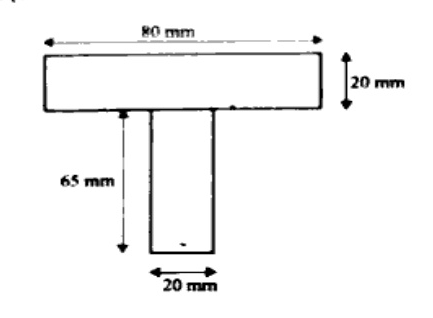
7 MarksbDetermine the moment of inertia of the given plane lamina about its centroidal axis as shown in the figure below:
How to answer
- Divide T-section into two rectangles: Flange ($80 \times 20\text{ mm}$) and Web ($20 \times 65\text{ mm}$)
- Calculate areas: $A_1 = 80 \times 20 = 1600\text{ mm}^2$, $A_2 = 20 \times 65 = 1300\text{ mm}^2$; $A = 2900\text{ mm}^2$
- Determine centroid $\bar{y}$ from base: $y_1 = 65 + 10 = 75\text{ mm}$, $y_2 = 32.5\text{ mm}$; $\bar{y} = \frac{1600(75) + 1300(32.5)}{2900} = 55.95\text{ mm}$
- Apply parallel axis theorem to find $I_{xx} = (I_{G1} + A_1 d_1^2) + (I_{G2} + A_2 d_2^2)$
- Compute $I_{yy} = \frac{20(80)^3}{12} + \frac{65(20)^3}{12} = 853333.3 + 43333.3 = 8.97 \times 10^5\text{ mm}^4$
-
7 MarksaDefine the following terms: i) True bearing and magnetic bearing ii) Fore sight and back sight iii) Local attraction iv) Errors in chain surveying
How to answer
- True bearing: horizontal angle with geographic north meridian; Magnetic bearing: horizontal angle with magnetic north
- Back sight (BS): first staff reading taken after setting up instrument; Fore sight (FS): last staff reading taken before moving instrument
- Local attraction: disturbance of magnetic needle caused by local magnetic bodies like steel, iron pipes, transmission lines
- Errors in chain surveying: personal, instrumental, and natural errors; compensating vs cumulative errors
-
7 MarksbWhat do you understand by reversible and irreversible machines? Explain with suitable examples.
How to answer
- Define reversible machine: machine capable of doing work in reverse direction when effort is removed; efficiency condition $\eta > 50\%$
- Define irreversible / self-locking machine: machine that cannot do work in reverse direction when effort is removed; efficiency condition $\eta < 50\%$
- Provide derivation/justification: $\text{Work lost in friction} = W \left( \frac{1}{\eta} - 1 \right)$
- Give practical examples: reversible (simple pulley system), irreversible/self-locking (screw jack, worm and worm wheel)
Go to where you left off?
Quick Add to Notes
Save questions, your own notes and screenshots into notes filed by unit. It takes a free account.
Create free accountHave an account? Log in
Notes Panel