BT-204 · Basic Civil Engineering & Mechanics/Unsolved PYQ Paper
BT-204 Basic Civil Engineering and Engineering Mechanics - Jun 2022 Question Paper
Under each question, How to answer lists the points an answer should cover, outlined by CampusPrep from the syllabus. Check the details against your textbook.
-
7 MarksaDefine workability of the Concrete and discuss the factor that affect the workability of the concrete.
How to answer
- Definition of concrete workability (ease of mixing, placing, compacting, and finishing)
- Factors affecting workability: water content/w-c ratio, aggregate size and shape, surface texture
- Grading of aggregates, use of admixtures, temperature and time
-
7 MarksbExplain about the different types of footing and types of brick bond used in construction.
How to answer
- Types of footings: Isolated/spread, combined, strip, strap, raft/mat
- Types of brick bonds: English bond, Flemish bond, Stretcher bond, Header bond
- Brief explanation of features and suitability for each
-
7 MarksaDiscuss about the any two-laboratory test conducted on the concrete.
How to answer
- Selection of two tests (e.g., Slump Cone Test and Compressive Strength Test)
- Apparatus and procedure for each test
- Test observations, calculations, and reporting of results
-
7 MarksbExplain about the description of the Dumpy level with a neat sketch.
How to answer
- Neat labeled sketch of a Dumpy level showing telescope, bubble tube, leveling screws, and tripod mount
- Description of essential components: telescope (eyepiece, objective, diaphragm), bubble tube, foot screws, tribrach and trivet
- Working principle and purpose in leveling
-
6 MarksaExplain in brief with about the different type of levelling operation (Profile, Cross-sectional, Differential and Fly levelling) used in survey of the field.
How to answer
- Profile levelling: determination of elevations along a fixed central line for roads/railways
- Cross-sectional levelling: obtaining lateral profile perpendicular to the central line
- Differential levelling: finding difference in elevation between two far-apart points
- Fly levelling: approximate check leveling between BM and start/end points without intermediate points
-
8 MarksbThe following are the consecutive reading were taken with a level and a 4-meter levelling staff on a continuously sloping ground at a common interval of 30 m. 0.855(A), 1.545, 2.335, 3.115, 3.825, 0.455, 1.380, 2.055, 2.855, 3.455, 0.585, 1.015, 1.850, 2.755, and 3.845(B). The R.L of the first reading at A was 380.500. Make entries in level book and apply the usual check. Determine the gradient of AB. The instrument is shifted after $5^{\text{th}}$ and $10^{\text{th}}$ reading.
How to answer
- Tabulate staff readings into BS, IS, FS based on shifts after 5th reading (3.825) and 10th reading (3.455)
- Calculate RL using either Height of Instrument (HI) or Rise and Fall method
- Apply arithmetic check: $\sum BS - \sum FS = \text{Last RL} - \text{First RL}$
- Calculate total length $L = (15 - 1) \times 30 = 420\text{ m}$
- Calculate gradient = $\frac{RL_B - RL_A}{420}$ (expressed as 1 in N falling)
-
6 MarksaAn embankment of a width 10m and side slope of 1.5:1 is required to be made on a ground which is level in a direction transverse to the centreline. The centre line heights at 40 m intervals area as follows: 0.90, 1.25, 2.15, 2.50, 1.85, 1.35 and 0.85 Calculate the volume of earth work according to trapezoidal and prismoidal method.
How to answer
- Calculate cross-sectional area at each station using $A_i = b h_i + s h_i^2 = 10 h_i + 1.5 h_i^2$
- Apply trapezoidal formula: $V = 40 [\frac{A_1 + A_7}{2} + A_2 + A_3 + A_4 + A_5 + A_6]$
- Apply prismoidal formula: $V = \frac{40}{3} [(A_1 + A_7) + 4(A_2 + A_4 + A_6) + 2(A_3 + A_5)]$
- State final volume values in cubic meters ($m^3$)
-
8 MarksbThe following offset were taken from a line to an irregular boundary line at an interval of 10 m 0, 2.50, 3.50, 5.00, 4.60, 3.20, 0 m Compute the area between the chain line, the irregular boundary line and the end offsets by i) Mid-Ordinate Rule ii) Average-Ordinate Rule iii) The Trapezoidal Rule iv) Simpson's Rule
How to answer
- Calculate area using Mid-Ordinate Rule: find mid-ordinates between consecutive offsets and sum them multiplied by $d=10$
- Calculate area using Average-Ordinate Rule: $\text{Total length } L = 60\text{ m}$, $A = L \times \frac{\sum O}{7}$
- Calculate area using Trapezoidal Rule: $A = 10 \times [\frac{0+0}{2} + 2.50 + 3.50 + 5.00 + 4.60 + 3.20]$
- Calculate area using Simpson's Rule: $A = \frac{10}{3} [(0+0) + 4(2.50+5.00+3.20) + 2(3.50+4.60)]$
-
5 MarksaWhat are Survey Stations and How to select a Survey Station.
How to answer
- Definition of Survey Stations (main, subsidiary, tie stations)
- Criteria for selection: mutual intervisibility between stations
- Ease of chaining/ranging, formation of well-conditioned triangles
- Avoidance of obstacles and ensuring safety/permanence of markings
-
9 MarksbCalculate the force in the member shown in fig. using the method of joints.
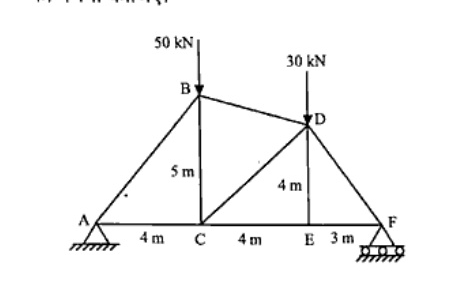
How to answer
- Calculate support reactions at hinged support A and roller support F using static equilibrium ($\sum F_x = 0, \sum M_A = 0, \sum F_y = 0$)
- Determine member angles/geometry at each joint
- Analyze joints sequentially using $\sum F_x = 0$ and $\sum F_y = 0$ (starting from Joint A or F)
- Tabulate the magnitude of force and nature (tension/compression) in each member
-
6 MarksaFind the least value of P required to cause the system of blocks shown in Fig. P-511 to have impending motion to the left. The coefficient of friction under each block is 0.20.
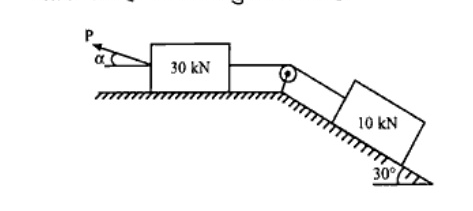
How to answer
- Draw FBD of the 10 kN block on the $30^\circ$ inclined plane with friction acting down the plane (since motion is impending up the plane / to the left)
- Calculate normal force $N_2 = 10 \cos 30^\circ$ and friction force $f_2 = 0.2 N_2$, find string tension $T = 10 \sin 30^\circ + f_2$
- Draw FBD of 30 kN block on horizontal surface with force $P$ acting at angle $\alpha$, tension $T$ pulling to the right, and friction opposing motion to the left
- Set up equilibrium equations to express $P$ in terms of $\alpha$ and minimize $P$ with respect to $\alpha$ (or evaluate least $P$ when $\tan \alpha = \mu$)
-
8 MarksbDetermine the force in members BC, CE, and EF shown in fig. using the method of joints.
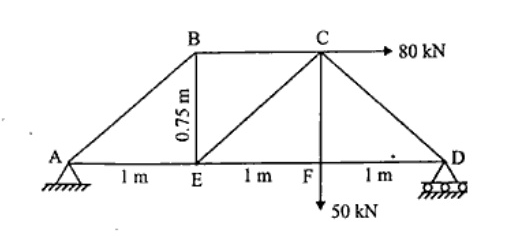
How to answer
- Find reactions at support A (hinged) and support D (roller on horizontal surface) using overall equilibrium equations
- Analyze Joint A to determine forces in AE and AB
- Analyze Joint E to find force in EF and BE
- Analyze Joint B to find forces in BC and member CE (or analyze joint C/E) and state whether each is tension or compression
-
6 MarksaExplain about the Moment of inertia and Radius of Gyration.
How to answer
- Definition of Moment of Inertia (second moment of area): $I = \int y^2 dA$
- Physical significance and units ($\text{mm}^4$ or $\text{m}^4$)
- Definition of Radius of Gyration: $k = \sqrt{\frac{I}{A}}$, geometric interpretation
- Units of radius of gyration (m or mm)
-
8 MarksbDraw the Shear force and Bending moment diagram for the simple supported beam carries a Point load of intensity "W" kN at a distance of "a" from the left supports and at a distance of "b" from the right supports. The total span of length "L" m.
How to answer
- Calculate support reactions: $R_A = \frac{W b}{L}$ and $R_B = \frac{W a}{L}$
- Formulate Shear Force equations: $SF = +\frac{W b}{L}$ for $0 < x < a$, and $SF = -\frac{W a}{L}$ for $a < x < L$
- Formulate Bending Moment equations: $BM = R_A x$ from 0 to $a$; maximum at load point: $M_{\max} = \frac{W a b}{L}$
- Draw neat labeled diagrams for SFD (step diagram) and BMD (triangular variation)
-
3 MarksaExplain about the following Terms: Roofs
How to answer
- Definition and function of roofs in building construction
- Classification: pitched/sloped roofs, flat roofs, curved/shell roofs
- Key requirements: water-tightness, thermal insulation, structural strength
-
3 MarksbExplain about the following Terms: Curing
How to answer
- Definition of curing of concrete
- Importance: maintaining moisture for cement hydration, strength gain, prevention of cracking
- Common methods: ponding, wet burlap, membrane curing, steam curing
-
4 MarkscExplain about the following Terms: Force Diagram and Bow's notations
How to answer
- Explanation of Bow's notation: labeling spaces between forces in clockwise order with uppercase letters
- Concept of space diagram vs force diagram (vector polygon)
- Use in graphical determination of member forces in trusses
-
4 MarksdExplain about the following Terms: Concurrent and non-concurrent Co- planner forces
How to answer
- Definition of coplanar forces (forces lying in the same plane)
- Concurrent coplanar forces: lines of action lie in one plane and intersect at a common point
- Non-concurrent coplanar forces: lines of action lie in one plane but do not pass through a single point
- Simple sketches illustrating both systems
Go to where you left off?
Quick Add to Notes
Save questions, your own notes and screenshots into notes filed by unit. It takes a free account.
Create free accountHave an account? Log in
Notes Panel