CE-802 (A) · Engineering Hydrology/Unsolved PYQ Paper
CE-802-A Engineering Hydrology - May 2026 Question Paper
Under each question, How to answer lists the points an answer should cover, outlined by CampusPrep from the syllabus. Check the details against your textbook.
-
7 MarksaExplain the practical applications of hydrology in civil engineering projects such as irrigation, flood control, reservoir planning, drainage, and bridge design.
How to answer
- Define hydrology and its scope in water resources
- Applications in irrigation, flood control, reservoir planning, drainage, bridge design
- Examples of design data derived from hydrological studies
- Need for hydrological data in safe and economical design
-
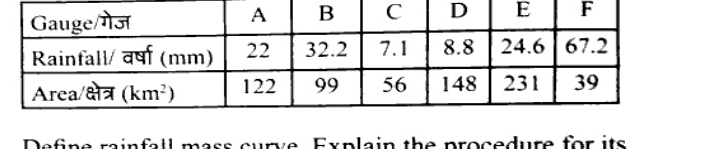
7 MarksbA watershed of $695 \text{ Km}^2$ with six rainfall gauges can be divided into Thiessen polygon with the data listed in the accompanying table. Using the total storm rainfall depth listed, find the average rainfall over the watershed.
How to answer
- Thiessen mean formula $P_{avg}=\sum P_i A_i / \sum A_i$
- Multiply each gauge rainfall by its polygon area
- Sum and divide by total watershed area 695 km2
- Report average depth in mm
-
7 MarksaDefine rainfall mass curve. Explain the procedure for its construction and interpretation with suitable sketch and applications.
How to answer
- Definition of rainfall mass curve: cumulative rainfall vs time
- Procedure: plotting from recording rain-gauge data
- Interpretation: slope as intensity, breaks, storm pattern
- Sketch and applications in design storm, runoff estimation
-
7 MarksbWhat is stream flow? Explain various methods of stream flow measurement with neat sketches and their applications.
How to answer
- Definition of stream flow / discharge
- Methods: area-velocity, dilution, weirs, flumes, slope-area, ultrasonic
- Neat sketches of current-meter, weir, etc.
- Applications and selection criteria
-
7 MarksaExplain the characteristics of a flood hydrograph with a neat sketch. A flood hydrograph is approximated as a triangular hydrograph having a base width of $36 \text{ h}$ and a peak discharge of $240 \text{ m}^3/\text{s}$. If the base flow is $40 \text{ m}^3 \text{ s}$, estimate: Peak direct runoff discharge and Total direct runoff volume.
How to answer
- Characteristics: rising limb, peak, recession, base flow, lag
- Sketch of flood hydrograph components
- Peak direct runoff = peak - base flow = 200 m3/s
- Volume = 0.5 x base width x peak DRD
-
7 MarksbDefine evapotranspiration. Explain the factors affecting evapotranspiration and describe any two methods used for estimating evapotranspiration.
How to answer
- Definition of evapotranspiration (ET)
- Factors: climatic, catchment, vegetation, soil
- Method 1 e.g. Penman, Thornthwaite, Blaney-Criddle
- Method 2 procedure and limitations
-
7 MarksaDescribe the construction and working of a double ring infiltrometer with a neat sketch. Mention its advantages and limitations.
How to answer
- Diagram of double ring infiltrometer: two concentric rings
- Procedure: driving rings, ponding water, measuring infiltration
- Advantages: minimizes lateral flow, simple
- Limitations: point measurement, water requirement
-
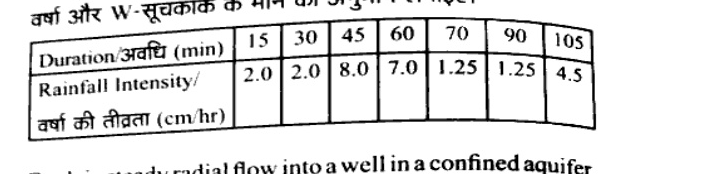
7 MarksbThe following is the set of observed data for successive $15$ minutes period of $105$ minutes storm in a catchment. If the value of $\phi$-index is $3.0 \text{ cm/hr}$, estimate the net runoff, the total rainfall and the value of W-index.
How to answer
- Compute total rainfall from intensity x 0.25h for 7 intervals
- Compute rainfall excess using phi-index 3.0 cm/hr for effective periods
- Net runoff = total excess depth
- W-index = (P - R)/te accounting for initial losses
-
7 MarksaExplain steady radial flow into a well in a confined aquifer. Using Dupuit's equation, determine the discharge of a well fully penetrating a confined aquifer of thickness $25 \text{ m}$ and permeability $30 \text{ m/day}$. The drawdowns at two observation wells located $20 \text{ m}$ and $60 \text{ m}$ away are $4 \text{ m}$ and $2 \text{ m}$ respectively.
How to answer
- Steady radial flow to well in confined aquifer - Thiem assumptions
- Dupuit-Thiem equation $Q=2\pi Kb(s1-s2)/ln(r2/r1)$
- Substitute K=30 m/day, b=25m, r1=20m, r2=60m, s1=4m, s2=2m
- Compute Q in m3/day and m3/s
-
7 MarksbDefine runoff. Explain the various factors affecting runoff from a catchment with suitable examples.
How to answer
- Definition of runoff and runoff cycle
- Climatic factors: rainfall, intensity, duration
- Physiographic factors: area, slope, soil, land use
- Examples for each factor
-
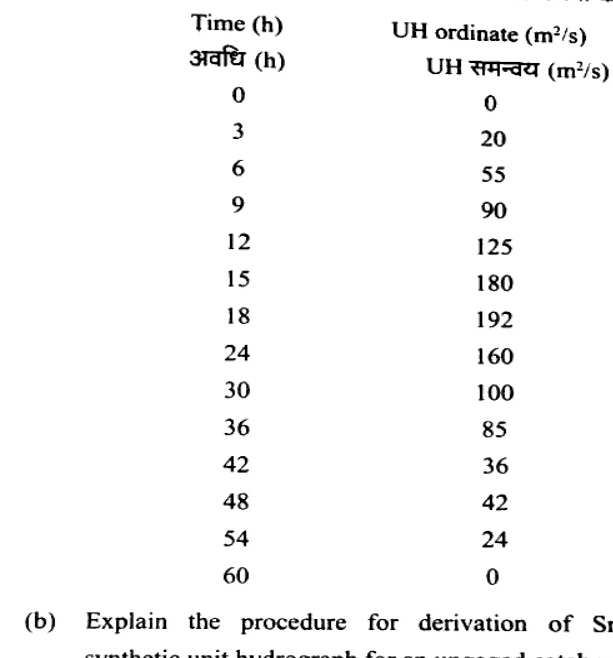
7 MarksaGiven below are the ordinates of a 6-h unit hydrograph for a catchment. Calculate the ordinates of the DRH due to a rainfall excess of $4.25 \text{cm}$ occurring in the 6h.
How to answer
- Principle: DRH ordinate = UH ordinate x rainfall excess
- Multiply each 6-h UH ordinate by 4.25
- Tabulate resulting DRH vs time
- Check volume corresponds to 4.25 cm over catchment
-
7 MarksbExplain the procedure for derivation of Snyder's synthetic unit hydrograph for an ungaged catchment.
How to answer
- Need for synthetic UH for ungauged catchments
- Snyder's parameters Ct, Cp, L, Lca
- Equations for tp, qp, Tb, widths
- Steps to construct triangular/curvilinear UH
-
7 MarksaDefine Instantaneous Unit Hydrograph (IUH). Explain its characteristics and describe the procedure for derivation of IUH with suitable sketch.
How to answer
- Definition of IUH: unit excess for infinitesimal duration
- Characteristics: single peak, time invariance, linearity
- Derivation from S-hydrograph or conceptual models
- Sketch of IUH and S-curve relationship
-
7 MarksbA flood hydrograph entering a river reach is given below. Route the flood through the reach using the Muskingum method. Assume Muskingum routing coefficients $K=8$ hours and $x=0.25$. The initial outflow discharge from the reach is $10 \text{ m}^3/\text{s}$.

How to answer
- Muskingum storage equation $S=K[xI+(1-x)O]$
- Compute routing coefficients C0,C1,C2 for K=8h, x=0.25, dt=4h
- Route step by step $O_2=C0I_2+C1I_1+C2O_1$ from O1=10 m3/s
- Tabulate outflow hydrograph and peak attenuation
-
14 MarksWrite a short note on any **two** :
- i)Gumbel's distribution method for flood frequency analysis.
- ii)Applications of unit hydrograph
- iii)Ground water exploration.
- iv)Stream Gauge Networking
How to answer
- For chosen topics: definition and governing principle
- Relevant formula / procedure / diagram
- Applications in hydrology with example
- Limitations / significance in practice
Go to where you left off?
Quick Add to Notes
Save questions, your own notes and screenshots into notes filed by unit. It takes a free account.
Create free accountHave an account? Log in
Notes Panel