CE-503 (C) · Quantity surveying & Costing/Unsolved PYQ Paper
CE-503-C Quantity Surveying and Costing - Dec 2024 Question Paper
Under each question, How to answer lists the points an answer should cover, outlined by CampusPrep from the syllabus. Check the details against your textbook.
-
6 MarksaState different types approximate estimate. Illustrate any one with example.
How to answer
- List types of approximate estimate: plinth area, cubical content, service unit, bay method, etc.
- Explain purpose and basis of each type
- Illustrate any one with example with rates and calculation
- Mention suitability and limitations
-
8 MarksbExplain principles of estimating. What are the general rules to be adopted for the measurement of various items of work?
How to answer
- Define estimating and its principles: accuracy, rates, measurement units
- Explain general rules for measurement: units, dimensions, order, deductions
- List IS 1200 rules for various items of work
- Give examples of measurement conventions
-
6 MarksaExplain the data required for preparation of detailed estimate.
How to answer
- Define detailed estimate and its purpose
- List data required: drawings, specifications, rates, site conditions
- Explain each: plans, sections, schedule of rates, soil, materials
- Mention report and abstract
-
8 MarksbPrepare approximate estimate of a building from following data: i) Plinth area - 180 sqm. ii) Plinth area rate - Rs. 3500/sqm. iii) Special architectural treatment - 1% of cost of building iv) Electrification charges - 8% of cost of building v) Water supply and sanitary installation - 5% of cost of building vi) Contingencies - 3% of cost of building vii) Supervisor charges - 3% of cost of building
How to answer
- Calculate cost of building = plinth area x plinth area rate
- Add percentages for architectural, electrification, water supply on building cost
- Add contingencies and supervisor charges
- Compute total approximate estimate with steps
-
6 MarksaDefine task work and state the factors affecting task work.
How to answer
- Define task work / out-turn work as work done per day per labour
- State standard task for different trades
- Explain factors: skill, material, weather, supervision, etc.
- Mention importance in labour requirement
-
8 MarksbDescribe the long wall and short wall method of estimating with suitable example.
How to answer
- Define long wall-short wall method principle
- Explain length measurement: long wall out-to-out, short wall in-to-in
- Illustrate with plan example and calculation steps
- Mention advantages for masonry and earthwork
-
6 MarksaExplain the rules for deduction in masonry and plastering work.
How to answer
- State IS rules for openings deduction in masonry
- Explain no deduction / half / full deduction criteria
- State rules for plastering deduction and pointing
- Give examples for doors, windows, lintels
-
8 MarksbThe formation level at starting chainage of a road is 530.00 m. The road surface has rising gradient of 1 in 100. The side slopes are 2:1 for embankment and 1.5:1 for cutting. Work out the quantity of earthwork for road using following data. Use mean sectional area method.
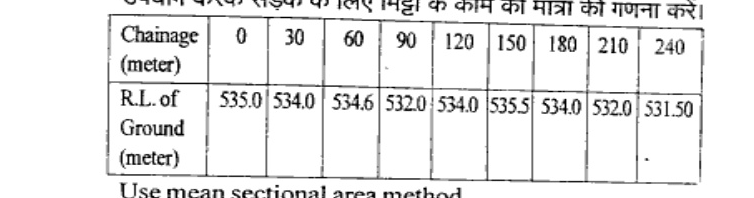
How to answer
- Compute formation levels at each chainage from gradient
- Find depth of cutting/filling = formation RL - ground RL
- Compute sectional area using side slopes for embankment/cutting
- Apply mean sectional area method between chainages and sum for quantity
-
6 MarksaDefine rate analysis and state the factors affecting rate analysis.
How to answer
- Define rate analysis as determination of rate per unit
- Explain purpose and procedure
- List factors: materials, labour, overhead, profit, location
- Mention lead, taxes, specifications effect
-
8 MarksbFind out the quantities of cement, sand and aggregate for R.C.C. 1:2:4 work of 25 cu.m quantity.
How to answer
- Convert nominal mix 1:2:4 to dry volume factor 1.52-1.57
- Calculate dry volumes of cement, sand, aggregate
- Convert cement volume to bags/weight
- Report quantities for 25 cu.m
-
6 MarksaExplain sinking fund and its importance in detail.
How to answer
- Define sinking fund and formula
- Explain purpose for replacement/depreciation
- Describe calculation with interest
- Explain importance in valuation and management
-
8 MarksbWhat is the purpose of valuation? Explain in brief different methods of valuation.
How to answer
- Define valuation and its purpose: sale, tax, rent, compensation
- List methods: rental, direct comparison, profit, cost, development
- Explain each method briefly
- Mention suitability of each
-
6 MarksaWhat is overhead cost? Enumerate various expense to be included in this.
How to answer
- Define overhead cost / establishment charges
- List items: office, supervision, transport, contingencies
- Explain percentage basis on estimate
- Give example of inclusion
-
8 MarksbWhat is DPR? Discuss the content of DPR in detail.
How to answer
- Expand DPR as Detailed Project Report
- List contents: introduction, surveys, design, estimate, drawings
- Explain each content in detail
- Mention approvals and financial analysis
-
14 MarksWrite short notes on (any four)
- i)Bill of quantities and abstract sheet
- ii)Current schedule of rates
- iii)Work charge establishment
- iv)Gross income and net income
- v)Year's purchase
- vi)Tender notice
How to answer
- Select any four topics from list
- Define each term with purpose
- Explain key components and format
- Give example / proforma where applicable
Go to where you left off?
Quick Add to Notes
Save questions, your own notes and screenshots into notes filed by unit. It takes a free account.
Create free accountHave an account? Log in
Notes Panel