CE-501 · Fluid Mechanics-I/Unsolved PYQ Paper
CE-501 Fluid Mechanics - I - Nov 2023 Question Paper
Under each question, How to answer lists the points an answer should cover, outlined by CampusPrep from the syllabus. Check the details against your textbook.
-
8 MarksaDescribe in brief about the Surface tension and Pressure intensity inside a droplet, a bubble and a liquid jet.
How to answer
- Define surface tension and excess pressure concept
- Droplet: single interface $p=2\sigma/d$ or $4\sigma/d$ by notation
- Bubble: two interfaces $p=8\sigma/d$
- Liquid jet: $p=2\sigma/d$ with cylindrical consideration
-
6 MarksbIf a density of a liquid is $840\text{ kg/m}^3$ and kinematics viscosity is $1.70\text{ St}$, find its specific weight, specific gravity, specific volume and coefficient of viscosity.
How to answer
- Compute specific weight $w=\rho g$
- Compute specific gravity $S=\rho/1000$
- Compute specific volume $v=1/\rho$
- Convert kinematic viscosity St to $m^2/s$ and $\mu=\rho \nu$
-
5 MarksaDefine Pascal law and intensity of pressure.
How to answer
- State Pascal's law of pressure transmission
- Define intensity of pressure $p=F/A$
- Unit and isotropic nature
-
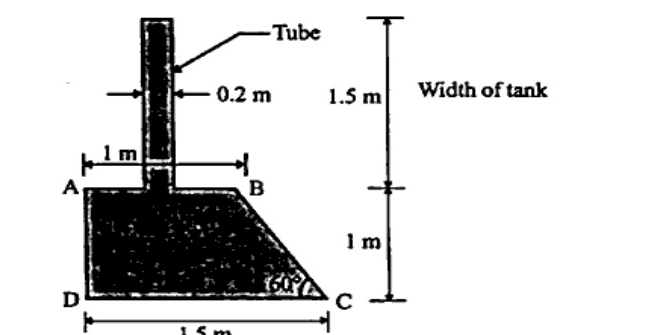
9 MarksbDetermine the total forces and pressure distribution diagram for the surface AB, BC, CD and DA and also locate the centre of pressure for the surface BC.
How to answer
- Compute hydrostatic force $F=\rho g \bar{h} A$ for each face AB, BC, CD, DA
- Draw triangular/trapezoidal pressure distribution diagrams
- Locate centre of pressure for BC using $h_p$ formula / $y_p$ formula
- Account for tube head and tank width
-
8 MarksaDescribe in brief about the Potential function, Stream Function and Flow net.
How to answer
- Define velocity potential function and its properties
- Define stream function and its properties
- Define flow net, equipotential and streamlines orthogonality
-
6 MarksbIf the velocity component is given by $$U = 8 + 4xy + t^2, V = -(xy + 20t), W = 5x + y$$ Find the velocity and acceleration of a particle at $(3, 2, 1)$ at $t = 1\text{ sec}$.
How to answer
- Substitute $x=3, y=2, z=1, t=1$ to get $U,V,W$ and resultant velocity
- Compute local and convective acceleration components $a_x, a_y, a_z$
- Compute magnitude of acceleration vector
-
9 MarksaDerive an Equation of Bernoulli's Theorem by using Euler Equation of motion along a streamline.
How to answer
- Write Euler equation along streamline
- Integrate assuming steady, incompressible, along streamline
- Obtain $p/\rho g + V^2/2g + z = $ constant
-
5 MarksbWrite the Assumption, Limitation and Modification of the Bernoulli's Theorem.
How to answer
- List assumptions: steady, incompressible, inviscid, along streamline
- List limitations: viscous losses, compressibility, unsteady
- Mention modifications: head loss, pump/turbine head
-
4 MarksaExplain the difference between Venturi meter and Orifice meter.
How to answer
- Construction differences: converging-diverging vs orifice plate
- Head loss and cost comparison
- Accuracy and application range
-
10 MarksbDerive the Expression for the measurement of Discharge using Orifice Meter.
How to answer
- Apply Bernoulli between inlet and orifice sections
- Introduce continuity and vena-contracta coefficients
- Obtain $Q = C_d A_0 A_1 \sqrt{2gh}/\sqrt{A_1^2-A_0^2}$ form
-
5 MarksaDescribe in brief about the Weirs and Notches.
How to answer
- Define weirs vs notches
- Types: rectangular, triangular, trapezoidal
- Uses in open channel flow measurement
-
9 MarksbA pump is pumping water at the rate of $7536\text{ lit/min}$. The pump inlet is $40\text{ cm}$ in diameter and the vacuum pressure over there is $15\text{ cm}$ of Mercury. The pump outlet is $20\text{ cm}$ in diameter and it is $1.2\text{ m}$ above the inlet. The pressure at the Outlet is $107.4\text{ kN/m}^2$. Estimate the power added by pump.
How to answer
- Convert discharge to $m^3/s$ and diameters to areas
- Convert vacuum 15 cm Hg and outlet pressure to head
- Apply Bernoulli with pump head between inlet and outlet
- Compute power $P=\rho g Q H_p$
-
9 MarksaDerive the expression for the Velocity Distribution and Shear stress distribution for the flow of a viscous fluid between two parallel fixed plate.
How to answer
- Consider steady laminar flow between fixed plates
- Integrate Navier-Stokes / force balance to get parabolic profile
- Derive shear stress linear variation across gap
-
5 MarksbA $150\text{ mm}$ diameter pipe carries liquid in laminar regime. At a radial distance of $20\text{ mm}$ from the axis of pipe the velocity is $0.4\text{ m/sec}$ calculate:
- i)Max velocity
- ii)Mean velocity
- iii)Discharge of pipe in lps
How to answer
- Use parabolic relation $u = U_{max}(1-r^2/R^2)$ with given $u$ at $r$
- Compute $U_{max}$ then $U_{mean}=U_{max}/2$
- Compute $Q = A U_{mean}$ and convert to lps
-
14 MarksDefine the following.
- i)Bulk Modulus
- ii)Reynolds number
- iii)Stoke's Law
- iv)Stream Lines
How to answer
- Define bulk modulus $K = -dp/(dV/V)$
- Define Reynolds number $Re=\rho VL/\mu$ and significance
- State Stokes law for drag
- Define streamlines and properties
Go to where you left off?
Quick Add to Notes
Save questions, your own notes and screenshots into notes filed by unit. It takes a free account.
Create free accountHave an account? Log in
Notes Panel