CE-501 · Fluid Mechanics-I/Unsolved PYQ Paper
CE-501 Fluid Mechanics - I - Jun 2025 Question Paper
Under each question, How to answer lists the points an answer should cover, outlined by CampusPrep from the syllabus. Check the details against your textbook.
-
7 MarksaWhat is manometer? What are the different types of manometer?
How to answer
- Definition of manometer as pressure measuring device
- Classification into open, differential, inverted U-tube etc.
- Simple manometers: piezometer, U-tube, single column
- Differential and inverted types with sketches
-
7 MarksbDifferentiate the following:
- i)Absolute and gauge pressure
- ii)Dynamic viscosity and kinematic viscosity
- iii)Cohesion and adhesion
How to answer
- Define absolute vs gauge pressure with datum
- Define dynamic viscosity vs kinematic viscosity with formula $\nu=\mu/\rho$
- Define cohesion vs adhesion with examples
- Tabular comparison
-
7 MarksaA differential manometer is connected at the two points A and B of two pipes. The pipe A contains a liquid of sp. gr. 1.5 while pipe B contains a liquid of sp. gr. 0.9. The pressures at A and B are $1\text{ kgf/cm}^2$ and $1.8\text{ kgf/cm}^2$ respectively. Find the difference in mercury level in the differential manometer (h).
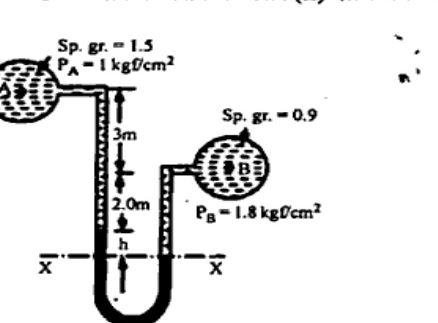
How to answer
- Write manometer equation between A and B along datum X-X
- Convert $kgf/cm^2$ to m of water/liquid heads
- Include 3 m, 2.0 m legs and mercury specific gravity 13.6
- Solve for mercury difference $h$
-
7 MarksbDefine the distinguish the following:
- i)streamlines and streak lines
- ii)rotational and irrotational flow
How to answer
- Define streamline vs streakline with equations
- Steady vs unsteady behaviour and example
- Define rotational vs irrotational via vorticity
- Give examples
-
7 MarksaIf $\phi = 3xy$, find $x$ and $y$ components of velocity at $(1, 3)$ and $(3, 3)$. Determining discharge passing between streamlines passing through these points.
How to answer
- Use $u=-\partial\phi/\partial x$, $v=-\partial\phi/\partial y$ for $\phi=3xy$
- Compute u,v at (1,3) and (3,3)
- Discharge $dq = d\phi$ between streamlines
- Evaluate $\Delta q = \phi_2-\phi_1$
-
7 MarksbWhat is a flow net? Briefly discuss any one method of drawing a flow net.
How to answer
- Definition of flow net: streamlines and equipotentials
- Properties of squares
- One method: graphical / electrical analogy / numerical
- Steps and use for seepage discharge
-
7 MarksaThe actual velocity of a liquid issuing through a $7\text{ cm}$ diameter orifice fitted in a open tank is $6\text{ m/s}$ under a head of $3\text{ m}$. If the discharge measured in a collecting tank is $0.020\text{ m}^3/\text{s}$, calculate the coefficient of velocity, coefficient of contraction and the theoretical discharge through the orifice.
How to answer
- Compute theoretical velocity $V_{th}=\sqrt{2gH}$
- Compute $C_v = V/V_{th}$
- Compute $Q_{th}=A V_{th}$ and $C_d=Q/Q_{th}$
- Compute $C_c = C_d/C_v$
-
7 MarksbCompare and contrast the discharge of venturimeter, flow nozzle and orifice meter as primary element for flow measurement.
How to answer
- Working principle of each primary element
- Discharge formula with $C_d$ and head loss
- Comparison of accuracy, loss, cost
- Suitability for different flows
-
7 MarksaWrite the Bernoulli's equation and explain the terms in it. What are the assumptions made in deriving Bernoulli's equation?
How to answer
- State Bernoulli $p/\rho g + V^2/2g + z = H$
- Explain pressure, velocity and datum heads
- List assumptions: steady, incompressible, inviscid, along streamline
- Derivation outline from Euler
-
7 MarksbDifferentiate the following:
- i)laminar flow and turbulent flow
- ii)smooth surface and rough surface
How to answer
- Velocity profile and Reynolds number criteria
- Shear stress and mixing differences
- Smooth vs rough based on roughness Reynolds
- Examples and friction factor behaviour
-
7 MarksaWhat is the significance of Reynold's number? Oil flows in a pipe $80\text{ mm}$ bore diameter with a mean velocity of $0.4\text{ m/s}$. The density is $890\text{ kg/m}^3$ and the viscosity is $0.075\text{ Ns/m}^2$. Show that the flow is laminar and hence deduce the pressure loss per metre length.
How to answer
- Define Reynolds number $Re=\rho V D/\mu$
- Compute Re ~ 379 and confirm <2000 laminar
- Use Hagen-Poiseuille $\Delta p = 32\mu V L/D^2$
- Compute pressure loss per metre
-
7 MarksbWhat is meant by geometric, kinematic and dynamic similarities? Are these similarities truly attainable or not?
How to answer
- Define geometric, kinematic, dynamic similarity
- Scale ratios for length, velocity, force
- Conditions for complete similarity
- Why full similarity rarely attainable
-
7 MarksaThe resistance $R$ experienced by a partially submerged body depends upon the velocity $v$, length of the body $l$, viscosity of the fluid $\mu$, density of the fluid and $p$ and gravitational acceleration $g$. Using Buckingham's pi theorem, determine an expression for $R$.
How to answer
- List variables $R,v,l,\mu,\rho,g$ with dimensions
- Choose repeating variables $l,v,\rho$
- Form two pi terms $\mu/\rho v l$, $lg/v^2$
- Write $R=\rho l^2 v^2 f(Re,Fr)$
-
7 MarksbHow do you derive Darcy Weisbach equation?
How to answer
- Consider steady flow in pipe with friction
- Apply Bernoulli with head loss $h_f$
- Equate wall shear to pressure force
- Arrive at $h_f = f L V^2/2gD$
-
14 MarksWrite short notes on the following (any four):
- i)Buckingham's $\Pi$ Theorem
- ii)Stokes law
- iii)Pitot tube
- iv)Stream function
- v)Buoyant force
- vi)Friction factor
How to answer
- Any four: statement/definition and formula
- Working principle with neat sketch
- Key assumptions and applications
- Example or significance
Go to where you left off?
Quick Add to Notes
Save questions, your own notes and screenshots into notes filed by unit. It takes a free account.
Create free accountHave an account? Log in
Notes Panel