CE-303 · Surveying/Unsolved PYQ Paper
CE-303 Surveying - Jun 2025 Question Paper
Under each question, How to answer lists the points an answer should cover, outlined by CampusPrep from the syllabus. Check the details against your textbook.
-
7 MarksaExplain how details can be surveyed by offset from survey lines. Discuss the relative merits of different types of offsets. Why are short offsets preferred to long one.
How to answer
- Method of locating ground details using perpendicular and oblique offsets from chain line
- Classification into perpendicular offsets and oblique offsets with merits and demerits
- Definition of short offsets vs long offsets
- Reason for preferring short offsets: reduced linear and angular error accumulation, easier handling of tape
-
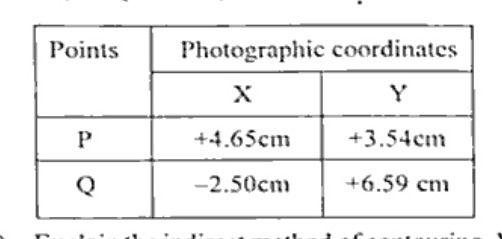
7 MarksbTwo points P and Q having elevations 700 m and 3000 m respectively above the datum, appear on a vertical photograph obtained with a camera of focal length of 250 mm and flying altitude of 2800 m above datum. Their correlated photographic coordinates are as follows. Calculate the length of ground line PQ.
How to answer
- State ground coordinates formulas: $X = \frac{H-h}{f} x$, $Y = \frac{H-h}{f} y$
- Calculate ground coordinates $(X_P, Y_P)$ for point P using $h_P = 700\text{ m}$
- Calculate ground coordinates $(X_Q, Y_Q)$ for point Q using $h_Q = 3000\text{ m}$ (noting $H < h_Q$ indicates anomalous data in problem)
- Determine distance $PQ = \sqrt{(X_P - X_Q)^2 + (Y_P - Y_Q)^2}$
-
7 MarksaExplain the indirect method of contouring. What are the advantages and disadvantages of these methods?
How to answer
- Definition of indirect contouring: taking RLs at guide points and interpolating contours
- Techniques: Method of squares (grid), Cross-sections method, Tacheometric/radial lines method
- Advantages: Quick, economical, suitable for large and hilly areas
- Disadvantages: Less accurate than direct method, interpolation errors
-
7 MarksbWhat is the principle of the stadia method? Derive the distance and elevation formula when the staff is held vertically and is inclined to the line of sight.
How to answer
- State stadia principle: ratio of distance to staff intercept is constant for fixed stadia wires
- Draw neat sketch showing inclined sight, angle of inclination $\theta$, vertical staff intercept $s$, and normal component $s' = s\cos\theta$
- Derive inclined distance $L = k s' + C = k s \cos\theta + C$
- Calculate horizontal distance $D = L \cos\theta = k s \cos^2\theta + C \cos\theta$
- Calculate vertical height $V = L \sin\theta = \frac{1}{2} k s \sin 2\theta + C \sin\theta$
-
7 MarksaDefine Longitudinal and cross sectioning level and write a note on importance of Longitudinal and cross sectioning in surveying.
How to answer
- Define longitudinal leveling (profile leveling) along the center line of a project route
- Define cross-section leveling perpendicular to the center line
- Discuss importance: route design, gradient selection, volume of cut and fill computation
- Applications in highways, railways, pipelines, and canals
-
7 MarksbWhat is sounding in Hydrographic survey? Explain.
How to answer
- Definition of sounding: measurement of depth of water body below water surface
- Purpose of sounding: navigation charts, dredging operations, volume calculations
- Instruments used: sounding pole, lead line, echo sounder / fathometer
- Methods of locating soundings from shore or boat
-
7 MarksaStadia readings were taken with a theodolite on a vertical staff with the telescope inclined at an angle of depression of $3^\circ\;30'$. The staff readings were $2.990$, $2.055$ and $1.120$. The reduced level of the staff station is $100.000\text{ m}$ and the height of the instrument is $1.40\text{ m}$. What is the reduced level of the ground at the instrument? Take constants as $100$ and zero.
How to answer
- Calculate staff intercept $s = 2.990 - 1.120 = 1.870\text{ m}$ and central hair reading $h = 2.055\text{ m}$
- Calculate vertical distance $V = \frac{1}{2} k s \sin 2\theta = \frac{100 \times 1.870 \times \sin(7^\circ)}{2} = 11.395\text{ m}$
- Set up elevation relation for angle of depression: $\text{RL of staff} = \text{RL of Inst. Ground} + h_{inst} - V - h$
- Solve for $\text{RL of Inst. Ground} = \text{RL of staff} + h + V - h_{inst} = 100.000 + 2.055 + 11.395 - 1.400 = 112.05\text{ m}$
-
7 MarksbExplain the various types of vertical curves and its applications.
How to answer
- Definition of vertical curve to connect two gradients smoothly
- Types: Summit (crest) curve and Valley (sag) curve
- Sub-cases of summit and sag curves depending on combinations of grades
- Applications: highways, railways for sight distance, headlight sight distance, passenger comfort
-
7 MarksaA railway embankment $400\text{ m}$ long is $12\text{ m}$ wide at the formation level and has side slopes $2\text{ to }1$. The ground levels at every $100\text{ m}$ along the center are as under: The formation level at zero chainage is $207.00$ and embankment has a rising gradient of $1\text{ in }100$. The ground is level across the centre line. Calculate the volume of earth work by (i) trapezoidal rule (ii) prismoidal rule.

How to answer
- Determine formation levels at chainages $0, 100, 200, 300, 400$: $207.00, 208.00, 209.00, 210.00, 211.00\text{ m}$
- Compute height of banking $h = \text{FL} - \text{RL}$ at each chainage
- Compute cross-sectional area $A = Bh + sh^2 = 12h + 2h^2$ at each station
- Apply trapezoidal rule: $V = 100 [ (A_0 + A_4)/2 + A_1 + A_2 + A_3 ]$
- Apply prismoidal rule: $V = \frac{100}{3} [ (A_0 + A_4) + 4(A_1 + A_3) + 2 A_2 ]$
-
7 MarksbState four personal and four instrumental errors in leveling.
How to answer
- List 4 personal errors: imperfect leveling of bubble, error in staff reading/estimation, parallax not eliminated, staff not held vertical
- List 4 instrumental errors: line of collimation not parallel to bubble axis, sluggish bubble tube, incorrect graduations of staff, worn staff foot or tripod looseness
-
7 MarksaWhat are the methods of traversing by theodolite?
How to answer
- Definition of theodolite traverse (open and closed)
- Traversing by measurement of included angles
- Traversing by deflection angles (suitable for open traverse / route surveys)
- Traversing by direct observation of angles to the right
- Traversing by direct observation of bearings (fast needle / azimuth method)
-
7 MarksbDifferentiate between Prismatic and Surveyors compass.
How to answer
- Tabulate key differences:
- Graduation circle attached to needle (Prismatic) vs attached to box (Surveyor's)
- Bearings measured in WCB ($0^\circ-360^\circ$) vs Quadrantal system (QB)
- Prism present for simultaneous sighting and reading vs no prism (reading taken after sighting)
- Broad needle vs edge bar needle
-
7 MarksaExplain Elevation and Curvature correction in leveling. The eye of an observer is $7.5\text{ m}$ above sea level and he was able to see a lighthouse above $50\text{ m}$ high just above the horizontal. Find the distance between observer and lighthouse.
How to answer
- Explain curvature correction ($C_c = -0.0785 d^2$) and combined curvature-refraction correction ($C = 0.0673 d^2$)
- Visible horizon formula: $d = \sqrt{h / 0.0673}\text{ km}$
- Calculate distance from observer to horizon: $d_1 = \sqrt{7.5 / 0.0673} \approx 10.56\text{ km}$
- Calculate distance from lighthouse to horizon: $d_2 = \sqrt{50 / 0.0673} \approx 27.26\text{ km}$
- Total distance $D = d_1 + d_2 = 10.56 + 27.26 = 37.82\text{ km}$
-
7 MarksbExplain the elements of simple circular curve with neat sketch.
How to answer
- Draw neat diagram showing tangents, point of intersection (V), deflection angle ($\Delta$), and tangent points ($T_1, T_2$)
- Define Tangent Length: $T = R \tan(\Delta / 2)$
- Define Length of Curve: $L = \frac{\pi R \Delta}{180^\circ}$
- Define Apex Distance / External Distance: $E = R (\sec(\Delta / 2) - 1)$
- Define Mid-ordinate / Versine of curve: $M = R (1 - \cos(\Delta / 2))$
- Define Long Chord: $L_c = 2R \sin(\Delta / 2)$
-
7 MarksaExplain the Setting out of Horizontal curve by Theodolite (Rankine's method).
How to answer
- Principle: Deflection angle for any chord is proportional to its length
- Formula: $\delta_n = \frac{1718.9 \times C_n}{R}\text{ minutes}$
- Total deflection angle $\Delta_n = \Delta_{n-1} + \delta_n$
- Step-by-step field procedure to set out pegs using theodolite at $T_1$ and measuring chords with tape
- Check: Total deflection angle for last point must equal $\Delta/2$
-
7 MarksbExplain the requirement of a transition curve. Derive an expression for an ideal transition curve.
How to answer
- State requirements: gradual introduction of centrifugal acceleration, gradual application of superelevation, aesthetic appearance and passenger comfort
- State condition of ideal transition curve: radius of curvature decreases uniformly with distance along curve ($l \propto \frac{1}{r} \implies l \cdot r = L \cdot R$)
- Integrate intrinsic equation: $\frac{d\phi}{dl} = \frac{1}{r} = \frac{l}{L R} \implies \phi = \frac{l^2}{2 L R}$
- Convert to Cartesian coordinates: $x \approx l$ and $dy = \phi \, dx = \frac{x^2}{2 L R} dx$
- Integrate to obtain cubic parabola equation $y = \frac{x^3}{6 R L}$
Go to where you left off?
Quick Add to Notes
Save questions, your own notes and screenshots into notes filed by unit. It takes a free account.
Create free accountHave an account? Log in
Notes Panel