AL-702 (B) · Advance Machine Learning/Unsolved PYQ Paper
AL-702-B Advanced Machine Learning - Dec 2025 Question Paper
Under each question, How to answer lists the points an answer should cover, outlined by CampusPrep from the syllabus. Check the details against your textbook.
-
7 MarksaDefine Artificial Neural Networks. What is the role of the cost function in training Artificial Neural Networks?
How to answer
- Definition of Artificial Neural Networks as interconnected neurons, layers, weights and activation
- Components: input, hidden, output layers and learning from data
- Definition of cost/loss function measuring prediction error
- Role in training: guides optimization, weight update via minimization
-
7 MarksbDescribe the role of gradient descent in the backpropagation process. How does it influence weight updates.
How to answer
- Overview of backpropagation: forward pass, error, backward pass
- Gradient descent as iterative optimization of loss w.r.t. weights
- Chain rule to compute gradients layer by layer
- Weight update rule $w := w - \eta \nabla L$ and role of learning rate
-
7 MarksaDescribe the architecture and learning process of a multi-layer perceptron.
How to answer
- MLP structure: input layer, one or more hidden layers, output layer, fully connected
- Activations, weights, biases
- Learning: forward propagation, loss, backpropagation with gradient descent
- Non-linear separation capability
-
7 MarksbWhat is recursive induction in decision trees? Explain.
How to answer
- Definition of recursive induction / divide-and-conquer splitting
- Steps: select best attribute, split, recurse on subsets
- Stopping criteria and leaf labeling
- Example with entropy/information gain
-
7 MarksaDefine entropy and information gain. Calculate the overall entropy and information gain with the following dataset.
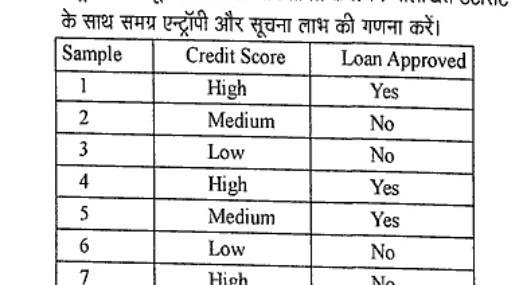
How to answer
- Definitions: $Entropy(S) = -\sum p_i \log_2 p_i$, information gain as entropy reduction
- Overall entropy of Loan Approved: 3 Yes, 4 No
- Conditional entropies for Credit Score = High/Medium/Low
- Information Gain = Overall entropy - weighted sum and interpretation
-
7 MarksbHow does noisy data affect decision tree performance? Write the strategies to overcome them.
How to answer
- Effect of noise: overfitting, spurious splits, reduced generalization
- Label noise vs attribute noise and impact on tree size/accuracy
- Strategies: pruning, minimum samples, depth limit, data cleaning
- Ensemble / validation and handling missing values
-
7 MarksaCompare Bagging and Boosting techniques in ensemble learning.
How to answer
- Bagging: bootstrap parallel, variance reduction; Boosting: sequential error correction, bias reduction
- Sample weighting, learner independence vs dependence
- Comparison table on basis, robustness, examples Random Forest vs AdaBoost/XGBoost
- Advantages and limitations
-
7 MarksbDescribe the working mechanism of a Random Forest algorithm.
How to answer
- Bootstrap sampling and random feature subset selection
- Building multiple decision trees in parallel and voting/averaging
- Out-of-bag error and feature importance
- Diagram of forest workflow
-
7 MarksaWhy ensemble methods offer greater robustness compared to individual models? Discuss.
How to answer
- Variance reduction by averaging diverse models, bias-variance view
- Robustness to noise, outliers and overfitting vs single model
- Diversity through data/feature/model variation
- Error independence and majority voting effect
-
7 MarksbExplain the Bellman Equations in the context of Reinforcement Learning.
How to answer
- Bellman expectation and optimality equations for $V$ and $Q$
- Relation of current value to immediate reward plus discounted future value
- Role in policy evaluation and improvement
- Example form $V(s)=\max_a [R+\gamma \sum P V(s')]$
-
7 MarksaDifferentiate between Q-learning and SARSA algorithms.
How to answer
- Q-learning: off-policy, max Q update; SARSA: on-policy, actual next action
- Update formulas comparison
- Exploration vs exploitation behavior and convergence differences
- Suitability and safety aspects
-
7 MarksbDescribe the concept of Policy Gradient methods in Reinforcement Learning.
How to answer
- Policy directly parameterized $\pi_\theta(a|s)$, gradient ascent on expected return
- REINFORCE / policy gradient theorem overview
- Advantages for continuous and stochastic policies
- High variance and baseline/actor-critic remedies
-
7 MarksaWhat is temporal difference learning and how does it differ from Monte Carlo methods?
How to answer
- TD learning: bootstrapping from current estimates, online update
- Monte Carlo: complete episode returns, no bootstrapping
- Differences in bias-variance, online vs offline, model-free nature
- Examples TD(0), SARSA vs MC prediction
-
7 MarksbHow does Generative Adversarial Imitation learning differ from standard RL approaches?
How to answer
- GAIL: discriminator-generator imitation from expert demos vs reward-driven RL
- No explicit reward function, occupancy matching
- Architecture: generator policy, discriminator distinguishing expert vs agent
- Advantages and challenges vs standard RL
-
14 MarksWrite short note on any two :
- a)Value Iteration and Policy Iteration
- b)Recent Trends in RL Architectures
- c)Random Forest
- d)Least Squares Methods
How to answer
- Select any two topics with definition and key steps/formulas
- Working principle and algorithm outline
- Advantages, limitations and applications
- Neat sketch/flow where relevant
Go to where you left off?
Quick Add to Notes
Save questions, your own notes and screenshots into notes filed by unit. It takes a free account.
Create free accountHave an account? Log in
Notes Panel