ME-602 · Machine Component and Design/Unsolved PYQ Paper
ME-602 Machine Component Design - May 2024 Question Paper
Under each question, How to answer lists the points an answer should cover, outlined by CampusPrep from the syllabus. Check the details against your textbook.
-
4 MarksaWhat are the primary causes of stress concentration in materials?
How to answer
- Define stress concentration and stress concentration factor Kt
- List primary causes: geometric discontinuities, holes, notches, fillets, keyways, threads
- Material defects, inclusions, cracks and surface roughness
-
5 MarksbDescribe the stress concentration phenomenon in tension, and provide examples.
How to answer
- Define stress concentration phenomenon in tension
- Explain localized stress rise with Kt = max stress / nominal stress
- Give examples: hole in plate, shoulder fillet, groove, crack
-
5 MarkscExplain the S-N Curve and its importance in predicting material fatigue behaviour.
How to answer
- Define S-N curve: stress amplitude vs cycles to failure
- Explain endurance limit, finite vs infinite life regions
- Importance in fatigue design and life prediction
-
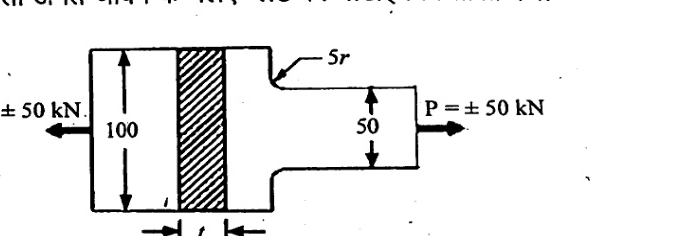
14 MarksA component machined from a plate made of steel 45C8 ($S_1 = 630\ \mathrm{N/mm^2}$) is shown in Fig. It is subjected to a completely reversed axial force of 50 kN. The expected reliability is 90% and the factor of safety is 2. The size factor is 0.85. Determine the plate thickness $t$ for infinite life, if the notch sensitivity factor is 0.8.
How to answer
- Calculate D/d ratio and theoretical Kt from stress concentration chart for shoulder fillet
- Calculate fatigue stress concentration factor Kf using notch sensitivity q=0.8
- Apply Marin factors including reliability 90% and size factor 0.85 to get corrected endurance limit
- Equate design stress for reversed load 50 kN with FOS=2 to find thickness t
-
14 MarksA machine component is subjected to a flexural stress which fluctuates between $+300\ \mathrm{MN/m^2}$ and $-150\ \mathrm{MN/m^2}$. Determine the value of minimum ultimate strength according to
- i)Modified Goodman relation
- ii)Soderberg relation.
How to answer
- Compute mean stress and stress amplitude from +300 and -150 MN/m2
- Write Modified Goodman and Soderberg design equations with FOS=2
- Substitute yield = 0.55 Sut and endurance = 0.5 Sut
- Solve for minimum Sut in each case
-
14 MarksDetermine the diameter of a circular rod made of ductile material with a fatigue strength (complete stress reversal), $\sigma_e = 265\ \mathrm{MPa}$ and a tensile yield strength of 350 MPa. The member is subjected to a varying axial load from $W_{min} = -300 \times 10^3\ \mathrm{N}$ to $W_{max} = 700 \times 10^3\ \mathrm{N}$ and has a stress concentration factor = 1.8. Use factor of safety as 2.0.
How to answer
- Compute mean load and alternating load from Wmin and Wmax
- Compute mean and alternating stresses in terms of diameter d with Kt=1.8
- Apply Soderberg/Goodman fatigue criterion with sigma_e=265 MPa, Syt=350 MPa, FOS=2.0
- Solve for diameter d
-
14 MarksA single row ball bearing carries a radial load of 8 kN and an axial thrust of 3.5 kN. The radial load factor and the axial load factor are given as 0.56 and 1.48 respectively. Desired reliability is 90 percent. The mounting of the bearing is such that the inner ring is stationary. The shaft rotates at 500 rpm and the expected life is 2500 operating hours. Find the dynamic load capacity of the bearing required for the application.
How to answer
- Compute equivalent dynamic load P = X*V*Fr + Y*Fa with rotation factor
- Compute life in million revolutions from 2500 hrs at 500 rpm
- Use bearing life equation L10 = (C/P)^k with 90% reliability
- Solve for required dynamic load capacity C
-
4 MarksaThe extension springs are in considerably less use than the compression springs. Why?
How to answer
- Explain need for initial tension and hooks in extension springs
- Compare manufacturing, stress, buckling and safety aspects
- Conclude why compression springs are preferred
-
10 MarksbGiven Parameters: Load (F) : 1000 N Spring Rate (k) : 200 N/mm Maximum Deflection ($\delta_{max}$) : 25 mm Calculate:
- i)The required number of active coils for the spring
- ii)The solid length of the spring.
- iii)The wire diameter required for the spring.
How to answer
- Use k = Gd^4/(8D^3N) and deflection relation to find wire diameter and coils
- Calculate number of active coils N from spring rate and deflection
- Calculate solid length = (N+2)*d or N*d as applicable
-
10 MarksaA deep groove ball bearing of basic design no. SKF 6312 has a dynamic load capacity of 81900 N. If this bearing is expected to carry a pure radial load of 37800 N, find the loading ratio and estimate the nominal life of the bearing in millions of revolutions. If the rotational speed of the bearing is 500 rpm, find the bearing life in number of operating hours. Find the reduction in service life when the radial load is increased by 10000 N.
How to answer
- Compute loading ratio C/P
- Compute L10 = (C/P)^3 in millions of revolutions
- Convert to hours at 500 rpm; repeat with increased load to find reduction
-
4 MarksbWrite a note on the dynamic load capacity of a rolling bearing.
How to answer
- Define dynamic load capacity C and L10 life basis
- Explain 90% reliability, 1 million revolutions criterion
- Note factors affecting C: material, geometry, load type
-
7 MarksaConsider a heavy-duty industrial clutch designed based on the uniform pressure theory. The clutch has a diameter of 50 cm and is subjected to a varying pressure distribution from the center to the periphery, ranging from 3 MPa at the center to 5 MPa at the periphery. Calculate the total force exerted on the clutch disc due to pressure.
How to answer
- State uniform pressure theory assumption
- Integrate varying pressure p(r) from 3 to 5 MPa over disc area
- Compute total axial force F = ∫ p·2πr dr for D=50 cm
-
3 MarksbCompare and contrast the advantages and disadvantages of rope, band, and block brakes.
How to answer
- List construction of rope, band and block brakes
- Compare heat dissipation, holding torque, simplicity and wear
- Summarize suitable applications for each
-
4 MarkscHow does the coefficient of friction affect the performance of a rope, band, or block brake system?
How to answer
- State braking torque relation T ∝ μ and capstan equation
- Explain increase in holding power with μ up to self-locking limit
- Discuss overheating, fade and instability if μ too high/low
Go to where you left off?
Quick Add to Notes
Save questions, your own notes and screenshots into notes filed by unit. It takes a free account.
Create free accountHave an account? Log in
Notes Panel